
问答题You are studying in Britain and living with a British family. They have decided to visit your country next year and spend two weeks travelling round there. You have said you will make the travel arrangements for them. Write to the travel agent and ask
题目
相似考题
参考答案和解析
Dear Sir or Madam,
I am writing to see if it is possible for you to provide me with some information about travelling in Beijing.
I would like to know how much we should pay for three people in your tour group. And a schedule for next month with specific dates would be appreciated. My friends are from Britain, and I wonder whether there will be a hotel suitable for them. It would be very kind of you to inform me the booking conditions.
Thank you for your time. I’m looking forward to your early reply.
Sincerely yours,
更多“You are studying in Britain and living with a British family”相关问题
-
第1题:
The nuclear family is the same as the extended family: it consists of many relatives living in the same house.()
参考答案:错误
-
第2题:
阅读下列短文,并根据短文内容判断其后的句子是正确(T),还是错误(F)。
In Britain people usually have a doctor near their home or in their town. This is the local doctor. You have to register with a doctor before you can make an appointment. You usually have to fill in a form. and the doctor examines you. Families often all register with the same doctor.
Doctors often work together in groups, and the name of the place where they work is a Doctor's Surgery. The government pays for this system, and it is free to go to see your doctor.
If the doctor decides that you need treatment he can prescribe medicine. For example he can prescribe antibiotics for an infection. Medicine can be tablets to take with water or liquid to drink. The doctor writes the prescription. You take the prescription to the chemist's, and the chemist will make up the medicine for you. You usually have to pay some money for the medicine but you don't have to pay the full price.
()21. British people usually go a long way to see a doctor.
()22. British families often register with the same doctor.
()23. Doctors always work alone in their own Doctor's Surgery.
()24. British people don't have to pay when they see their doctor.
()25. British people usually have to pay for their prescription at the chemist's.
参考答案:21-25:F T F T T
-
第3题:
听力原文:M: What is a cheque card?
W: It was originally issued in UK. British banks started to issue cheque cards in 1965, and as from 1969 all the main commercial banks in Britain agreed to issue a standardized form. of cheque card.
Q: What happened to British banks in 1969?
(17)
A.All the main commercial banks in Britain agreed to issue a standardized form. of cheque card.
B.British banks started to issue credit cards.
C.Customers of British banks may cash their cheques in European countries.
D.Commercial banks in the United States began to issue cheque card.
正确答案:A
解析:根据女士回答:支票卡最先在1965年由英国银行发行,从1969年开始,英国各大商业银行协定发行标准化的支票卡。 -
第4题:
Where are you living now?
正确答案:
-
第5题:
There’s a stalemate between EU and Britain after Brexit because( )A.the two sides have not reached an agreement on conditions of Britain’s orderly exit
B.British people are divided on the issue of Brexit
C.Britain refuses to fill the financial hole of the EU
D.EU does not want Britain to exit from it答案:A解析: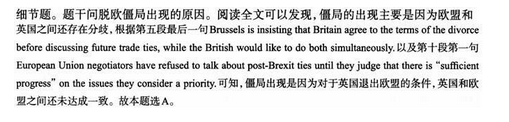
-
第6题:
The Commonwealth of Nations is an association of independent countries ( )A.that speak English as their native language
B.that have a large number of British immigrants
C.that were once colonies of Britain
D.that fought on the side of Britain in the two world wars答案:C解析:考查英国政治。英联邦(Commonwealth of Nations )是一个国际组织,由53个独立主权国家(包括属地)组成,成员大多为前英国殖民地或者保护国。英联邦元首同时身兼包括英国在内的16个英联邦王国名义上的元首,此16国构成了一个现代版的共主邦联,然而英联邦元首并无实权,英国君主无权干涉各成员国内政。 -
第7题:
Scotland occupies the()third of the island of Great Britain in the British Isles.
Asouthern
Bnorthern
Ceastern
Dwestern
B
略 -
第8题:
The two large islands that make up the British Isles are().
- A、Scotland and Ireland
- B、Britain and Scotland
- C、Great Britain and Northern Ireland
- D、Great Britain and Ireland
正确答案:D -
第9题:
The following are the reasons why British coal mining is today called a"sick"industry except()
- A、Britain has used up almost all coal deposits
- B、the demand for British coal has declined
- C、petroleum,water power,and electric power are replacing coal for many purposes
- D、the old British mines are narrow and deep,making it difficult to sue machines fro mining.
正确答案:A -
第10题:
问答题For a glimpse of the future of advertising, the place to look appears to be Britain. The country is a “test bed” according to Mr. Schmidt, Chief Executive of Google. Why Britain? The country has several factors in its favor. For a start, the British online advertising market is “exploding”, said Mr. Schmidt. The internet accounts for 14% of companies’ total spending on advertising in Britain, compared with about 50% worldwide. Expenditure on internet advertising in America is similar to that in Britain, but Britain’s growth rates are slightly higher.正确答案:
如果你想窥见广告业的未来,应该关注的地方似乎就是英国了。借用谷歌首席执行官施密特的说法:英国是一块“试验田”。为什么是英国?因为英国有几个有利因素。首先,施密特认为,英国的网络广告市场正在“爆炸式扩张”;英国网络广告占该国公司全部广告支出的14%,而世界其他地区仅为5%。美国的网络广告投资与英国相近,但英国的增长速度稍快。解析: 暂无解析 -
第11题:
单选题The two large islands that make up the British Isles are().AScotland and Ireland
BBritain and Scotland
CGreat Britain and Northern Ireland
DGreat Britain and Ireland
正确答案: B解析: 暂无解析 -
第12题:
单选题The discovery of Indo-European language family began with the work of the British scholar().AJacob Grimm
BRasmus Rask
CFranz Bopp
DSir William Jones
正确答案: B解析: 暂无解析 -
第13题:
A: Could you tell me where you were studying at that time? B: ( ).
A、Oh, really?
B、Yes, I could.
C、enjoyed the game very much.
D、was studying at the University of Sydney
参考答案:D
解析:问:那时你在哪里学习?四个选项中“我在悉尼大学学习”比较合理
-
第14题:
—What subjects are you studying? -- ().A、Yes, I’m studying history
B、I’m studying now
C、I’m studying philosophy
D、I’m doing my homework
参考答案:C
-
第15题:
What's ( )job? Are ( ) British?
A. your, your
B. you, your
C. your, you
正确答案:C
-
第16题:
The cost of living in Glasgow is among the lowest in Britain,__________the qualityof life is probably one of the highest.A.since
B.when
C.as
D.while答案:D解析:考情点拨:本题考查连词辨析。应试指导:句意:格拉斯哥的消费在英国是最低的,然而,生活质量有可能是最高的一个。while在此处是一个表示转折意义的连词,意为“然而”,表示the costof living与the quality of life的对比。since引导原因状语从句,意为“因为”;when引导时间状语从句,意为“当……的时候”;as可以引导时间状语从句也可引导原因状语从句。 -
第17题:
The two main islands of the British Isles are( ).A.Great Britain and Northern Ireland
B.Great Britain and Northern Scotland
C.Great Britain and Southern Wales
D.Great Britain and Southern England答案:A解析:考查英国国家概况。英国的全称为the United Kingdom of Great Britain and Northern Ireland,观察选项可知,A项符合题意。 -
第18题:
The two large islands that make up the British Isles are().
AScotland and Ireland
BBritain and Scotland
CGreat Britain and Northern Ireland
DGreat Britain and Ireland
D
略 -
第19题:
The discovery of Indo-European language family began with the work of the British scholar().
AJacob Grimm
BRasmus Rask
CFranz Bopp
DSir William Jones
D
略 -
第20题:
Why is it that Britain today imports more clothing than it exports?()
- A、British clothing is of poor quality.
- B、Britain does not grow cotton.
- C、Many countries with lower costs can produce clothing more cheaply than the British can.
- D、Britain has a highly developed transportation system.
正确答案:C -
第21题:
Which of the following is not true of Britain.s agriculture?()
- A、British farming is highly mechanized.
- B、Agriculture in Britain is intensive.
- C、British farming is very efficient.
- D、Britain.s agriculture can produce enough food for its people
正确答案:D -
第22题:
问答题【参考范例九】Education Are you with a job or are you studying?正确答案: I’m currently studying at University. I major in the English.解析:
根据自身情况简要回答。 -
第23题:
问答题You are studying in Britain and living with a British family. They have decided to visit your country next year and spend two weeks travelling round there. You have said you will make the travel arrangements for them. Write to the travel agent and ask for details about: ●prices●types of accommodation available ●dates●booking conditions ●toursWrite a letter in no less than 80 words asking for the information you require. You do not need to write your name and address. Now write the letter on the Answer Sheet.正确答案:
Dear Sir or Madam,
I am writing to see if it is possible for you to provide me with some information about travelling in Beijing.
I would like to know how much we should pay for three people in your tour group. And a schedule for next month with specific dates would be appreciated. My friends are from Britain, and I wonder whether there will be a hotel suitable for them. It would be very kind of you to inform me the booking conditions.
Thank you for your time. I’m looking forward to your early reply.
Sincerely yours,解析: 暂无解析 -
第24题:
单选题Scotland occupies the()third of the island of Great Britain in the British Isles.Asouthern
Bnorthern
Ceastern
Dwestern
正确答案: B解析: 暂无解析