
Assume that the rates and allowances for 2004/05 apply throughout this part.(b) Explain the consequences of filing the VAT returns late and advise Fred how he should deal with theunderpayment and bad debt for VAT purposes. Your explanation should be suppo
题目
Assume that the rates and allowances for 2004/05 apply throughout this part.
(b) Explain the consequences of filing the VAT returns late and advise Fred how he should deal with the
underpayment and bad debt for VAT purposes. Your explanation should be supported by relevant
calculations. (10 marks)
相似考题
参考答案和解析
(b) Late filing of VAT returns
The late filing of two or more VAT returns within the period of one year will give rise to a default surcharge. This occurs when
either
– The return is late and/or
– The payment is late.
Customs & Excise will serve a surcharge liability notice on the taxpayer when a single return is filed late and/or the VAT due
is paid late. The surcharge period will run from the date of notice to the anniversary of the quarter end of the period in which
the trader is in default.
Any further defaults within the surcharge period will extend the surcharge period.
If there is a late payment of VAT in the surcharge period, a surcharge will be levied at the rate of 2% on the first occasion,
rising progressively to a maximum of 15% if there are several defaults. One complete year of correct compliance is necessary
to escape the default surcharge regime.
For Flop Ltd, the surcharge period originally ran to 31 December 2005 but was extended to 31 March 2006 as the second
return is late. This could be extended again if the June return is late. The second default (31 March return) will give rise to
a 2% surcharge, based on the tax paid late of £24,000. This gives a surcharge of £480. This exceeds the de minimus level
of £400, so will be collected.
To avoid a further surcharge, the VAT return to 30 June 2005 should be submitted by 31 July at the latest. This would save
5% x £8,250 = £412.
In addition, Flop Ltd should obtain a refund of the VAT on the bad debt. Relief is available where;
(i) the debt is more than six months old, and
(ii) the debt has been written off in the creditor’s accounts.
The claim must be made within three years. The amount of VAT repayable is 17·5% of £50,000 = £8,750. If this is claimed
though the VAT return to 30 June 2005, there should be a net VAT repayment of (£8,250 - £8,750) = £500. Even if this
return is submitted late, the fact that no VAT is outstanding means that there will be no surcharge actually payable (as
calculated above), but the surcharge period will nevertheless be extended.
更多“Assume that the rates and allowances for 2004/05 apply throughout this part.(b) Explain the consequences of filing the VAT returns late and advise Fred how he should deal with theunderpayment and bad debt for VAT purposes. Your explanation should be suppo”相关问题
-
第1题:
3 Assume that today’s date is 10 May 2005.
You have recently been approached by Fred Flop. Fred is the managing director and 100% shareholder of Flop
Limited, a UK trading company with one wholly owned subsidiary. Both companies have a 31 March year-end.
Fred informs you that he is experiencing problems in dealing with aspects of his company tax returns. The company
accountant has been unable to keep up to date with matters, and Fred also believes that mistakes have been made
in the past. Fred needs assistance and tells you the following:
Year ended 31 March 2003
The corporation tax return for this period was not submitted until 2 November 2004, and corporation tax of £123,500
was paid at the same time. Profits chargeable to corporation tax were stated as £704,300.
A formal notice (CT203) requiring the company to file a self-assessment corporation tax return (dated 1 February
2004) had been received by the company on 4 February 2004.
A detailed examination of the accounts and tax computation has revealed the following.
– Computer equipment totalling £50,000 had been expensed in the accounts. No adjustment has been made in
the tax computation.
– A provision of £10,000 was made for repairs, but there is no evidence of supporting information.
– Legal and professional fees totalling £46,500 were allowed in full without any explanation. Fred has
subsequently produced the following analysis:
Analysis of legal & professional fees
£
Legal fees on a failed attempt to secure a trading loan 15,000
Debt collection agency fees 12,800
Obtaining planning consent for building extension 15,700
Accountant’s fees for preparing accounts 14,000
Legal fees relating to a trade dispute 19,000
– No enquiry has yet been raised by the Inland Revenue.
– Flop Ltd was a large company in terms of the Companies Act definition for the year in question.
– Flop Ltd had taxable profits of £595,000 in the previous year.
Year ended 31 March 2004
The corporation tax return has not yet been submitted for this year. The accounts are late and nearing completion,
with only one change still to be made. A notice requiring the company to file a self-assessment corporation tax return
(CT203) dated 27 July 2004 was received on 1 August 2004. No corporation tax has yet been paid.
1 – The computation currently shows profits chargeable to corporation tax of £815,000 before accounting
adjustments, and any adjustments for prior years.
– A company owing Flop Ltd £50,000 (excluding VAT) has gone into liquidation, and it is unlikely that any of this
money will be paid. The money has been outstanding since 3 September 2003, and the bad debt will need to
be included in the accounts.
1 Fred also believes there are problems in relation to the company’s VAT administration. The VAT return for the quarter
ended 31 March 2005 was submitted on 5 May 2005, and VAT of £24,000 was paid at the same time. The previous
return to 31 December 2004 was also submitted late. In addition, no account has been made for the VAT on the bad
debt. The VAT return for 30 June 2005 may also be late. Fred estimates the VAT liability for that quarter to be £8,250.
Required:
(a) (i) Calculate the revised corporation tax (CT) payable for the accounting periods ending 31 March 2003
and 2004 respectively. Your answer should include an explanation of the adjustments made as a result
of the information which has now come to light. (7 marks)
(ii) State, giving reasons, the due payment date of the corporation tax (CT) and the filing date of the
corporation tax return for each period, and identify any interest and penalties which may have arisen to
date. (8 marks)
正确答案:(a) Calculation of corporation tax
Year ended 31 March 2003
Corporation tax payable
There are three adjusting items:.
(i) The computers are capital items, as they have an enduring benefit. These need to be added back in the Schedule D
Case I calculation, and capital allowances claimed instead. The company is not small or medium by Companies Act
definitions and therefore no first year allowances are available. Allowances of £12,500 (50,000 x 25%) can be claimed,
leaving a TWDV of £37,500.
(ii) The provision appears to be general in nature. In addition there is insufficient information to justify the provision and it
should be disallowed until such times as it is released or utilised.
(iii) Costs relating to trading loan relationships are allowable, as are costs relating to the trade (debt collection, trade disputes
and accounting work). Costs relating to capital items (£5,700) are not allowable so will have to be added back.
Total profit chargeable to corporation tax is therefore £704,300 + 50,000 – 12,500 + 10,000 + 5,700 = 757,500. There are two associates, and therefore the 30% tax rate starts at £1,500,000/2 = £750,000. Corporation tax payable is 30% x£757,500 = £227,250.
Payment date
Although the rate of tax is 30% and the company ‘large’, quarterly payments will not apply, as the company was not large in the previous year. The due date for payment of tax is therefore nine months and one day after the end of the tax accounting period (31 March 2003) i.e. 1 January 2004.
Filing date
This is the later of:
– 12 months after the end of the period of account: 31 March 2004
– 3 months after the date of the notice requiring the return 1 May 2004
i.e. 1 May 2004.
-
第2题:
(c) Advise Alan on the proposed disposal of the shares in Mobile Ltd. Your answer should include calculations
of the potential capital gain, and explain any options available to Alan to reduce this tax liability. (7 marks)
正确答案: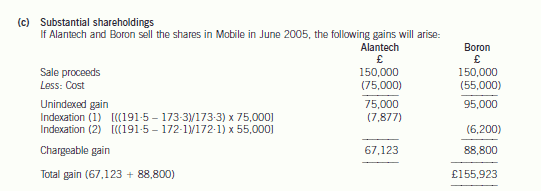
However, an exemption from corporation tax exists for any gain arising when a trading company (or member of a trading
group) sells the whole or any part of a substantial shareholding in another trading company.
A substantial shareholding is one where the investing company holds 10% of the ordinary share capital and is beneficially
entitled to at least 10% of the
(i) profits available for distribution to equity holders and
(ii) assets of the company available for distribution to equity holders on a winding up.
In meeting the 10% test, shares owned by a chargeable gains group may be amalgamated. The 10% test must have been
met for a continuous 12 month period during the 2 years preceding the disposal.
The companies making the disposals must have been trading companies (or members of a trading group) throughout the
12 month period, as well as at the date of disposal. In addition, they must also be trading companies (or members of a trading
group) immediately after the disposal.
The exemption is given automatically, and acts to deny losses as well as eliminate gains.
While Alantech Ltd has owned its holding in Mobile Ltd for 33 months, its ownership of the Boron holding has only lasted
for 10 months (at 1 June 2005) since Boron was acquired on 1 July 2004. Selling the shares in June 2005 will fail the
12 month test, and the gain will become chargeable.
It would be better for the companies to wait for a further month until July 2005 before selling the amalgamated shareholding.
By doing so, they will both be able to take advantage of the substantial shareholdings relief, thereby saving tax of £29,625
assuming a corporation tax rate of 19%. -
第3题:
(c) Outline the ways in which Arthur and Cindy can reduce their income tax liability by investing in unquoted
shares and recommend, with reasons, which form. of investment best suits their circumstances. You are not
required to discuss the qualifying conditions applicable to the investment vehicle recommended. (5 marks)
You should assume that the income tax rates and allowances for the tax year 2005/06 apply throughout this
question
正确答案:
(c) Reduction of income tax liability by investing in unquoted shares
The two forms of investment
Income tax relief is available for investments in venture capital trusts (VCTs) and enterprise investment scheme (EIS) shares.
A VCT is a quoted company that invests in shares in a number of unquoted trading companies. EIS shares are shares in
qualifying unquoted trading companies.
Recommendation
The most suitable investment for Arthur and Cindy is a VCT for the following reasons.
– An investment in a VCT is likely to be less risky than investing directly in EIS companies as the risk will be spread over
a greater number of companies.
– The tax deduction is 40% of the amount invested as opposed to 20% for EIS shares.
– Dividends from a VCT are not taxable whereas dividends on EIS shares are taxed in the normal way. -
第4题:
(c) Prepare brief notes for the proposed meeting with Charles and Jane. Clearly identify the further information
you would need in order to advise them more fully and suggest appropriate personal financial planning
protection products, in respect of both death and serious illness. (9 marks)
You should assume that the income tax rates and allowances for the tax year 2005/06 and the corporation tax
rates for the financial year 2005 apply throughout this question.
正确答案: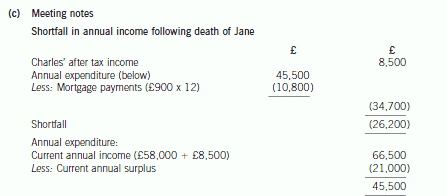
When considering the shortfall
– The family’s expenditure is likely to increase as the children get older, particularly if there is a need for school fees.
– There will be a need for some cash immediately to pay for the cost of the funeral.
– It is assumed that the whole of Jane’s estate has been left to Charles such that there will be no inheritance tax on her
death.
– The shortfall may be reduced by:
(i) State benefits and tax credits.
(ii) Expenditure on non-essential items, e.g. holidays and entertainment included in the annual expenditure of
£45,500.
(iii) The income generated by Charles if he were to return to work.
– The shortfall may be increased by additional child-care costs due to Charles being a single parent, particularly if he
returns to work full-time.
Further information required
– The level of state benefits and tax credits available to Charles.
– The current level of expenditure on non-essential items.
– The costs of child-care if Charles were to return to work.
– Details of any wills made by Charles or Jane.
– Whether Charles’ investment properties could be sold and the proceeds invested in assets with a higher annual return.
– Whether there is any value in Speak Write Ltd independent of Jane, such that the company could be sold after Jane’s
death.
Other related issues
– The couple should consider making provision for their retirement via pension contributions or some other form. of long
term investment plan.
– The couple should recognise that there would be significant financial problems if Jane were to become seriously ill. In
addition to the family’s income falling as set out above, its expenditure would probably increase.
Protection products
– Term life assurance
A qualifying life policy would pay out a tax-free lump sum on Jane’s death.
– Permanent health insurance
Would provide a regular income if Jane were unable to work due to illness.
– Critical illness insurance
Would provide a capital sum in the event of Jane being diagnosed with an insured illness. -
第5题:
(iii) State the value added tax (VAT) and stamp duty (SD) issues arising as a result of inserting Bold plc as
a holding company and identify any planning actions that can be taken to defer or minimise these tax
costs. (4 marks)
You should assume that the corporation tax rates for the financial year 2005 and the income tax rates
and allowances for the tax year 2005/06 apply throughout this question.
正确答案:
(iii) Bold plc will be making a taxable supply of services, likely to exceed the VAT threshold. It should therefore consider
registering for VAT – either immediately on a voluntary basis, or when its cumulative taxable supplies in the previous
twelve months exceed £60,000.
As an alternative, the new group can apply for a group VAT registration. This will simplify its VAT administration as intragroup
transactions are broadly disregarded for VAT purposes, and only one VAT return is required for the group as a
whole.
Stamp duty normally applies at 0·5% on the consideration payable in respect of transactions in shares. However, an
exemption is available in the case of a takeover, reconstruction or amalgamation where there is no real change in
ownership, i.e. the new shareholdings mirror the old shareholdings, and the transaction is for commercial purposes. The
insertion of a new holding company over an existing company, as proposed here, would qualify for this exemption.
There is no VAT on transactions in shares. -
第6题:
(iii) The extent to which Amy will be subject to income tax in the UK on her earnings in respect of duties
performed for Cutlass Inc and the travel costs paid for by that company. (5 marks)
Appropriateness of format and presentation of the report and the effectiveness with which its advice is
communicated. (2 marks)
Note:
You should assume that the income tax rates and allowances for the tax year 2006/07 and the corporation tax
rates and allowances for the financial year 2006 apply throughout this questio
正确答案:
(iii) Amy’s UK income tax position
Amy will remain UK resident and ordinarily resident as she is not leaving the UK permanently or for a complete tax year
under a full time contract of employment. Accordingly, she will continue to be subject to UK tax on her worldwide income
including her earnings in respect of the duties she performs for Cutlass Inc. The earnings from these duties will also be
taxable in Sharpenia as the income arises in that country.
The double tax treaty between the UK and Sharpenia will either exempt the employment income in one of the two
countries or give double tax relief for the tax paid in Sharpenia. The double tax relief will be the lower of the UK tax and
the Sharpenian tax on the income from Cutlass Inc.
Amy will not be subject to UK income tax on the expenses borne by Cutlass Inc in respect of her flights to and from
Sharpenia provided her journeys are wholly and exclusively for the purposes of performing her duties in Sharpenia.
The amounts paid by Cutlass Inc in respect of Amy’s family travelling to Sharpenia will be subject to UK income tax as
Amy will not be absent from the UK for a continuous period of at least 60 days. -
第7题:
(d) Evaluate the effect on Gerard of the changes to be made by Fizz plc to its performance related bonus scheme.
You should ignore the effect of any pension contributions to be made by Gerard in the future, consider both
the value and timing of amounts received by Gerard and include relevant supporting calculations.
(5 marks)
Note: – You should assume that the income tax rates and allowances for the tax year 2006/07 apply throughout
this question.
正确答案:
(d) Implications for Gerard of the changes to Fizz plc’s bonus scheme
Value received
Under the existing scheme Gerard receives approximately £4,500 each year. This is subject to income tax at 40% and
national insurance contributions at 1% such that Gerard receives £2,655 (£4,500 x 59%) after all taxes.
Under the proposed share incentive plan (SIP), Gerard expects to receive free shares worth £3,500 (£2,100 + £1,400).
Provided the shares remain in the plan for at least five years there will be no income tax or national insurance contributions
in respect of the value received. Gerard’s base cost in the shares for the purposes of capital gains tax will be their value at
the time they are withdrawn from the scheme.
In addition, the amount he spends on partnership shares will be allowable for both income tax and national insurance such
that he will obtain shares with a value of £700 for a cost of only £413 (£700 x 59%).
Accordingly, Gerard will receive greater value under the SIP than he does under the existing bonus scheme. However, as noted
below, he will not be able to sell the free or matching shares until they have been in the scheme for at least three years by
which time they may have fallen in value.
Timing of receipt of benefit
Under the existing scheme Gerard receives a cash bonus each year.
The value of free and matching shares awarded under a SIP cannot be realised until the shares are withdrawn from the
scheme and sold. This withdrawal cannot take place until at least three years after the shares are awarded to Gerard.
Accordingly, Gerard will not have access to the value of the bonuses he receives under the SIP until the scheme has been in
operation for at least three years. In addition, if the shares are withdrawn within five years of being awarded, income tax and
national insurance contributions will become payable on the lower of their value at the time of the award and their value at
the time of withdrawal thus reducing the value of Gerard’s bonus. -
第8题:
(c) Explanatory notes, together with relevant supporting calculations, in connection with the loan. (8 marks)
Additional marks will be awarded for the appropriateness of the format and presentation of the schedules, the
effectiveness with which the information is communicated and the extent to which the schedules are structured in
a logical manner. (3 marks)
Notes: – you should assume that the tax rates and allowances for the tax year 2006/07 and for the financial year
to 31 March 2007 apply throughout the question.
– you should ignore value added tax (VAT).
正确答案:
(c) Tax implications of there being a loan from Flores Ltd to Banda
Flores Ltd should have paid tax to HMRC equal to 25% of the loan, i.e. £5,250. The tax should have been paid on the
company’s normal due date for corporation tax in respect of the accounting period in which the loan was made, i.e. 1 April
following the end of the accounting period.
The tax is due because Flores Ltd is a close company that has made a loan to a participator and that loan is not in the ordinary
course of the company’s business.
HMRC will repay the tax when the loan is either repaid or written off.
Flores Ltd should have included the loan on Banda’s Form. P11D in order to report it to HMRC.
Banda should have paid income tax on an annual benefit equal to 5% of the amount of loan outstanding during each tax
year. Accordingly, for each full year for which the loan was outstanding, Banda should have paid income tax of £231
(£21,000 x 5% x 22%).
Interest and penalties may be charged in respect of the tax underpaid by both Flores Ltd and Banda and in respect of the
incorrect returns made to HMRC
Willingness to act for Banda
We would not wish to be associated with a client who has engaged in deliberate tax evasion as this poses a threat to the
fundamental principles of integrity and professional behaviour. Accordingly, we should refuse to act for Banda unless she is
willing to disclose the details regarding the loan to HMRC and pay the ensuing tax liabilities. Even if full disclosure is made,
we should consider whether the loan was deliberately hidden from HMRC or Banda’s previous tax adviser.
In addition, companies are prohibited from making loans to directors under the Companies Act. We should advise Banda to
seek legal advice on her own position and that of Flores Ltd. -
第9题:
(ii) Explain how the inclusion of rental income in Coral’s UK income tax computation could affect the
income tax due on her dividend income. (2 marks)
You are not required to prepare calculations for part (b) of this question.
Note: you should assume that the tax rates and allowances for the tax year 2006/07 and for the financial year to
31 March 2007 will continue to apply for the foreseeable future.
正确答案:
(ii) The effect of taxable rental income on the tax due on Coral’s dividend income
Remitting rental income to the UK may cause some of Coral’s dividend income currently falling within the basic rate
band to fall within the higher rate band. The effect of this would be to increase the tax on the gross dividend income
from 0% (10% less the 10% tax credit) to 221/2% (321/2% less 10%).
Tutorial note
It would be equally acceptable to state that the effective rate of tax on the dividend income would increase from 0%
to 25%. -
第10题:
(ii) Write a letter to Donald advising him on the most tax efficient manner in which he can relieve the loss
incurred in the year to 31 March 2007. Your letter should briefly outline the types of loss relief available
and explain their relative merits in Donald’s situation. Assume that Donald will have no source of income
other than the business in the year of assessment 2006/07 and that any income he earned on a parttime
basis while at university was always less than his annual personal allowance. (9 marks)
Assume that the corporation tax rates and allowances for the financial year 2004 and the income tax rates
and allowances for 2004/05 apply throughout this question.
Relevant retail price index figures are:
January 1998 159·5
April 1998 162·6
正确答案:(ii) [Donald’s address] [Firm’s address]
Dear Donald [Date]
I understand that you have incurred a tax loss in your first year of trading. The following options are available in respect
of this loss.
1. The first option is to use the trading loss against other forms of income in the same year. If such a claim is made,
losses are offset against income before personal allowances.
Any excess loss can still be offset against capital gains of the year. However, any offset against capital gains is
before both taper relief and annual exemptions.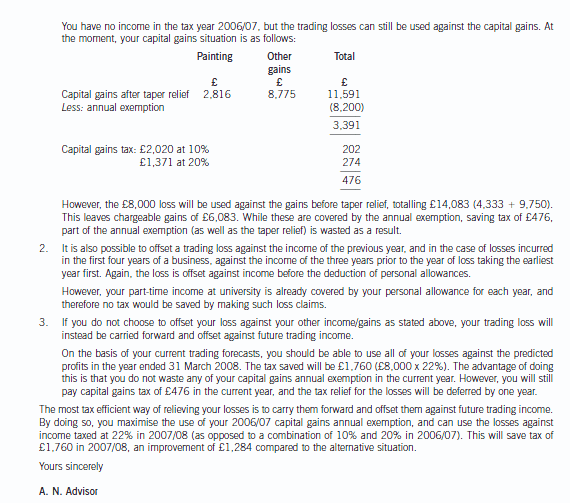
-
第11题:
Write a letter to Mr Green to apply for a job.In the lelter,you should 1)show your interest,2)describe your previous experience,and 3)explain why you would be suitable for the job.You should write about 100 words neatly on the ANSWER SHEET.Do not sign your own name.Use"Li Ming"instead.Do not write your address.答案:解析:Dear MrGreen,
I am writing to apply for the programmer position advertised in the China Daily.As requested,I have enlosed a completed job application,my certification,my resume,and three references.I believe that my strong technical experience and education will make me a very competitive candidate for this position.With a BS degree in Computer Programming,I have a full understanding of the full lifecycle of a software development project.I also have experience in learning and exceUing at new technologies as needed.Please see my resume for additional information on my experience.I can be reached anytime via emailing to liming@163.com or dialing my cell phone number 138-XXXX-XXXX.Thank you for your time and consideration.I look forward to speaking with you about this position.
Sincerely,
Li Ming -
第12题:
问答题Practice 6Your cousin, Xiaoming, is asking you about the admission to your university, and you’re required to write in reply to his letter. Your letter should cover these points given below:(1)the major you advise him to apply for and the reason for your advice;(2)the basic requirements to apply for this major;(3) how to do relevant preparation workWrite at least 150 words.You do NOT need to write any addresses.正确答案: 【参考范文】
Dear Xiaoming,
Thank you for your last letter. When it comes to which major you should choose, I suggest that you apply for the major of English. To begin with, English is the most popular language in the world. Also, English majors are more likely to find a good job after graduation.
In order to study at English Department, firstly, you have to spend a lot of time on it, just as the old saying goes, “Practice makes perfect”. Secondly, the basic skills of reading, writing, listening and speaking are necessary, because they are the foundations for your future study. And don’t forget “interest is the best teacher.”
As to the preparation work, you should first of all review all the vocabulary required, then you should spend some time on reading and writing. Only through these measures can you hope to enroll in our university.
Yours sincerely,
Li Ming解析: 暂无解析 -
第13题:
(b) Assuming that the income from the sale of the books is not treated as trading income, calculate Bob’s taxable
income and gains for all relevant tax years, using any loss reliefs in the most tax-efficient manner. Your
answer should include an explanation of the loss reliefs available and your reasons for using (or not using)
them. (12 marks)
Assume that the rates and allowances for 2004/05 apply throughout this part of the question.
正确答案:
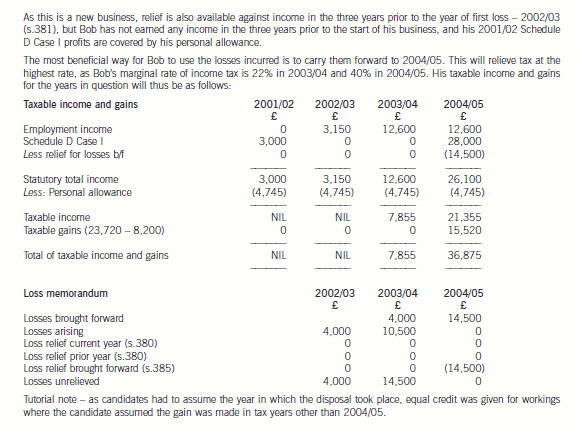
-
第14题:
(c) Without changing the advice you have given in (b), or varying the terms of Luke’s will, explain how Mabel
could further reduce her eventual inheritance tax liability and quantify the tax saving that could be made.
(3 marks)
The increase in the retail prices index from April 1984 to April 1998 is 84%.
You should assume that the rates and allowances for the tax year 2005/06 will continue to apply for the
foreseeable future.
正确答案:
(c) Further advice
Mabel should consider delaying one of the gifts until after 1 May 2007 such that it is made more than seven years after the
gift to the discretionary trust. Both PETs would then be covered by the nil rate band resulting in a saving of inheritance tax
of £6,720 (from (b)).
Mabel should ensure that she uses her inheritance tax annual exemption of £3,000 every year by, say, making gifts of £1,500
each year to both Bruce and Padma. The effect of this will be to save inheritance tax of £1,200 (£3,000 x 40%) every year. -
第15题:
(d) Explain how Gloria would be taxed in the UK on the dividends paid by Bubble Inc and the capital gains tax
and inheritance tax implications of a future disposal of the shares. Clearly state, giving reasons, whether or
not the payment made to Eric is allowable for capital gains tax purposes. (9 marks)
You should assume that the rates and allowances for the tax year 2005/06 apply throughout this question.
正确答案:
(d) UK tax implications of shares in Bubble Inc
Income tax
Gloria is UK resident and is therefore subject to income tax on her worldwide income. However, because she is non-UK
domiciled, she will only be taxed on the foreign dividends she brings into the UK.
Dividends brought into the UK will be grossed up for any tax paid in Oceania. The gross amount is taxed at 10% if it falls
into the starting or basic rate band and at 321/2% if it falls into the higher rate band. The tax suffered in Oceania is available
for offset against the UK tax liability. The offset is restricted to a maximum of the UK tax on the dividend income.
Capital gains tax
Individuals are subject to capital gains tax on worldwide assets if they are resident or ordinarily resident in the UK. However,
because Gloria is non-UK domiciled and the shares are situated abroad, the gain is only taxable to the extent that the sales
proceeds are brought into the UK. Any tax suffered in Oceania in respect of the gain is available for offset against the UK
capital gains tax liability arising on the shares.
Any loss arising on the disposal of the shares would not be available for relief in the UK.
In computing a capital gain or allowable loss, a deduction is available for the incidental costs of acquisition. However, to be
allowable, such costs must be incurred wholly and exclusively for the purposes of acquiring the asset. The fee paid to Eric
related to general investment advice and not to the acquisition of the shares and therefore, would not be deductible in
computing the gain.
Taper relief will be at non-business asset rates as Bubble Inc is an investment company.
Inheritance tax
Assets situated abroad owned by non-UK domiciled individuals are excluded property for the purposes of inheritance tax.
However, Gloria will be deemed to be UK domiciled (for the purposes of inheritance tax only) if she has been resident in the
UK for 17 out of the 20 tax years ending with the year in which the disposal occurs.
Gloria has been running a business in the UK since June 1992 and would therefore, appear to have been resident for at least
15 tax years (1992/93 to 2006/07 inclusive).
If Gloria is deemed to be UK domiciled such that the shares in Bubble Inc are not excluded property, business property relief
will not be available because Bubble Inc is an investment company. -
第16题:
(c) Explain the capital gains tax (CGT) and income tax (IT) issues Paul and Sharon should consider in deciding
which form. of trust to set up for Gisella and Gavin. You are not required to consider inheritance tax (IHT) or
stamp duty land tax (SDLT) issues. (10 marks)
You should assume that the tax rates and allowances for the tax year 2005/06 apply throughout this question.
正确答案:
(c) As the trust is created in the settlors’ (Paul and Sharon’s) lifetime its creation will constitute a chargeable disposal for capital
gains tax. Also, as the settlors and trustees are connected persons, the disposal will be deemed to be at market value, resulting
in a chargeable gain of £80,000 (160,000 – 80,000). No taper relief will be available as the property is a non-business
asset, and has been held for less than three years, but annual exemptions of £17,000 (2 x £8,500) will be available.
However, in the case of a discretionary trust, gift hold over relief will be available. This is because the gift will constitute a
chargeable lifetime transfer and because there is an immediate charge to inheritance tax (even though no tax is payable due
to the nil rate band) relief is available if a specific accumulation and maintenance trust is used, as in this case the gift will
qualify as a potentially exempt transfer and so gift relief would only be available in respect of business assets. The use of a
basic discretionary trust will thus facilitate the deferral of an immediate capital gains tax charge of £25,200 (63,000 x 40%).
If/when the property is disposed of, however, the trustees will pay capital gains tax on the deferred gain at the trust income
tax rate of 40%, and have an annual exemption of only £4,250 (50% of the normal individual rate) available to them. The
40% rate of tax and lower annual exemption rate also apply to chargeable gains arising in a specific accumulation and
maintenance trust, as well as a basic discretionary trust.
A chargeable disposal between connected persons will also arise for the purposes of capital gains tax if/when the property
vests in a beneficiary, i.e. one or more of the beneficiaries becomes absolutely entitled to all or part of the income or capital
of the trust. Gift hold over relief will again be available on all assets in the case of a discretionary trust, but only on business
assets in the case of an accumulation and maintenance trust, except where a beneficiary becomes entitled to both income
and capital at the same time.
The trust will have taxable property income in the form. of net rents from its creation and in future years is also likely to have
other investment income, probably in the form. of interest, to the extent that monies are retained in the trust. Whichever form
of trust is used, the trustees will pay tax at the standard trust rate of 40% on income other than dividend income (32·5%),
except to the extent of (1) the first £500 of taxable income, which is taxed at the rate that would otherwise apply to such
income (i.e. 22% for non-savings (rental) income, 20% for savings income (interest) and 10% for dividends) but, only to the
extent that it is not distributed; and (2) the legitimate trust management expenses, which are offsettable for the purposes of
the higher trust tax rates against the income with the lowest rate(s) of normal tax and so bear tax only at that rate. The higher
trust tax rate always applies to income that is distributed, other than to the extent that it has been treated as the settlor’s
income, and taxed at that settlor’s marginal tax rate.
As Paul and Sharon intend to create a trust for their unmarried minor (under 18) children, then even if the trust specifically
excludes them from any benefit under the trust, the trust income will be treated as theirs for income tax purposes to the extent
that it constitutes income paid for on behalf (including maintenance payments) of Gisella and Gavin; except where (1) the
total income arising does not exceed £100 gross per annum, and (2) income is held for the benefit of a child under an
accumulation and maintenance settlement, to the extent that it is not paid out. -
第17题:
(d) Advise Trent Limited of the consequences arising from the submission of the incorrect value added tax (VAT)
return, assuming that the company has previously had a good compliance record with regard to accounting
for VAT. (6 marks)
正确答案:
(d) Default surcharge
Although the VAT return was submitted on time (i.e. within one month of the end of the tax period), part of the quarterly VAT
liability has not yet been paid. As a result this payment will be made late and a surcharge liability notice will be issued on
the company. The surcharge period will run from the date of the notice until the anniversary of the end of the period for which
the VAT was paid late (i.e. until 31 March 2007). During this period any further default will extend the surcharge period and
any further late payments of VAT will attract a surcharge penalty of 2% on the first occasion, rising to 15% for successive late
payments.
Mis-declaration penalty
As the return understates the VAT payable, a potential mis-declaration penalty arises. The amount understated exceeds 30%
of the sum of the true input tax and output tax, known as the gross amount of tax (GAT) ((30% of (87,500 + 55,000) +
40,000) = 54,750). There has, thus, been a significant understatement of the true VAT return liability, resulting in a penalty
rate of 15% of the VAT which would have been lost had the error not been discovered. However, where an under declaration
arises out of a true error i.e. there is no intention to evade tax involved, and it is voluntarily disclosed, then a mis-declaration
penalty is not normally imposed. Although the company is still within the ‘period of grace’ allowed by HMRC for the correction
of errors in the next following VAT return, it would be advisable for Trent Limited to notify HMRC of the error immediately, in
writing, unless it has a ‘reasonable excuse’ for the error having occurred.
Default interest
Default interest is chargeable when an assessment to VAT arises for an amount that has been under declared in a previous
period, whether as a result of voluntary disclosure or as identified by HMRC. Interest is charged on a daily basis from the
date the under declaration should have been declared (i.e. 1 May 2006) to the date shown on the notice of assessment or
notice of voluntary disclosure. As given the size of the error the de minimis relief for voluntarily declared errors of less than
£2,000 is not applicable, the only way for Trent Limited to minimise the interest charge is by means of early disclosure and
payment of the additional VAT due. -
第18题:
(iii) The effect of the restructuring on the group’s ability to recover directly and non-directly attributable input
tax. (6 marks)
You are required to prepare calculations in respect of part (ii) only of this part of this question.
Note: – You should assume that the corporation tax rates and allowances for the financial year 2006 apply
throughout this question.
正确答案:(iii) The effect of the restructuring on the group’s ability to recover its input tax
Prior to the restructuring
Rapier Ltd and Switch Ltd make wholly standard rated supplies and are in a position to recover all of their input tax
other than that which is specifically blocked. Dirk Ltd and Flick Ltd are unable to register for VAT as they do not make
taxable supplies. Accordingly, they cannot recover any of their input tax.
Following the restructuring
Rapier Ltd will be carrying on four separate trades, two of which involve the making of exempt supplies such that it will
be a partially exempt trader. Its recoverable input tax will be calculated as follows.
– Input tax in respect of inputs wholly attributable to taxable supplies is recoverable.
– Input tax in respect of inputs wholly attributable to exempt supplies cannot be recovered (subject to the de minimis
limits below).
– A proportion of the company’s residual input tax, i.e. input tax in respect of inputs which cannot be directly
attributed to particular supplies, is recoverable. The proportion is taxable supplies (VAT exclusive) divided by total
supplies (VAT exclusive). This proportion is rounded up to the nearest whole percentage where total residual input
tax is no more than £400,000 per quarter.
The balance of the residual input tax cannot be recovered (subject to the de minimis limits below).
– If the de minimis limits are satisfied, Rapier Ltd will be able to recover all of its input tax (other than that which is
specifically blocked) including that which relates to exempt supplies. The de minimis limits are satisfied where the
irrecoverable input tax:
– is less than or equal to £625 per month on average; and
– is less than or equal to 50% of total input tax.
The impact of the restructuring on the group’s ability to recover its input tax will depend on the level of supplies made
by the different businesses and the amounts of input tax involved. The restructuring could result in the group being able
to recover all of its input tax (if the de minimis limits are satisfied). Alternatively the amount of irrecoverable input tax
may be more or less than the amounts which cannot be recovered by Dirk Ltd and Flick Ltd under the existing group
structure.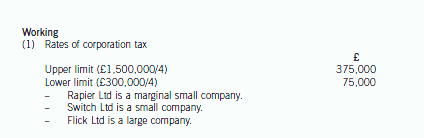
-
第19题:
(c) The inheritance tax payable by Adam in respect of the gift from his aunt. (4 marks)
Additional marks will be awarded for the appropriateness of the format and presentation of the memorandum and
the effectiveness with which the information is communicated. (2 marks)
Note: you should assume that the tax rates and allowances for the tax year 2006/07 will continue to apply for the
foreseeable future.
正确答案:
(c) Inheritance tax payable by Adam
The gift by AS’s aunt was a potentially exempt transfer. No tax will be due if she lives until 1 June 2014 (seven years after
the date of the gift).
The maximum possible liability, on the assumption that there are no annual exemptions or nil band available, is £35,216
(£88,040 x 40%). This will only arise if AS’s aunt dies before 1 June 2010.
The maximum liability will be reduced by taper relief of 20% for every full year after 31 May 2010 for which AS’s aunt lives.
The liability will also be reduced if the chargeable transfers made by the aunt in the seven years prior to 1 June 2007 are
less than £285,000 or if the annual exemption for 2006/07 and/or 2007/08 is/are available. -
第20题:
(b) Explain why making sales of Sabals in North America will have no effect on Nikau Ltd’s ability to recover its
input tax. (3 marks)
Notes: – you should assume that the corporation tax rates and allowances for the financial year to 31 March 2007
will continue to apply for the foreseeable future.
– you should ignore indexation allowance.
正确答案:
(b) Recoverability of input tax
Sales by Nikau Ltd of its existing products are subject to UK VAT at 17·5% because it is selling to domestic customers who
will not be registered for VAT. Accordingly, at present, Nikau Ltd can recover all of its input tax.
Sales to customers in North America will be zero rated because the goods are being exported from the EU. Zero rated supplies
are classified as taxable for the purposes of VAT and therefore Nikau Ltd will continue to be able to recover all of its input tax. -
第21题:
(c) On the assumption that the administrators of Noland’s estate will sell quoted shares in order to fund the
inheritance tax due as a result of his death, calculate the value of the quoted shares that will be available to
transfer to Avril. You should include brief notes of your treatment of the house and the shares in Kurb Ltd.
(9 marks)
Note: you should assume that the tax rates and allowances for the tax year 2006/07 apply throughout this
question.
正确答案:(c) Value of quoted shares that can be transferred to Avril
The value of shares to be transferred to Avril will be equal to £370,000 less the inheritance tax due by the estate.
IHT is payable on transfers in the seven years prior to Noland’s death and on the death estate.
The only chargeable gift in the seven years prior to Noland’s death is the transfer to the discretionary trust. No tax is due in
respect of this gift as it is covered by the nil rate band.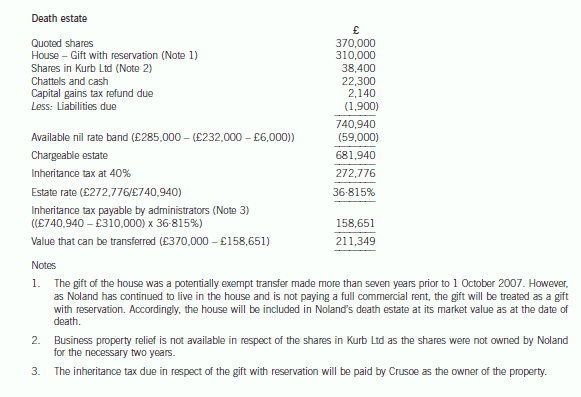
-
第22题:
( )You want to apply for the position of a teaching assistant for a particular course,write a letter to Professor Stevens to(1)show your interest(2)describe yourself,and(3)explain why you would be suitable for the job You should include the details you think necessary You should write neatly on the ANSWER SHEE/Do not sign your own name at the end of the letter.Use"Li Ming"instead答案:解析:Dear Professor Stevens I am writing to apply for the position of teaching assistance for the course Creative Writing and Literature"at Peking University I am currently a junior in Literature in Peking University.Since my second year,I have worked as a teaching assistant for the course"American Literature".I have also received multiple awards for excellence in writing,including a national Endowment for the Arts grant in Beijing.I am passionate about writing and the teaching of writing,and I look forward to the opportunity to share those passions with you and the students MycvisattachedIcanbereachedat1364-0006orliming@email.com,and I am available to interview at your convenience.I look forward to meeting you,and thank you for the opportunity to be considered for the post of the teaching assistant Sicerely,Li Ming -
第23题:
如果他希望做盘旋,应当通知ATC。()
- A、If he desires to circle, he should advise ATC
- B、If he wants to hover, he should advise ATC
- C、If he wants to hover, he should ask ATC
- D、If he desires to spiral, he should ask ATC
正确答案:A