
● Bitmap images use a grid of small squares known as (72) to represent images.(72)A. pixels B. points C. elements D. dots
题目
● Bitmap images use a grid of small squares known as (72) to represent images.
(72)A. pixels B. points C. elements D. dots
相似考题
更多“● Bitmap images use a grid of small squares known as (72) to represent images.(72)A. pixel ”相关问题
-
第1题:
试题(71)~(75)Object-oriented analysis (OOA) is a semiformal specification technique for the object-oriented paradigm. Object-oriented analysis consists of three steps. The first step is (71). It determines how the various results are computed by the product and presents this information in the form. of a (72) and associated scenarios. The second is (73) , which determines the classes and their attributes. Then determine the interrelationships and interaction among the classes. The last step is (74) , which determines the actions performed by or to each class or subclass and presents this information in the form. of (75) .
(71)
A. use-case modeling
B. class modeling
C. dynamic modeling
D. behavioral modeling
(72)
A. collaboration diagram
B. sequence diagram
C. use-case diagram
D. activity diagram
(73)
A. use-case modeling
B. class modeling
C. dynamic modeling
D. behavioral modeling
(74)
A. use-case modeling
B. class modeling
C. dynamic modeling
D. behavioral modeling(75)
A. activity diagram
B. component diagram
C. sequence diagram
D. state diagram
正确答案:A,C,B,C,D
参考译文
面向对象的分析(OOA)是一种面向对象范型的半形式化描述技术。面向对象的分析包括3个步骤:第1步是用例建模,它决定了如何由产品得到各项计算结果,并以用例图和相关场景的方式展现出来;第2步是类建模,它决定了类及其属性,然后确定类之间的关系和交互;第3步是动态建模,它决定了类或每个子类的行为,并以状态图的形式进行表示。
-
第2题:
YourcompanyusesWindowsDeploymentServices(WDS)todeployWindows7.YoucreateanewimageofWindows7.YouneedtoensurethatyoucandeploytheimagebyusingWDS.Whatshouldyoudo?()A.FromtheWindowsDeploymentServicessnap-in,addanewinstallimage.
B.FromtheWindowsDeploymentServicessnap-in,addanewbootimage.
C.RunOscdimg.exeandspecifythe-bootparameter.CopytheimagetoC:\remoteinstall\boot.
D.RunImagex.exeandspecifythe/appendparameter.CopytheimagetoC:\remoteinstall\images.
参考答案:A
-
第3题:
● It should go without saying that the focus of UML is modeling.However, what that means, exactly, can be an open-ended question. (71) is a means to capture ideas, relationships, decisions, and requirements in a well-defined notation that can be applied to many different domains.Modeling not only means different things to different people, but also it can use different pieces of UML depending on what you are trying to convey.In general, a UML model is made up of one or more (72) . A diagram graphically representsthings, and the relationships between these things.These (73) can be representations ofreal-world objects, pure software constructs, or a description of the behavior. of some other objects.It is common for an individual thing to show up on multiple diagrams; each diagram represents a particular interest, or view, of the thing being modeled.UML 2.0 divides diagrams into two categories: structural diagrams and behavioral diagrams. (74) are used to capture the physical organization of the things in your system, i. e. , how one object relates
to another. (75) focus on the behavior. of elements in a system.For example, you can use behavioral diagrams to capture requirements, operations, and internal state changes forelements.
(71)
A.Programming
B.Analyzing
C.Designing
D.Modeling
(72)
A.views
B.diagrams
C.user views
D.structure pictures
(73)
A.things
B.pictures
C.languages
D.diagrams
(74)
A.Activity diagrams
B.Use-case diagrams
C.Structural diagrams
D.Behavioral diagrams
(75)
A.Activity diagrams
B.Use-case diagrams
C.Structural diagrams
D.Behavioral diagrams
正确答案:D,B,A,C,D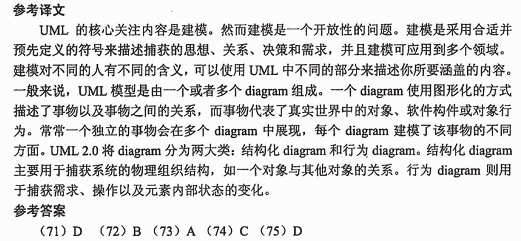
-
第4题:
●Object-oriented analysis (OOA) is a semiformal specification technique for the object-oriented paradigm. Object-oriented analysis consists of three steps. The first step is (71). It determines how the various results are computed by the product and presents this information in the form. of a (72) and associated scenarios. The second is (73) , which determines the classes and their attributes, then determines the interrelationships and interaction among the classes. The last step is (74) , which determines the actions performed by or to each class or subclass and presents this information in the form. of (75) .
(71)
A.use-case modeling
B. class modeling
C. dynamic modeling
D. behavioral modeling
(72)
A. collaboration diagram
B. sequence diagram
C. use-case diagram
D. activity diagram
(73)
A. use-case modeling
B. class modeling
C. dynamic modeling
D. behavioral modeling
(74)
A.use-case modeling
B. class modeling
C. dynamic modeling
D. behavioral modeling
(75)
A. activity diagram
B. component diagram
C. sequence diagram
D. state diagram
正确答案:A,C,B,C,D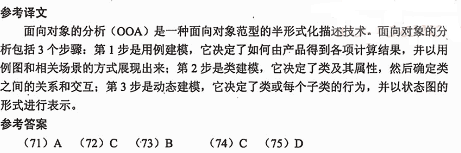
-
第5题:
● It should go without saying that the focus of UML is modeling. However, what that means, exactly, can be an open-ended question. (71) is a means to capture ideas, relationships, decisions, and requirements in a well-defined notation that can be applied to many different domains. Modeling not only means different things to different people, but also it can use different pieces of UMLdepending on what you are trying to convey. In general, a UML model is made up of one or more (72) . A diagram graphically represents things, and the relationships between these things. These (73) can be representations of real-world objects, pure software constructs, or a description of the behavior. of some other objects. It is common for an individual thing to show up on multiple diagrams; each diagram represents a particular interest, or view, of the thing being modeled. UML 2.0 divides diagrams into two categories: structural diagrams and behavioral diagrams. (74) are used to capture the physical organization of the things in your system, i.e., how one object relates to another. (75) focus on the behavior of elements in a system. For example, you can use behavioral diagrams to capture requirements, operations, and internal state changes for elements.
(71)
A.Programming
B. Analyzing
C. Designing
D. Modeling
(72)
A.views
B. diagrams
C. user views
D. structure pictures
(73)
A. things
B. pictures
C. languages
D. diagrams
(74)
A. Activity diagrams
B. Use-case diagrams
C. Structural diagrams
D. Behavioral diagrams
(75)
A. Activity diagrams
B. Use-case diagrams
C. Structural diagrams
D. Behavioral diagrams
正确答案:D,B,A,C,D
-
第6题:
● Object-oriented analysis (OOA) is a semiformal specification technique for the object-oriented paradigm. Object-oriented analysis consists of three steps. The first step is (71). It determines how the various results are computed by the product and presents this information in the form. of a (72) and associated scenarios. The second is (73) , which determines the classes and their attributes. Then determine the interrelationships and interaction among the classes. The last step is (74) , which determines the actions performed by or to each class or subclass and presents this information in the form. of (75) .
(71)
A.use-case modeling
B. class modeling
C. dynamic modeling
D. behavioral modeling
(72)
A. collaboration diagram
B. sequence diagram
C. use-case diagram
D. activity diagram
(73)
A. use-case modeling
B. class modeling
C. dynamic modeling
D. behavioral modeling
(74)
A.use-case modeling
B. class modeling
C. dynamic modeling
D. behavioral modeling
(75)
A. activity diagram
B. component diagram
C. sequence diagram
D. state diagram
正确答案:A,C,B,C,D