
根据下面材料,回答第 31~35 题:In 2010. a federal judge shook America's biotech industry to its core. Companies had won patents for isolated DNA for decades-by 2005 some 20% of human genes were parented. But in March 2010 a judge ruled that genes were unpatentable. E
题目
根据下面材料,回答第 31~35 题:
In 2010. a federal judge shook America's biotech industry to its core. Companies had won patents for isolated DNA for decades-by 2005 some 20% of human genes were parented. But in March 2010 a judge ruled that genes were unpatentable. Executives were violently agitated. The Biotechnology Industry Organisation (BIO), a trade group, assured members that this was just a “preliminary step” in a longer battle.
On July 29th they were relieved, at least temporarily. A federal appeals court overturned the prior decision, ruling that Myriad Genetics could indeed hold patents to two genes that help forecast a woman's risk of breast cancer. The chief executive of Myriad, a company in Utah, said the ruling was a blessing to firms and patients alike.
But as companies continue their attempts at personalised medicine, the courts will remain rather busy. The Myriad case itself is probably not over. Critics make three main arguments against gene patents: a gene is a product of nature, so it may not be patented; gene patents suppress innovation rather than reward it; and patents' monopolies restrict access to genetic tests such as Myriad's. A growing number seem to agree. Last year a federal task-force urged reform. for patents related to genetic tests. In October the Department of Justice filed a brief in the Myriad case, arguing that an isolated DNA molecule “is no less a product of nature... than are cotton fibres that have been separated from cotton seeds.”
Despite the appeals court's decision, big questions remain unanswered. For example, it is unclear whether the sequencing of a whole genome violates the patents of individual genes within it. The case may yet reach the Supreme Court.
AS the industry advances, however, other suits may have an even greater impact. Companies are unlikely to file many more patents for human DNA molecules - most are already patented or in the public domain .firms are now studying how genes interact, looking for correlations that might be used to determine the causes of disease or predict a drug’s efficacy. Companies are eager to win patents for ‘connecting the dots’, explains Hans Sauer, a lawyer for the BIO.
Their success may be determined by a suit related to this issue, brought by the Mayo Clinic, which the Supreme Court will hear in its next term. The BIO recently held a convention which included sessions to coach lawyers on the shifting landscape for patents. Each meeting was packed.
第 31 题 It can be learned from paragraph I that the biotech companies would like______
A.their executives to be active
B.judges to rule out gene patenting
C.genes to be patentable
D.the BIO to issue a warning
相似考题
更多“根据下面材料,回答第 31~35 题: In 2010. a federal judge shook America's biotech indust ”相关问题
-
第1题:
根据下面材料回答第 111~115 题:

第 111 题 1978—2007年世界货物贸易进出口总额增长了:( )
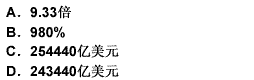 正确答案:C
由表格可知,1978年世界货物贸易进出口额为26650亿美元,2007年为281090亿美元,故增加了281090—26650=254440亿美元,增长了254440+26650=10-12060+26650≈9.5倍。 -
第2题:
根据下面材料,回答第 41~45 题:
第 41 题 UCLA is making an apology because its letters to its students and alumni were stolen by a hacker.
正确答案: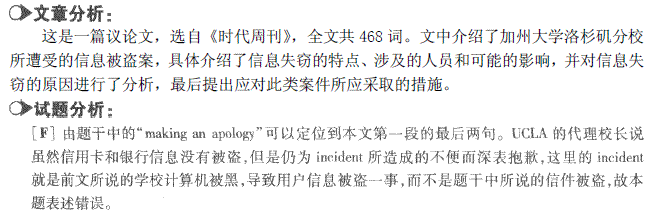
-
第3题:
根据材料回答 30~31 题:
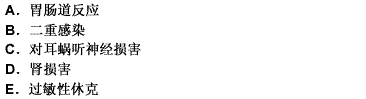
第 30 题 链霉素最常见的不良反应是
正确答案:C
试题难度:易认知层次:记忆此题是记忆题,考查考生对链霉素重要不良反应的了解。链霉素为氨基糖苷类抗生素,其主要不良反应为耳毒性,包括前庭功能障碍和耳蜗听神经损害;此外尚有过敏反应、神经肌肉阻滞作用及肾毒性等。 -
第4题:
根据下面材料,回答第 41~40 题:
第 41 题 Findings of the Stanford University researchers will promote the sales of new Boeing and Airbus aircraft.
正确答案: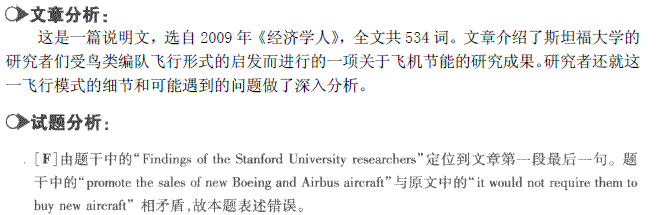
-
第5题:
根据材料回答 34~35 题:

第 34 题 目标人群认知的变化,属于
正确答案:C
近期效果即健康教育干预活动实施后,率先显示出的健康教育效果通常表现为目标人群认知的改变,如卫生保健知识的增加,健康观念转变等。目标人群行为改变要建立在知识技能提高的基础上,并有环境的支持。因此需要有一段时间,往往滞后于近期效果一段时间,往往滞后于近期效果。