
下列关于Test类的定义中,正确的是( )。A.class Test implements Runnable{ public void run{} Dublic void someMethod[]{} }B.class Test implements Runnable( puIblic void run; }C.class Test implements Runnable( Dublic void someMethod[]; }D.class Test implements Runnable( publi
题目
下列关于Test类的定义中,正确的是( )。
A.class Test implements Runnable{ public void run{} Dublic void someMethod[]{} }
B.class Test implements Runnable( puIblic void run; }
C.class Test implements Runnable( Dublic void someMethod[]; }
D.class Test implements Runnable( public void someMethod{} }
相似考题
更多“下列关于Test类的定义中,正确的是( )。 A.class Test implements Runnable{ public void run{} D ”相关问题
-
第1题:
下列程序的运行结果是______。 includeclass test { private: int hum; public: tes 下列程序的运行结果是______。
include<iostream.h>
class test
{
private:
int hum;
public:
test( );
int TEST( ){return num+100;)
~test( );
};
test::test( ){num=0;)
test::~test( ){cout<<"Destructor is active"<<endl;)
void main( )
{
test x[3];
cout<<x[1].TEST( )<<endl;
}
正确答案:100 Destructor is active Destructor is active Destructor is active
100 Destructor is active Destructor is active Destructor is active 解析:本题比较简单,考查考生基本的类的定义,构造函数以及对象数组的概念。 -
第2题:
有如下类定义: class Test { public: Test(){a=0;c=0} //① int f(int a)const{this->a=a;} //② static int g(){return a;} //③ void h(int b){Test::b;}; //④ private: int a; static int b; const int C; }; int Test::b=0; 在标注号码的行中,能被正确编译的是( )。
A.①
B.②
C.③
D.④
正确答案:D
解析:此题考查的是类的定义。一个类的长数据成员的初始化只能在成员初始化列表中进行,故选项A) 错误;常成员函数不能更新对象的数据成员,故选项B) 错误;静态成员函数可以直接访问类中说明的静态成员,但不能直接访问类中说明的非静态成员,故选项C) 错误。 -
第3题:
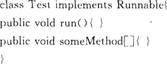
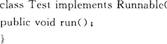
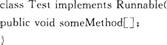
下列关于Test类的定义中,正确的是( )。
A.
B.
C.
D.
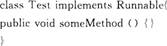 正确答案:A
java中实现多线程的方法之-就是实现Runnable接口中的run方法,把实现Runnable接口的子类对象传递给Thread类的构造函数。 -
第4题:
如果使用Thread t=new Test()语句创建一个线程,则下列叙述正确的是
A.Test类一定要实现Runnable接口
B.Test类一定是Thread类的子类
C.Test类一定是Runnable的子类
D.Test类一定是继承Thread类并且实现Runnable接口
正确答案:B
解析:本题考查线程的使用。Java中可以通过实现Runnable接口来创建线程。通过这种方式创建线程是把Runnable的一个对象作为参数传递给Thread类的一个构造方法,该对象提供线程体run()。如果题目中Test实现Runnable接口,则创建线程的方法是Thread t=new Thread(new Test())。Java中另一种创建线程的方法是通过继承 Thread类,重写其中的run()方法定义线程体,然后直接创建该子类的对象即可创建线程。题目中使用Thread t=new Test()语句创建线程,其中直接创建Test类对象,可知该类一定是继承Thread类。因此,本题的正确答案是选项B。 -
第5题:
有如下类定义: class Test { public: Test(){a=0;c=0;} //① int f(int a)const {this->a=a;} //② static int g(){return a;} //③ void h(int b){Test::b=b;}; //④ private: int a; static int b; const int c; }; int Test::b=0; 在标注号码的行中,能被正确编译的是
A.①
B.②
C.③
D.④
正确答案:D
解析:本题考查了类的定义。一个类的常数据成员的初始化只能在成员初始化列表中进行,所以选项A不正确。常成员函数不能更新对象的数据成员,所以选项B不正确。静态成员函数可以直接访问类中说明的静态成员,但不能直接访问类中说明的非静态成员,所以选项C也不正确。故应该选择D。 -
第6题:
【单选题】定义了类选择器test,让段落应用class名为test的类,下列写法正确的是:
A..test{color:red;}
B.#test{color:red;}
C.test{color:red;}
D.,test{color:red;}
A