
A curiosity B tears C words D judgment
题目
A curiosity B tears C words D judgment
相似考题
更多“A curiosity B tears C words D judgment ”相关问题
-
第1题:
How men first learnt to invent words is unknown; in other words, the origin of language is a mystery. All we really know is that men, unlike animals, somehow invented certain sounds to express thought and feelings, actions and things, so that they could communicate with each other; and that later they agreed upon certain signs, called letters, which could be combined to present those sounds, and which could be written down. Those sounds, whether spoken or written in letters, we call words. The power of words, then, lies in their associations - the things they bring up before our minds. Words become filled with meaning for us by experience; and the longer we live, the more certain words recall to us the glad and sad events of our past; and the more we read and learn, the more the number of words that mean something increases. Great writers are those who not only have great thoughts but also express these thoughts in words which appeal powerfully to our minds and emotions. This charming and telling use of words is what we call literary style. Above all, the real poet is a master of words. He can convey his meaning in words which sing like music and which by their position and association can move men to tears. We should therefore learn to choose our words carefully and use them accurately, or they will make our speech silly and vulgar. What is true about words?
:A、They are used to express feelings only
B、They can not be written down
C、They are simply sounds
D、They are mysterious.
标准答案:C
-
第2题:
There are tears and smiles, pure delight ___ in people’s laughter.A、ringing
B、rings
C、rang
D、is ringing
正确答案:A
-
第3题:
Eventually he _____ the judgment and set the prisoner free.
A、refused
B、returned
C、reversed
D、recovered
参考答案:C
-
第4题:
Signs can carry as many _________ as words.
A.questions B.examples C.tears and smiles D.messages
正确答案:D
-
第5题:
Why do people read negative Internet comments and do other things that will obviously be painful?Because humans have an inherent need to 1 uncertainty,according to a recent study in Psychological Science.The new research reveals that the need to know is so strong that people will 2 to satisfy their curiosity even when it is clear the answer will 3.In a series of four experiments,behavioral scientists at the University of Chicago and the Wisconsin School of Business tested Student’s willingness to 4 themselves to unpleasant stimuli in an effort to satisfy curiosity.For one 5,each participant was shown a pile of pens that the researcher claimed were from a previous experiment.The twist?Half of the pens would 6 an electric shock when clicked.Twenty-seven students were told with pens were electrified,another twenty-seven were told only that some were electrified.7 left alone in the room.The students who did not know which ones would shock them clicked more pens and incurred more shocks than the students who knew what would 8 subsequent experiments reproduced,this effect with other stimuli 9 the sound of fingernails on a chalkboard and photographs of disgusting insects.The drive to 10 is deeply rooted in humans.Much the same as the basic drives for 11 or shelter,says Christopher Hsee of the University of Chicago Curiosity is often considered a good instinct—it can 12 New Scientific advances,for instance—but sometimes such 13 can backfire,the insight that curiosity can drive you to do 14 things is a profound one.Unhealthy curiosity is possible to 15,however.in a final experiment,participants who were encouraged to 16 how they would feel after viewing an unpleasant picture were less likely to 17 to see such an image.These results suggest that imagining the 18 of following through on one’s curiosity ahead of time can help determine 19 it is worth the endeavor.Thinking about long-term 20 is key to reducing the possible negative effects of curiosity.Hsee says.“in other words,don’t read online comments”17选?A.remember
B.promise
C.choose
D.pretend答案:B解析:动宾搭配。 -
第6题:
共用题干
The Value of Tears
Tears can ruin make-up,bring conversation to a stop,and give you a runny nose. They can leave you embarrassed and without energy. However,crying is a fact of life,and tears are very useful.Even when you're not crying,your eyes produce tears.These create a film over the eye's surface.This film contains a substance that protects your eyes against infection.
Tears relieve stress.but we tend to fight them for all sorts of reasons."People worry about showing their emotions.They're afraid that once they lose control,they'll never get it back." explains psychologist Dorothy Rowe."As children we were sometimes punished for shedding tears or expressing anger. As adults we still fear the consequences of showing emotions."
Almost any emotion-good or bad,happy or sad-can cause tears. Crying is a way mat we release buil-up emotions.Tears help you when you feel you are ready to explode because of very strong feelings.It may explain why people who are afraid to cry often suffer more heart attacks than people who cry more freely.
When some people become very stressed,however,they can't cry.They may be feeling shock, anger, fear, or grief, but they repress(抑制)the emotion. "Everyone has the need to cry,"says psychotherapist(精神治疗师)Vera Diamond. Sometimes in therapy sessions, patients participate in crying exercises.They practice crying so that they can get used to expressing emo- tion .Diamond says it's best to cry in safe,private places,like under the bedcovers or in the car. That's because many people get uncomfortable when others cry in front of them. In fact,they may be repressing their own need to cry.
In certain situations,such as at work,tears are not appropriate.It's good to hold back tears during a tense business discussion."But once you are safely behind closed doors,don't just cry," Diamond says.She suggests that you act out the whole situation again and be as noisy and angry as you like.It will help you feel better."And,she adds,"Once our tears have released the stress,you can begin to think of logical ways to deal with the problem." Tears are a sign of our ability to feel.You should never be afraid to cry.What are you expected to do in a tense business discussion?
A: Hold back your tears.
B: Cry in private.
C: Release your stress with tears.
D: Find out the problems.答案:A解析:根据第一段的“These create a film over the eye's surface. This film contains a sub-stance that protects your eyes against infection.”可知,眼泪可以产生出一种保护膜,覆盖在眼睛表面,保护眼睛免于感染。因此,与film意义最接近的是coat。
根据第三段的“It may explain why people who are afraid to cry often suffer more heart attacks than people who cry more freely.”可知,本题选B。
由第四段“...They practice crying so that they can get used to expressing emotion.”可知,哭泣是需要练习的。故本题选A。
根据倒数第二段“It's good to hold back tears during a tense business discussion.”即可得出答案。故本题选A。
主旨大意题。很明显,本文通篇都在讲适时地哭的重要性和必要性。故本题选D。 -
第7题:
Five minutes left,the outcome of the match was still in doubt.A:result
B:judgment
C:decision
D:event答案:A解析:本句意思:比赛只剩下5分钟了,可是结果仍然难以预料。outcome意为“结果”,与result(结果)意思相近。judgement评价,判断;decision决定;event事件,大事。 -
第8题:
下列选项中不属于计算机英语中常见的词汇分类的是()。
- A、 技术词汇(technical words)
- B、 准技术词汇(sub- technical words)
- C、 关键词汇(key words)
- D、 特用词(big words)
正确答案:C -
第9题:
单选题Which of the following statements about the real poet is NOT true?AHe is no more a master of words than an ordinary person.
BHe can convey his ideas in words which sing like music.
CHe can move men to tears.
DHis style is always charming.
正确答案: A解析:
细节题。最后一段第三句提到“Above all, the real poet is a master of words”,首先,真正的诗人是语言大师。A项与之不符。因此A项为正确答案。 -
第10题:
填空题The youngster immediately fell ____(silence) as tears flew down from his big blue eyes.正确答案: silent解析:
句意:当眼泪从他蓝色的大眼睛里流下来时,这个年轻人立刻就沉默了。形容词通常放在系动词之后作表语,本句中feel为系动词,后应接形容词silent作表语。故划线处填silent。 -
第11题:
单选题Her tears()great sympathy from the audience.Aelicited
Baroused
Ccommanded
Dengaged
正确答案: B解析: 暂无解析 -
第12题:
单选题What’s the main topic of this text?AThe magic usage of words.
BThe origin of words.
CHow to choose our words.
DThe definition of words.
正确答案: B解析:
主旨题。B选项为混淆项。综观全文,只有第一段提到了词语的起源和词语的定义,第二段、第三段是告诫大家要慎重选择词语并合理运用,全篇讲词语可以用来做什么,因此选A项。 -
第13题:
Generally, children have a natural() about the world around them.A、curious
B、being curious
C、with curiosity
D、curiosity
参考答案:D
-
第14题:
By origin, English words can be classified as “native words” and “loan words”.( )此题为判断题(对,错)。
正确答案:正确
-
第15题:
C
You speak, write a letter, make a telephone. Your words carry a message. People communicate with words. Do you think you can communicate without words? A smile on your face shows you are happy or friendly. Tears in your eyes tell others that you are sad.
When you put up your hands in class, the teacher knows you want to say something or ask questions. You shake your head, and people know you are saying "No". You nod and people know you are saying "Yes". Other things can also carry messages. For example, a sign at the bus helps you to know which bus to take. A sign on the door helps you where to go in or out. Have you ever thought that there are a lot of signs around you and that you receive messages from them all the time? People can communicate in many other ways. An artist can use his drawing to tell beautiful mountains, about the blue sea and many other things. Books are written to tell about all the wonderful things in the world and also about people and their ideas. Books, magazines, TV, radio and films all help us communicate with others. They can help us to know what is going on in the world and what other people are thinking about.
61. People communicate ________.
A.with words only B.in many different ways
C.in letters and drawings D.with smiles, tears and hands
正确答案:B
-
第16题:
She shed a few tears at her daughter's wedding.A:wiped
B:injected
C:produced
D:removed答案:C解析:本句意思:在女儿的婚礼上,她流泪了。shed tears是固定用法,意为“流泪”,与produce ( tears)产生(泪)意思相近。wipe擦,试,揩;inject注射;增加;投入;remove移动,拿开。 -
第17题:
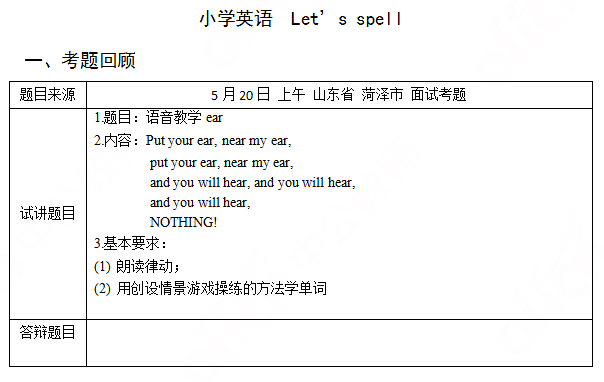
二、考题解析
【教案】
Teaching aims:
Knowledge aim: Students can understand the pronunciation of “ear”, and get some simple spelling rules.
Ability aim: Students can read the words with the pronunciation of “ear” correctly by listening and speaking. Ability of listening and speaking will be improved.
Emotional aim: Students can increase their interests in learning English.
Key and difficult point:
Key points: Students can understand the pronunciation of “ear”, and how how to read the words contain “ear”, such as hear, near and etc.
Difficult points: Students can master the pronunciation of “ear” and read the related words correctly.
Teaching procedure:
Step 1: Warming-up
Greeting the students.
Sing a song: Head shoulder keens and toes.
Step 2: Presentation
1. Show the chant and ask the students the question: Can you find the same letter combination in these words?
2. Listen to the tape and let students pay attention to the pronunciation of “ear”, and then ask the students question: what does “ear” sounds like in these words?
3. Teacher the pronunciation of “ear” ,and let students pay attention to the teacher’s mouth.
4. Game: Play the finger show to practice the new words.
Step 3: Practice
Find more words with “ear” such as tear, dear, clear... and ask students to try to read by themselves and then invite some of them to share with the class. The teacher should act the role of monitor.
Step4: Production
1. Ask students to make up their own sentences by using the words learned today, such as “He hears the bad news,and then his tears falls down. ”.
2. Reading competition: let students to read the chant as quickly as possible, and then let students choose the best one.
Step5: Summary and homework
1. Summary: ask students summary what have learned in the class.
2. Homework:
(1) read these word after class.
(2) Find more words with “ear” and make another chant.
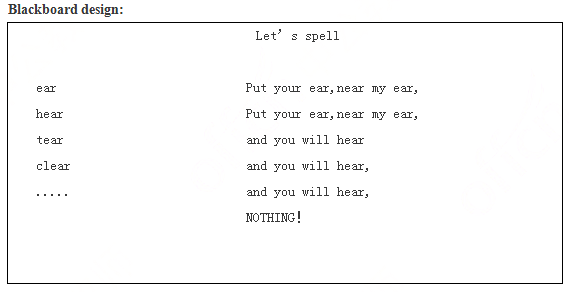 答案:解析:暂无解析
 -
第18题:
共用题干
The Value of Tears
Tears can ruin make-up,bring conversation to a stop,and give you a runny nose. They can leave you embarrassed and without energy. However,crying is a fact of life,and tears are very useful.Even when you're not crying,your eyes produce tears.These create a film over the eye's surface.This film contains a substance that protects your eyes against infection.
Tears relieve stress.but we tend to fight them for all sorts of reasons."People worry about showing their emotions.They're afraid that once they lose control,they'll never get it back." explains psychologist Dorothy Rowe."As children we were sometimes punished for shedding tears or expressing anger. As adults we still fear the consequences of showing emotions."
Almost any emotion-good or bad,happy or sad-can cause tears. Crying is a way mat we release buil-up emotions.Tears help you when you feel you are ready to explode because of very strong feelings.It may explain why people who are afraid to cry often suffer more heart attacks than people who cry more freely.
When some people become very stressed,however,they can't cry.They may be feeling shock, anger, fear, or grief, but they repress(抑制)the emotion. "Everyone has the need to cry,"says psychotherapist(精神治疗师)Vera Diamond. Sometimes in therapy sessions, patients participate in crying exercises.They practice crying so that they can get used to expressing emo- tion .Diamond says it's best to cry in safe,private places,like under the bedcovers or in the car. That's because many people get uncomfortable when others cry in front of them. In fact,they may be repressing their own need to cry.
In certain situations,such as at work,tears are not appropriate.It's good to hold back tears during a tense business discussion."But once you are safely behind closed doors,don't just cry," Diamond says.She suggests that you act out the whole situation again and be as noisy and angry as you like.It will help you feel better."And,she adds,"Once our tears have released the stress,you can begin to think of logical ways to deal with the problem." Tears are a sign of our ability to feel.You should never be afraid to cry.What is the main idea of this passage?
A: How to release your stress.
B: Ways to repress your emotion in public.
C: How to fight tears in a business situation.
D: Importance and necessity of crying.答案:D解析:根据第一段的“These create a film over the eye's surface. This film contains a sub-stance that protects your eyes against infection.”可知,眼泪可以产生出一种保护膜,覆盖在眼睛表面,保护眼睛免于感染。因此,与film意义最接近的是coat。
根据第三段的“It may explain why people who are afraid to cry often suffer more heart attacks than people who cry more freely.”可知,本题选B。
由第四段“...They practice crying so that they can get used to expressing emotion.”可知,哭泣是需要练习的。故本题选A。
根据倒数第二段“It's good to hold back tears during a tense business discussion.”即可得出答案。故本题选A。
主旨大意题。很明显,本文通篇都在讲适时地哭的重要性和必要性。故本题选D。 -
第19题:
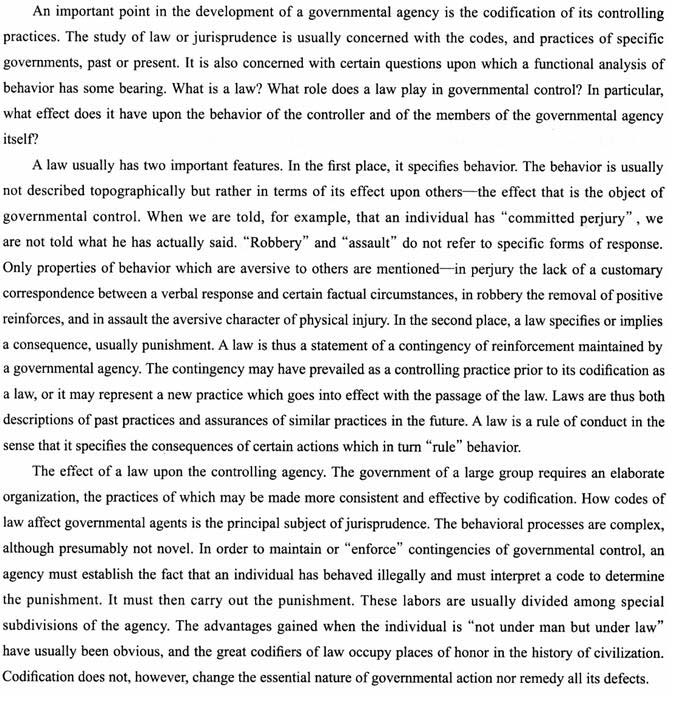
In the development of a government agency,( )A.the standard on which the judgment may be made is more important than the actual application of this judgment
B.the function of law is important
C.the study of ordinance is the most important
D.practice is more important than criterion答案:B解析: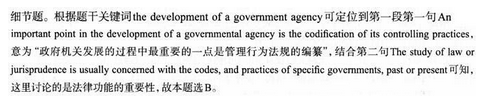
-
第20题:
单选题She sat in the corner of the room, with tears _____ down her cheeks.Aran
Bto run
Crun
Drunning
正确答案: A解析:
with+宾语+宾补,run和tears形成主谓关系,所以用现在分词做宾补。句意是:她坐在房间的角落里,泪流满面。 -
第21题:
单选题With tears in her eyes, the champion was oblivious to the cheering in the stands.Agrateful to
Bunaware of
Cconscious of
Dpleased with
正确答案: B解析:
句意:冠军眼里充满泪水,完全没有意识到看台上的欢呼声。be oblivious to忘记,意识不到。be unaware of“意识不到”与之相符。be grateful to感激。be pleased with满意。 -
第22题:
单选题Judgment was suspended till the following Monday because of the lack of evidence.Achanged
Bdiscussed
Cpostponed
Dinformed
正确答案: C解析:
句意:由于缺乏证据,判决被推迟到了下周一。postpone推迟。change改变。discuss讨论。inform通知。 -
第23题:
单选题The real poet is a master of words. He can _____ his meaning in words which sing like music, and which by their position and association can move men tears.Atransform
Btransmit
Cmanifest
Dconvey
正确答案: B解析:
句意:真正的诗人是文字的巧匠。他能用音乐般的文字表达自己的思想,而这些文字的组合能催人泪下。convey传达,传送,与meaning形成语义关系,为正确答案。transform改变,转换,常指“改变或转换事物的性质、职能或状况”,一般不能和meaning搭配使用。transmit传输,传送,通常与光、热、信号、素质等搭配使用。manifest表明,显示出,后面通常与表示兴趣或某种状态的词连用。