
单选题Life learners recognize that learning will not be difficult if they are ______.A clear about why to learnB careful to make a timetableC able to respect other peopleD cautious about any mistakes
题目
clear about why to learn
careful to make a timetable
able to respect other people
cautious about any mistakes
相似考题
更多“单选题Life learners recognize that learning will not be difficult if they are ______.A clear about why to learnB careful to make a timetableC able to respect other peopleD cautious about any mistakes”相关问题
-
第1题:
Part A
Directions: Read the following four texts. Answer the questions below each text by choosing A,B, C or D. Mark your answers on ANSWER SHEET I. (40 points)
Text 1
We can make mistakes at any age. Some mistakes we make are about money. But most mistakes are about people. "Did Jerry really care when I broke up with Helen? .... When I got that great job, did Jim really feel good about it, as a friend? Or did he envy my luck?" "And Paul—why didn't pick up that he was friendly just because I had a car?" When we look back, doubts like these can make us feel bad. But when we look back, it' s too late.
Why do we go wrong about our friends or our enemies? Sometimes what people say hides their real meaning. And if we don' t really listen we miss the feeling behind the words. Suppose someone tells you, "You' re a lucky dog." That' s being friendly. But "lucky dog?" There's a bit of envy in those words. Maybe he doesn't see it himself. But bringing in the "dog" bit puts you down a little. What he may be saying is that the doesn't think you deserve your luck.
"Just think of all the things you have to be thankful for," is another noise that says one thing and means another. It could mean that the speaker is trying to get you to see your problem as part of your life as a whole. But is he? Wrapped up in this phrase is the thought that your problem isn’t important. It' s telling you to think of all the starving people in the world when you haven' t got a date for Saturday night.
How can you tell the real meaning behind someone' s words? One way is to take a good look at the person talking. Do his words fit the way he looks? Does what he says agree with the tone of voice?
His posture? The look in his eyes? Stop and think. The minute you spend thinking about the real meaning of what people to you may save another mistake.
21. This passage is mainly about______.
A) how to interpret what people say
B) what to do when you listen to others talking
C) how to avoid mistakes when you communicate with people
D) why we go wrong with people sometimes
正确答案:C
答案:C
[试题分析]文章主旨题。
[详细解答]本文开篇就指出了我们会经常在交流时出现一些错误,然后举了一些例子做分析,最后直接给出了避免错误的建议。可见,所有的内容都是围绕怎样去避免在与人交流过程中的错误。所以正确答案为C。
-
第2题:
请阅读短文,完成此题。
Often heard people complain about, why not my face, why so bad weather today, why do I livein such a poor family, why God told me ... why should we complain about it complained that it?Life was not all the best, life was not perfect, on the contrary, the ups and downs, is the routine. Do not complain, evervone's life will not be easy, but precisely because of these?twists and turns?infolding wave, acquired a colourful life.
If we can often look at the issue from another angle, you might easily find the life is still veryexciting. You can't change the face, smile, why don't you think about indulgence; you can'tchange the weather, why don't you change the mood? As the saying goes: after the storm. The sameis true of life, after training can often make life wonderful.
China, a writer came to the United States, he saw a flower of the old lady is always veryhappy, very strange. He would pick a flower asked:"Why are you always so happy?" Replied theold lady. And it made the writer stand in amazement."That Jesus was crucified is the world'sdarkest day, three days later to Easter. All the trouble to wait for three days as long as the right notto vanish into thin air?" Writer for the old lady answered and moved an old lady could look at thisfree and easy life, could see so thoroughly to life. King inventors--Edison filament do in order tofind the best materials have been done a 1,000 experiment many times and failed. Have a laugh athis neighbour, "Do you know to do 1,000 experiments have failed many times?" Edison said, "I amnot found more than 1,000 kinds of inappropriate material filament so it?" Edison failed to look atfrom another angle, he is quite sure that it can be the most suitable materials, is precisely becauseof this self-confidence, they are able to make unremitting efforts, finally successful.
People to love life, love life, to have self-confidence, it is necessary to make unremitting effortstowards the target, like Ai Qing said, "Even if we are a candle, wax should be dry before the torchashes tears; even though we are a match should be at the crucial moment there is a ray of light," ifso, will the meaning of our lives, our lives will be able to issue a strange glory. Finally, I had toremind you that in the face of setbacks, do not complain about it complained that the old, and tolearn how to transform the issue of perspective, so that life is not susceptible to "rain" by knockout.
What is the main idea of the first paragraph?
查看材料A.People are accustomed to complaining life.
B.People are not satisfied with their lives.
C.Life is not perfect and don't complain.
D.The life of everybody is miserable.答案:C解析:文章第一段讲到作者自己经常听到别人抱怨,作者认为生活本来就不是十全十美,进而引出话题:对待生活的态度——不要抱怨。选项中,C项“生活并不完美,不要抱怨”与原文文意最为贴切,因此选择C。 -
第3题:
共用题干
第三篇
The Balance between Fluency and Accuracy
To be able to speak English with fluency and accuracy is a goal of many Chinese English learners.Fluency can be simply defined as"being able to communicate ideas without having to stop and think too much about what one is saying";speaking accurately means"speaking without errors of grammar and vocabulary".
However,the fact is that many students find that the faster they try to speak,the more mistakes they make.And,when they slow down,there may be fewer errors though it can sound unnatural. So,how to balance accuracy and fluency in spoken English?
It can depend on the manner in which one has studied English in the past.People who tend to focus on accuracy may find that they worry too much about making mistakes.This can make them nervous or embarrassed about speaking English in public.As a result,their spoken English might not improve.This means that,although they know English grammar and vocabulary well,they might not be able to hold a good conversation.
On the other hand,there are those who really like to talk and are willing to try their language out even if they make mistakes.This willingness to take risks helps them speak more fluidly.But,if they make a lot of mistakes,it may make it difficult for them to have their ideas understood.
The debate about which is more important一fluency or accuracy一in the English language has lasted for a long time.Still,one thing is clear:neither of them should be absent if one is to speak a language well.How can we be sure that we can develop both?The following tips could help.
Find the problem.What kind of person are you一one who focuses on accuracy or one who focuses on frequency?The first step is to recognize your problem and go to work on it.Think about situations where you've used English and how you felt about making mistakes?Do you always try some new language even though it might not be correct?Or do you feel embarrassed by mistakes?
Focus on one problem at a time.When you speak English,find the mistakes you make most often.One mistake Chinese often make is omitting the"S"from the third person singular verb.Or you may speak too slowly as if you were searching for the right word and correct grammar. The next time you use English,try to work on those problems you have identified.If it's fluency,try to focus on it.If you have a problem with the third person singular,try to concentrate on when you make such errors.Don't spend time thinking about other mistakes.By choosing an area to work on,you can isolate problems and help yourself overcome them.
Vary your practice.If you go to an English corner or an English club,try to change the types of activities you take part in so that you practice both fluency and accuracy.Public speaking allows you to slow down and be sure you have time to concentrate on the language.Meanwhile,discussions are good practice for fluency,especially if you don't stop each time a mistake is made.
Tell the difference between fluency and speed.Some Chinese think that speaking fast is the same as speaking fluently.In fact,speaking fluently involves not only speed.It also involves stress, pronunciation and intonation. If you make a mistake in these,speaking fast will only make it worse. Don't sacrifice understanding for speed.
Record yourself. Take a tape recorder and record a conversation with a friend or a speech or talk to yourself as you do it naturally!A two-or-three-minute recording is enough.When you've finished,listen to yourself. Can you find out any error and correct it?Make it a regular practice.The more you record yourself,the more confident and natural sounding you will become.Who are likely to feel nervous or embarrassed about speaking English in public?
A:Those who focus on fluency.
B:Those who focus on accuracy.
C:Those who speaks fast.
D:Those who record themselves.答案:B解析:本题是细节推理题。题干是:准确性的定义是什么?选择A的依据是第一段最后一句:" speaking without errors of grammar and vocabulary”说话不犯语法错误和词汇错误。这与选项A的内容一致。所以选项A是正确答案。
本题是细节理解题。题干是:在“This willingness to take risks helps them speak more fluidly”句中fluidly的意思是什么?(第四段,第二行)。选择A的依据第四段的第一句:" On the other hand , there are those who really like to talk and are willing to try their language out even if they make mistakes.”另一方面,有一些人真的很喜欢说话,而且就算说错,他们也愿意试着说。这说明该段主要强调注重流利性多于准确性的人,所以依此推理fluidly是“流利的”意思。另外,也可以通过fluid作为名词液体的意思,借助一些名词加“ly”以后变成副词或者形容词这一常识推理出正确答案。所以选A。
本题是细节理解题。题干是:流利性和准确性哪个更重要?选择D的依据是,第五段的前两句:" The debate about which is more important一fluency or accuracy一in the English language has lasted for a long time.Still,one thing is clear:neither of them should be absent if one is to speak a language well.”说英语时流利重要还是准确重要,关于这个问题的辩论持续了很长时间。然而,有一点是明确的,即想要说好一门语言,流利性和准确性都不能少。作者似乎提出在文中提出了和题干一样的题,但后面的回答只是关于二者的必要性,而非就二者之间哪个更重要,所以D是正确答案。
本题是细节理解题。题干是:根据本文,哪个说法是正确的? 选择D的依据是全文最后一句:"The more you record yourself, the more confident and natural sounding you will become.”你自己录音越多,你就越有自信,你的英语听上去会更自然。所以选择与原文同义的选项D。
本题是细节推理题。题干是:在进行公共演讲时,谁会感到紧张、尴尬?选择B的依据是第三段的第二、三句:" People who tend to focus on accuracy may find that they worry too much about making mistakes.This can make them nervous or embarrassed about speaking English in public.”那些倾向于注重说话准确性的人可能会发现,他们太过担心犯错误。这可能导致他们在公众场合说英语感到紧张或尴尬。所以,选项B注重说话准确性的人,是正确答案。 -
第4题:
共用题干
第三篇
The Balance between Fluency and Accuracy
To be able to speak English with fluency and accuracy is a goal of many Chinese English learners.Fluency can be simply defined as"being able to communicate ideas without having to stop and think too much about what one is saying";speaking accurately means"speaking without errors of grammar and vocabulary".
However,the fact is that many students find that the faster they try to speak,the more mistakes they make.And,when they slow down,there may be fewer errors though it can sound unnatural. So,how to balance accuracy and fluency in spoken English?
It can depend on the manner in which one has studied English in the past.People who tend to focus on accuracy may find that they worry too much about making mistakes.This can make them nervous or embarrassed about speaking English in public.As a result,their spoken English might not improve.This means that,although they know English grammar and vocabulary well,they might not be able to hold a good conversation.
On the other hand,there are those who really like to talk and are willing to try their language out even if they make mistakes.This willingness to take risks helps them speak more fluidly.But,if they make a lot of mistakes,it may make it difficult for them to have their ideas understood.
The debate about which is more important一fluency or accuracy一in the English language has lasted for a long time.Still,one thing is clear:neither of them should be absent if one is to speak a language well.How can we be sure that we can develop both?The following tips could help.
Find the problem.What kind of person are you一one who focuses on accuracy or one who focuses on frequency?The first step is to recognize your problem and go to work on it.Think about situations where you've used English and how you felt about making mistakes?Do you always try some new language even though it might not be correct?Or do you feel embarrassed by mistakes?
Focus on one problem at a time.When you speak English,find the mistakes you make most often.One mistake Chinese often make is omitting the"S"from the third person singular verb.Or you may speak too slowly as if you were searching for the right word and correct grammar. The next time you use English,try to work on those problems you have identified.If it's fluency,try to focus on it.If you have a problem with the third person singular,try to concentrate on when you make such errors.Don't spend time thinking about other mistakes.By choosing an area to work on,you can isolate problems and help yourself overcome them.
Vary your practice.If you go to an English corner or an English club,try to change the types of activities you take part in so that you practice both fluency and accuracy.Public speaking allows you to slow down and be sure you have time to concentrate on the language.Meanwhile,discussions are good practice for fluency,especially if you don't stop each time a mistake is made.
Tell the difference between fluency and speed.Some Chinese think that speaking fast is the same as speaking fluently.In fact,speaking fluently involves not only speed.It also involves stress, pronunciation and intonation. If you make a mistake in these,speaking fast will only make it worse. Don't sacrifice understanding for speed.
Record yourself. Take a tape recorder and record a conversation with a friend or a speech or talk to yourself as you do it naturally!A two-or-three-minute recording is enough.When you've finished,listen to yourself. Can you find out any error and correct it?Make it a regular practice.The more you record yourself,the more confident and natural sounding you will become.What is the definition for accuracy?
A:To speak without errors of grammar and vocabulary.
B:To be able to communicate ideas without having to stop and think too much about what one is saying.
C:To sound confident and natural when speaking.
D:To be able to speak at a high speed.答案:A解析:本题是细节推理题。题干是:准确性的定义是什么?选择A的依据是第一段最后一句:" speaking without errors of grammar and vocabulary”说话不犯语法错误和词汇错误。这与选项A的内容一致。所以选项A是正确答案。
本题是细节理解题。题干是:在“This willingness to take risks helps them speak more fluidly”句中fluidly的意思是什么?(第四段,第二行)。选择A的依据第四段的第一句:" On the other hand , there are those who really like to talk and are willing to try their language out even if they make mistakes.”另一方面,有一些人真的很喜欢说话,而且就算说错,他们也愿意试着说。这说明该段主要强调注重流利性多于准确性的人,所以依此推理fluidly是“流利的”意思。另外,也可以通过fluid作为名词液体的意思,借助一些名词加“ly”以后变成副词或者形容词这一常识推理出正确答案。所以选A。
本题是细节理解题。题干是:流利性和准确性哪个更重要?选择D的依据是,第五段的前两句:" The debate about which is more important一fluency or accuracy一in the English language has lasted for a long time.Still,one thing is clear:neither of them should be absent if one is to speak a language well.”说英语时流利重要还是准确重要,关于这个问题的辩论持续了很长时间。然而,有一点是明确的,即想要说好一门语言,流利性和准确性都不能少。作者似乎提出在文中提出了和题干一样的题,但后面的回答只是关于二者的必要性,而非就二者之间哪个更重要,所以D是正确答案。
本题是细节理解题。题干是:根据本文,哪个说法是正确的? 选择D的依据是全文最后一句:"The more you record yourself, the more confident and natural sounding you will become.”你自己录音越多,你就越有自信,你的英语听上去会更自然。所以选择与原文同义的选项D。
本题是细节推理题。题干是:在进行公共演讲时,谁会感到紧张、尴尬?选择B的依据是第三段的第二、三句:" People who tend to focus on accuracy may find that they worry too much about making mistakes.This can make them nervous or embarrassed about speaking English in public.”那些倾向于注重说话准确性的人可能会发现,他们太过担心犯错误。这可能导致他们在公众场合说英语感到紧张或尴尬。所以,选项B注重说话准确性的人,是正确答案。 -
第5题:
Online distance learning is an instructional system which connects learners with educational resources.Students work on their own at home,at work,or at school and communicate with faculty and other students by means of e-mail,electronic meetings,videoconferencing,chat rooms,instant messaging and other forms of computer-based communication.There are both advantages and disadvantages to online distance learning.
There are many benefits to using online distance learning environments.Online education is available all the time,anywhere and to all people.However,there are weaknesses for some learners.The online learner only has the written text and no other face-to-face hints.This may confuse the learner and cause misunderstanding.While distance learning allows for an openness,it is also difficult because it is done by e-mail messages and writing,and therefore may take more time than face-to-face learning.Sometimes the messages can be overwhelming for many online students.
Universities,colleges and schools use online distance learning environments.These are important for students who may be unable to attend classes for various reasons like illnesses or busy everyday schedules.Some learners just want to further their studies at home.They enjoy the convenience of home learning as they take regular programs or enrichment classes.
Online courses keep learners very occupied at all hours of the day.There are a great many messages and other online resources to read and respond to.Most learners have regular jobs or attend regular school classes on ground as well.However,the benefits are clear.Online distance learning is becoming very popular.Some online classes have become a profitable business as they replace regular traditional means of learning.
Which of the following is TRUE of the passage about online distance learning?A.It has more disadvantages than advantage
B.It is a learning form based on interne
C.It is not available for some student
D.It has only enrichment classe答案:B解析:从第一段可知,远程教育是以计算机为最基本的应用工具,通过电子邮件、聊天室等形式进行授课和听课。也就是通过网络。 -
第6题:
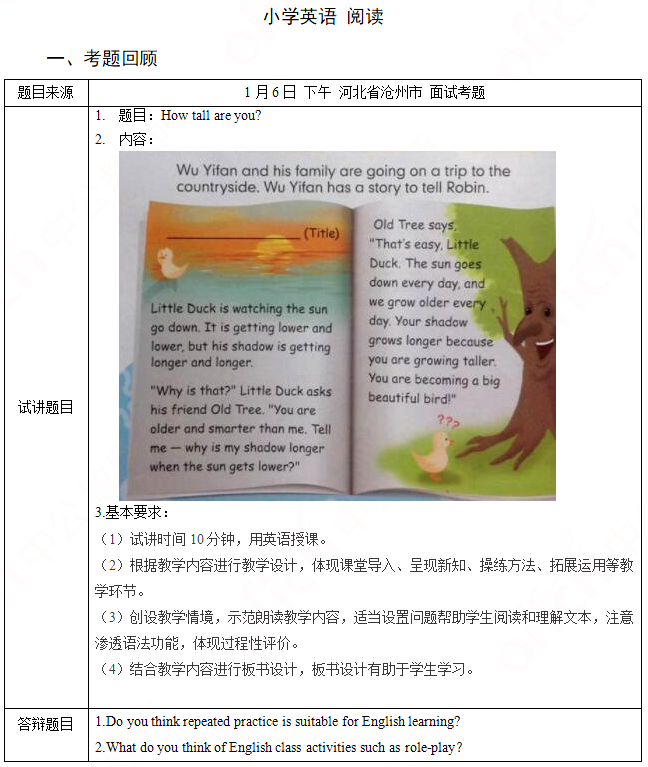
二、考题解析
【教学设计】
Teaching aims:
Knowledge aims:
Students will know about the relation between shadow and the sun through reading the passage.
Students will master the usage of comparative degree in the reading.
Ability aim:
Students will apply the comparative degree to retell the story.
Emotional aim:
Students will be more interest in learning English.
Key and difficult point:
Key Point: Students will master the usage of comparative degree in the reading.
Difficult Point: Students will apply the comparative degree to retell the story.
Teaching procedure:
Step 1: Warming-up
1. Greetings.
2. Play a riddle--it rises up and goes down every day, what is it? and students guess it’s the sun, then lead to the story about the sun.
Step 2: Pre-reading
According to the word “sun”, students have a brainstorm about what natural phenomenon about sun they have known.
Step 3: While-reading
1. Fast reading: students read the passage fast and figure out what the tree and the duck are talking about.
2. Careful reading: students read the passage carefully and answer the question: why does the shadow get longer when the sun gets lower? And underline the words with “er”.
3. The teacher explains the words with “er” to the students.
Step4: Post-reading
1. Students work in pairs to make a role-play (one is the little duck, the other is the old tree) to make a conversation according to the passage.
2. Students work in groups to find the real reason why the shadow gets longer when the sun gets lower.
Step5: Summary and Homework
Summary: ask a student to conclude the content of the lesson and summarize with the whole class.
Homework: students tell the story to their parents.
Blackboard design:

1.Do you think repeated practice is suitable for English learning?
2.What do you think of English class activities such as role-play?答案:解析:1.
Reciting is a way of practicing. There is a gap between understanding English and using English. For students, even if they think they can remember what they learn in class, after class while applying the knowledge taught in class, it possibly doesn’t work very well. So it is a practice way but we can not only use it. We need to use more practice ways together reciting to ensure the effect of teaching and learning.
2.
English class activities play an important role in English teaching. These performances can stimulate students' interest in learning English, mobilize students' enthusiasm for learning English, activate classroom atmosphere, reduce students' learning pressure, help students overcome fear of English learning, cultivate students' participation awareness, cooperation spirit and leadership ability. -
第7题:
共用题干
Successful Language Learners
1. Some people seem to have a knack for learning languages.They can pick up new vocabulary, master rules or grammar,and learn to write in the new language more quickly than others.They do not seem to be any more intelligent than others,so what makes language learning so much eas- ier for them?Perhaps if we take a close look at these successful language learners,we may dis- cover a few of the techniques which make language learning easier for them.
2. First of all,successful language learners are independent learners.They do not depend on the book or the teacher;they discover their own way to learn the language.Instead of waiting for the teacher to explain,they try to find the patterns and the rules for themselves.They are good guess-ers who look for clues and form their own conclusions.When they guess wrong,they guess again. They try to learn from mistakes.
3. Successful language learning is active learning. Therefore,successful learners do not wait for a chance to use the language;they look for such a chance.They find people who speak the lan-guage and they ask these people to correct them when they make a mistake.They will try anything to communicate .They are not afraid to repeat what they hear or to say strange things;they are willing to make mistakes and try again .When communication is difficult,they can accept information that is inexact or incomplete.It is more important for them to learn to think in the language than to know the meaning of every word.
4. Finally,successful language learners are learners with a purpose.They want to learn the language because they are interested in the language and the people who speak it.It is necessary for them to learn the language in order to communicate with these people and to learn from them. They find it easy to practice using the language regularly because they want to learn with it.
5. What kind of language learner are you?If you are a successful language learner,you have probably been learning independently,actively,and purposefully. On the other hand,if your language learning has been less than successful,you might as well try some of the techniques outlined above.Active language learners seize every opportunity______.
A: to discover sentence patterns and grammatical rules
B: to expand vocabulary
C: to use the target language
D: to encourage unsuccessful language learners to learn independently,actively and purposefully
E: from clues
F: to say strange things答案:C解析:本段首先通过举例方式说明有些人似乎学习语言比别人更快更轻松,引出该篇文章的主题:…a few of the techniques which make language learning easier for them.即成功学习语言的方法。
本段主要讲述的是第一个学习语言的方法,就是独立学习的能力,作者通过举例子的方式来说明这一方法,例如这些人不会依赖老师或者课本,而是自己去摸索总结出一定的模式,寻找线索,大胆地不断地进行猜测,从错误中学习。
本段主要讲述的另外一个语言学习的方法,就是积极主动学习的能力,这些人会寻找一切使用语言的机会,找人纠正他们的错误,敢于说一些即使有别扭的句子,愿意接受不准确或不完整的信息,对他们来说学习另一种思维方式比知道单词的意思更加重要。
本段主要讲述的另外一个语言学习的方法,就是有目的性的学习的能力,这些人往往是因为对讲这种语言的人以及语言本身感兴趣才学习的英语,这样他们可以更好地和使用这种语言的当地人交流并向他们学习。
依据是第二段第四句话:They are good guessers who look for clues and form their own conclusions.
依据是第二段第三句话:Instead of waiting for the teacher to explain, they try to find the patterns and the rules for themselves.
依据是第三段第二句话:Therefore, successful learners do not wait for a chance to use the language;they look for such a chance.
依据是第二段、第三段、第四段的第一句也就是每一段的主题句。本文的主旨就是介绍这三种重要的英语学习方法:独立、主动、有目的的学语言。 -
第8题:
Learn from Mistakes You can only learn from a mistake after you (1) you’ve made it. As soon as you start blaming other people (or the universe itself) you distance yourself (2)any possible lesson. But if you courageously stand up and honestly say “This is my mistake and I am responsible” the possibilities for learning will move towards you. Admission of a mistake, even if only privately to yourself, makes learning (3)by moving the focus away from blame assignment and towards understanding. This advice (4)counter to the cultural assumptions we have about mistakes and failure, namely that they are (5) things. We’re taught in school, in our families, or at work to feel guilty about failure and to do whatever we can to (6)mistakes. This sense of shame explains why many people give up on their goals: they’re not (7) for the mistakes and failures What’s missing in many people’s beliefs about success is the fact that the more (8)the goal, the more frequent and difficult setbacks will be. The larger your ambitions, the more dependent you will be on your ability to overcome and learn from your mistakes. But for many reasons admitting mistakes is difficult. An implied value in many cultures is that our work represents us: if you fail a test, then you are a (9). If you make a mistake then you are a mistake. Learning from mistakes requires three things: putting yourself in situations where you can make interesting mistakes; having the self-confidence to admit to them; being (10)about making changes. (1)内应选()
- A、runs
- B、access
- C、challenging
- D、shameful
- E、courageous
- F、possible
- G、admit
- H、failure
- I、avoid
- J、prepared
- K、activities
- L、from
正确答案:J -
第9题:
问答题Practice 3 You should spend about 40 minutes on this task. Write about the following topic: Happiness is considered very important in life. Why is it difficult to define? What factors are important in achieving happiness? You should write at least 250 words.正确答案: 【参考范文】
Throughout the history of human being, people are always pursuing happiness while nobody can give a definition nor can a consensus be achieved. Generally, happiness consists of two levels: material level and spiritual level. As far as I am concerned, spiritual happiness can bring people with greater satisfaction.
To begin with, being happy is not a mood under certain circumstances, but a person with a certain set of attitudes. It is difficult for anyone to get what he wants without a great deal of effort. After making great and arduous effort, even if the target is achieved as expectation, there is nothing left but suffering and pain, because he amplifies the efforts rather than emphasizes the harvests. To reach the happiness they seek, however, the only thing people should do is to change their attitude toward happiness, and the way they look at the world around them.
Moreover, happiness is not what people are born with but what people take action to get. Many people seek their unique happiness through imagination and daydreams. Obviously, everyone fantasies sometimes. But, without actions, no one can come close to finding the happiness he seeks. Happiness and bliss cannot be found merely through unrealistic envision, but must be sought through actions, through doing.
To sum up, although we say that happiness is rooted in optimistic attitudes, it can never be achieved without any effort. It arises spontaneously from within as small goals are reached.解析: 暂无解析 -
第10题:
单选题What’s the writer’s opinion about Star Trek?AThe life forms on other planets are stupid.
BInteresting ideas make a new series popular.
CThe new series might not be successful without better actors.
正确答案: C解析:
细节理解题。文章最后一段第二、三句提到如果没有很好的演员,这部新剧不会成功。所以,C项为正确答案。 -
第11题:
单选题The more careful you are while writing a composition, ______ .Ayou make the fewer mistakes
Bthe few mistakes would you make
Cthe fewer mistakes you will make
Dfewer mistakes will be made
正确答案: D解析:
句意:你写作文的时候越仔细,犯的错误就会越少。”the+比较级, the+比较级”是固定搭配,意为”越…,越…”。故答案是C项。 -
第12题:
单选题Both passages suggest which of the following about evolution?AThe fossil record is incomplete, so we must supplement it with other evidence.
BOur claims about evolutionary processes should be supported with clear evidence.
CHumans are no longer closely related to other species on the planet.
DMacroevolution has been shown to take place millions of times since life began.
EIndisputable evidence for evolution can be found in humans' genetic code.
正确答案: B解析:
第一篇文章用一些基因来证明进化,而第二篇文章认为进化论这个观点是可疑的,因为缺乏足够的证据。 -
第13题:
B
For many parents , raising a teenager is like fighting a long war ,but years go by without any clear winner . Like a border conflict between neighboring countries ,the parent-teen war is about boundaries: Where is the line between what I control and what you do?
Both sides want peace ,but neither feels it has any power to stop the conflict . In part ,this is because neither is willing to admit .any responsibility for starting it . From the parents’ point of view, the only cause of their fight is their adolescents’ complete unreasonableness. And of course .the teens see it in exactly the same way , except oppositely . Both feel trapped
In this article. I’ll describe three no-win situations that commonly arise between teens and parents and then suggest some ways out of the trap. The first no-win situation is quarrels over unimportant things . Examples include the color of the teen’s hair, the cleanliness of the bedroom ,the preferred style. of clothing , the child’s failure to eat a good breakfast before school ,or his tendency to sleep until noon on the weekends .Second ,blaming , the goal of a blaming battle is to make the other admit that his bad attitude is the reason why everything goes wrong . Third , needing to be right ,It doesn’t matter what the topic is –politics. The taws of physics ,or the proper way to break an egg –the point of these arguments is to prove that you are right and the other person is wrong .for both wish to be considered an authority --- someone who actually knows something --- and therefore to command respect. Unfortunately , as long as long as parents and teens continue to assume that they know more than the other ,they’ll continue to fight these battles forever and never make any real progress
55. Why does the author compare the parent—teen war to a border conflict?
A. both can continue for generations .
B. Both are about where to draw the line
C. Neither has any clear winner
D. Neither can be put to an end
正确答案:B
-
第14题:
The passage is mainly about__________.A.what has brought about less working time
B.why employees want to make more money
C.why employees have less leisure time
D.what a good employee should be like答案:C解析:通过对全文的通读和理解,可知本文一直在围绕着为什么现在工作的人的业余时间那么少。 -
第15题:
共用题干
第三篇
The Balance between Fluency and Accuracy
To be able to speak English with fluency and accuracy is a goal of many Chinese English learners.Fluency can be simply defined as"being able to communicate ideas without having to stop and think too much about what one is saying";speaking accurately means"speaking without errors of grammar and vocabulary".
However,the fact is that many students find that the faster they try to speak,the more mistakes they make.And,when they slow down,there may be fewer errors though it can sound unnatural. So,how to balance accuracy and fluency in spoken English?
It can depend on the manner in which one has studied English in the past.People who tend to focus on accuracy may find that they worry too much about making mistakes.This can make them nervous or embarrassed about speaking English in public.As a result,their spoken English might not improve.This means that,although they know English grammar and vocabulary well,they might not be able to hold a good conversation.
On the other hand,there are those who really like to talk and are willing to try their language out even if they make mistakes.This willingness to take risks helps them speak more fluidly.But,if they make a lot of mistakes,it may make it difficult for them to have their ideas understood.
The debate about which is more important一fluency or accuracy一in the English language has lasted for a long time.Still,one thing is clear:neither of them should be absent if one is to speak a language well.How can we be sure that we can develop both?The following tips could help.
Find the problem.What kind of person are you一one who focuses on accuracy or one who focuses on frequency?The first step is to recognize your problem and go to work on it.Think about situations where you've used English and how you felt about making mistakes?Do you always try some new language even though it might not be correct?Or do you feel embarrassed by mistakes?
Focus on one problem at a time.When you speak English,find the mistakes you make most often.One mistake Chinese often make is omitting the"S"from the third person singular verb.Or you may speak too slowly as if you were searching for the right word and correct grammar. The next time you use English,try to work on those problems you have identified.If it's fluency,try to focus on it.If you have a problem with the third person singular,try to concentrate on when you make such errors.Don't spend time thinking about other mistakes.By choosing an area to work on,you can isolate problems and help yourself overcome them.
Vary your practice.If you go to an English corner or an English club,try to change the types of activities you take part in so that you practice both fluency and accuracy.Public speaking allows you to slow down and be sure you have time to concentrate on the language.Meanwhile,discussions are good practice for fluency,especially if you don't stop each time a mistake is made.
Tell the difference between fluency and speed.Some Chinese think that speaking fast is the same as speaking fluently.In fact,speaking fluently involves not only speed.It also involves stress, pronunciation and intonation. If you make a mistake in these,speaking fast will only make it worse. Don't sacrifice understanding for speed.
Record yourself. Take a tape recorder and record a conversation with a friend or a speech or talk to yourself as you do it naturally!A two-or-three-minute recording is enough.When you've finished,listen to yourself. Can you find out any error and correct it?Make it a regular practice.The more you record yourself,the more confident and natural sounding you will become.What does the word"fluidly"mean in the sentence"This willingness to take risks helps them speak more fluidly"(Line 2,Para. 4)?
A:Fluently.
B:Accurately.
C:Fluently and accurately.
D:Clearly.答案:A解析:本题是细节推理题。题干是:准确性的定义是什么?选择A的依据是第一段最后一句:" speaking without errors of grammar and vocabulary”说话不犯语法错误和词汇错误。这与选项A的内容一致。所以选项A是正确答案。
本题是细节理解题。题干是:在“This willingness to take risks helps them speak more fluidly”句中fluidly的意思是什么?(第四段,第二行)。选择A的依据第四段的第一句:" On the other hand , there are those who really like to talk and are willing to try their language out even if they make mistakes.”另一方面,有一些人真的很喜欢说话,而且就算说错,他们也愿意试着说。这说明该段主要强调注重流利性多于准确性的人,所以依此推理fluidly是“流利的”意思。另外,也可以通过fluid作为名词液体的意思,借助一些名词加“ly”以后变成副词或者形容词这一常识推理出正确答案。所以选A。
本题是细节理解题。题干是:流利性和准确性哪个更重要?选择D的依据是,第五段的前两句:" The debate about which is more important一fluency or accuracy一in the English language has lasted for a long time.Still,one thing is clear:neither of them should be absent if one is to speak a language well.”说英语时流利重要还是准确重要,关于这个问题的辩论持续了很长时间。然而,有一点是明确的,即想要说好一门语言,流利性和准确性都不能少。作者似乎提出在文中提出了和题干一样的题,但后面的回答只是关于二者的必要性,而非就二者之间哪个更重要,所以D是正确答案。
本题是细节理解题。题干是:根据本文,哪个说法是正确的? 选择D的依据是全文最后一句:"The more you record yourself, the more confident and natural sounding you will become.”你自己录音越多,你就越有自信,你的英语听上去会更自然。所以选择与原文同义的选项D。
本题是细节推理题。题干是:在进行公共演讲时,谁会感到紧张、尴尬?选择B的依据是第三段的第二、三句:" People who tend to focus on accuracy may find that they worry too much about making mistakes.This can make them nervous or embarrassed about speaking English in public.”那些倾向于注重说话准确性的人可能会发现,他们太过担心犯错误。这可能导致他们在公众场合说英语感到紧张或尴尬。所以,选项B注重说话准确性的人,是正确答案。 -
第16题:
共用题干
第三篇
The Balance between Fluency and Accuracy
To be able to speak English with fluency and accuracy is a goal of many Chinese English learners.Fluency can be simply defined as"being able to communicate ideas without having to stop and think too much about what one is saying";speaking accurately means"speaking without errors of grammar and vocabulary".
However,the fact is that many students find that the faster they try to speak,the more mistakes they make.And,when they slow down,there may be fewer errors though it can sound unnatural. So,how to balance accuracy and fluency in spoken English?
It can depend on the manner in which one has studied English in the past.People who tend to focus on accuracy may find that they worry too much about making mistakes.This can make them nervous or embarrassed about speaking English in public.As a result,their spoken English might not improve.This means that,although they know English grammar and vocabulary well,they might not be able to hold a good conversation.
On the other hand,there are those who really like to talk and are willing to try their language out even if they make mistakes.This willingness to take risks helps them speak more fluidly.But,if they make a lot of mistakes,it may make it difficult for them to have their ideas understood.
The debate about which is more important一fluency or accuracy一in the English language has lasted for a long time.Still,one thing is clear:neither of them should be absent if one is to speak a language well.How can we be sure that we can develop both?The following tips could help.
Find the problem.What kind of person are you一one who focuses on accuracy or one who focuses on frequency?The first step is to recognize your problem and go to work on it.Think about situations where you've used English and how you felt about making mistakes?Do you always try some new language even though it might not be correct?Or do you feel embarrassed by mistakes?
Focus on one problem at a time.When you speak English,find the mistakes you make most often.One mistake Chinese often make is omitting the"S"from the third person singular verb.Or you may speak too slowly as if you were searching for the right word and correct grammar. The next time you use English,try to work on those problems you have identified.If it's fluency,try to focus on it.If you have a problem with the third person singular,try to concentrate on when you make such errors.Don't spend time thinking about other mistakes.By choosing an area to work on,you can isolate problems and help yourself overcome them.
Vary your practice.If you go to an English corner or an English club,try to change the types of activities you take part in so that you practice both fluency and accuracy.Public speaking allows you to slow down and be sure you have time to concentrate on the language.Meanwhile,discussions are good practice for fluency,especially if you don't stop each time a mistake is made.
Tell the difference between fluency and speed.Some Chinese think that speaking fast is the same as speaking fluently.In fact,speaking fluently involves not only speed.It also involves stress, pronunciation and intonation. If you make a mistake in these,speaking fast will only make it worse. Don't sacrifice understanding for speed.
Record yourself. Take a tape recorder and record a conversation with a friend or a speech or talk to yourself as you do it naturally!A two-or-three-minute recording is enough.When you've finished,listen to yourself. Can you find out any error and correct it?Make it a regular practice.The more you record yourself,the more confident and natural sounding you will become.Which statement is true according to the passage?
A:You don't stop each time when you practice your accuracy.
B:You should care about all the mistakes in your speaking all the time.
C:Record yourself for three to four minutes is a good method to improve accuracy.
D:You record yourself more,and you will become more confident and natural sounding.答案:D解析:本题是细节推理题。题干是:准确性的定义是什么?选择A的依据是第一段最后一句:" speaking without errors of grammar and vocabulary”说话不犯语法错误和词汇错误。这与选项A的内容一致。所以选项A是正确答案。
本题是细节理解题。题干是:在“This willingness to take risks helps them speak more fluidly”句中fluidly的意思是什么?(第四段,第二行)。选择A的依据第四段的第一句:" On the other hand , there are those who really like to talk and are willing to try their language out even if they make mistakes.”另一方面,有一些人真的很喜欢说话,而且就算说错,他们也愿意试着说。这说明该段主要强调注重流利性多于准确性的人,所以依此推理fluidly是“流利的”意思。另外,也可以通过fluid作为名词液体的意思,借助一些名词加“ly”以后变成副词或者形容词这一常识推理出正确答案。所以选A。
本题是细节理解题。题干是:流利性和准确性哪个更重要?选择D的依据是,第五段的前两句:" The debate about which is more important一fluency or accuracy一in the English language has lasted for a long time.Still,one thing is clear:neither of them should be absent if one is to speak a language well.”说英语时流利重要还是准确重要,关于这个问题的辩论持续了很长时间。然而,有一点是明确的,即想要说好一门语言,流利性和准确性都不能少。作者似乎提出在文中提出了和题干一样的题,但后面的回答只是关于二者的必要性,而非就二者之间哪个更重要,所以D是正确答案。
本题是细节理解题。题干是:根据本文,哪个说法是正确的? 选择D的依据是全文最后一句:"The more you record yourself, the more confident and natural sounding you will become.”你自己录音越多,你就越有自信,你的英语听上去会更自然。所以选择与原文同义的选项D。
本题是细节推理题。题干是:在进行公共演讲时,谁会感到紧张、尴尬?选择B的依据是第三段的第二、三句:" People who tend to focus on accuracy may find that they worry too much about making mistakes.This can make them nervous or embarrassed about speaking English in public.”那些倾向于注重说话准确性的人可能会发现,他们太过担心犯错误。这可能导致他们在公众场合说英语感到紧张或尴尬。所以,选项B注重说话准确性的人,是正确答案。 -
第17题:
Online distance learning is an instructional system which connects learners with educational resources.Students work on their own at home,at work,or at school and communicate with faculty and other students by means of e-mail,electronic meetings,videoconferencing,chat rooms,instant messaging and other forms of computer-based communication.There are both advantages and disadvantages to online distance learning.
There are many benefits to using online distance learning environments.Online education is available all the time,anywhere and to all people.However,there are weaknesses for some learners.The online learner only has the written text and no other face-to-face hints.This may confuse the learner and cause misunderstanding.While distance learning allows for an openness,it is also difficult because it is done by e-mail messages and writing,and therefore may take more time than face-to-face learning.Sometimes the messages can be overwhelming for many online students.
Universities,colleges and schools use online distance learning environments.These are important for students who may be unable to attend classes for various reasons like illnesses or busy everyday schedules.Some learners just want to further their studies at home.They enjoy the convenience of home learning as they take regular programs or enrichment classes.
Online courses keep learners very occupied at all hours of the day.There are a great many messages and other online resources to read and respond to.Most learners have regular jobs or attend regular school classes on ground as well.However,the benefits are clear.Online distance learning is becoming very popular.Some online classes have become a profitable business as they replace regular traditional means of learning.
Sometimes online distance learning can be a problem because__.A.learners can't afford it
B.learners get too many hints
C.it involves excessive writing
D.it is not available at the weekend答案:C解析:从第二段可知,远程教育有很多优势,但也有劣势。劣势就是需要以写作来完成的东西太多。另外,此段还提到,远程教育不能进行面对面的教授。因此,喜欢亲临现场听课的学生不会喜欢远程教育。 -
第18题:
共用题干
Successful Language Learners
1.Some people seem to have a knack for learning languages.They can pick up new vocabulary,master rules or grammar,and learn to write in the new language more quickly than others.They do not seem to be any more intelligent than others,so what makes language learning so much easier for them?Perhaps if we take a close look at these successful language learners,we may discover a few of the techniques which make language learning easier for them.
2.First of all,successful language learners are independent learners.They do not depend on the book or the teacher;they discover their own way to learn the language.Instead of waiting for the teacher to explain,they try to find the patterns and the rules for themselves.They are good guessers who look for clues and form their own conclusions.When they guess wrong,they guess again.They try to learn from mistakes.
3.Successful language learning is active learning. Therefore,successful learners do not wait for a chance to use the language;they look for such a chance.They find people who speak the language and they ask these people to correct them when they make a mistake.They will try anything to com-municate.They are not afraid to repeat what they hear or to say strange things;they are willing to make mistakes and try again.When communication is difficult,they can accept information that is inexact or incomplete.It is more important for them to learn to think in the language than to know the meaning of every word.
4.Finally,successful language learners are learners with a purpose.They want to learn the language because they are interested in the language and the people who speak it.It is necessary for them to learn the language in order to communicate with these people and to learn from them.They find it easy to practice using the language regularly because they want to learn with it.
5.What kind of language learner are you?If you are a successful language learner,you have probably been learning independently,actively,and purposefully.On the other hand,if your language learning has been less than successful,you might as well try some of the techniques outlined above.Paragraph 3_________.
A:Ways to learn a language successfully.
B:Learning a language purposefully.
C:Learning a language actively.
D:Learning a language independently.
E:Learning from mistakes.
F:Learning to think in the target language.答案:C解析:本题考查的是对所读材料大意与主旨的掌握。本段首先通过举例方式说明有些人似乎学习语言比别人更快更轻松,引出该篇文章的主题:…a few of the techniques which make language learning easier for them.即成功学习语言的方法。
本题考查的是对所读材料大意与主旨的掌握。本段主要讲述的是第一个学习语言的方法,就是独立学习的能力,作者通过举例子的方式来说明这一方法,例如这些人不会依赖老师或者课本,而是自己去摸索总结出一定的模式,寻找线索,大胆地、不断地进行猜测,从错误中学习。
本题考查的是对所读材料大意与主旨的掌握。本段主要讲述第二个语言学习的方法,就是积极主动学习的能力,这些人会寻找一切使用语言的机会,找人纠正他们的错误,敢于说一些即使有些别扭的句子,愿意接受不准确或不完整的信息,对他们来说,学习另一种思维方式比知道单词的意思更加重要。
本题考查的是对所读材料大意与主旨的掌握。本段主要讲述第三个语言学习的方法,就是有目的性地学习的能力,这些人往往是因为对讲这种语言的人以及语言本身感兴趣才学习,这样,他们可以更好地和使用这种语言的当地人交流并向他们学习。
本题考查的是对阐述文章的主旨事实与细节的了解。依据是第二段第四句话:They are good guessers who look for clues and form their own conclusions.
本题考查的是对阐述文章的主旨事实与细节的了解。依据是第二段第三句话:Instead of waiting for the teacher to explain, they try to find the patterns and the rules for themselves.
本题考查的是对阐述文章的主旨事实与细节的了解。依据是第三段第二句话:Therefore, successful learners do not wait for a chance to use the language; they look for such a chance.
本题考查的是对阐述文章的主旨的了解。依据是第二段、第三段、第四段的第一句也就是每一段的主题句。本文的主旨就是介绍这三种重要的语言学习方法:独立、主动、有目的地学语言。 -
第19题:
共用题干
Successful Language Learners
1. Some people seem to have a knack for learning languages.They can pick up new vocabulary, master rules or grammar,and learn to write in the new language more quickly than others.They do not seem to be any more intelligent than others,so what makes language learning so much eas- ier for them?Perhaps if we take a close look at these successful language learners,we may dis- cover a few of the techniques which make language learning easier for them.
2. First of all,successful language learners are independent learners.They do not depend on the book or the teacher;they discover their own way to learn the language.Instead of waiting for the teacher to explain,they try to find the patterns and the rules for themselves.They are good guess-ers who look for clues and form their own conclusions.When they guess wrong,they guess again. They try to learn from mistakes.
3. Successful language learning is active learning. Therefore,successful learners do not wait for a chance to use the language;they look for such a chance.They find people who speak the lan-guage and they ask these people to correct them when they make a mistake.They will try anything to communicate .They are not afraid to repeat what they hear or to say strange things;they are willing to make mistakes and try again .When communication is difficult,they can accept information that is inexact or incomplete.It is more important for them to learn to think in the language than to know the meaning of every word.
4. Finally,successful language learners are learners with a purpose.They want to learn the language because they are interested in the language and the people who speak it.It is necessary for them to learn the language in order to communicate with these people and to learn from them. They find it easy to practice using the language regularly because they want to learn with it.
5. What kind of language learner are you?If you are a successful language learner,you have probably been learning independently,actively,and purposefully. On the other hand,if your language learning has been less than successful,you might as well try some of the techniques outlined above.The author wrote this text______.
A: to discover sentence patterns and grammatical rules
B: to expand vocabulary
C: to use the target language
D: to encourage unsuccessful language learners to learn independently,actively and purposefully
E: from clues
F: to say strange things答案:D解析:本段首先通过举例方式说明有些人似乎学习语言比别人更快更轻松,引出该篇文章的主题:…a few of the techniques which make language learning easier for them.即成功学习语言的方法。
本段主要讲述的是第一个学习语言的方法,就是独立学习的能力,作者通过举例子的方式来说明这一方法,例如这些人不会依赖老师或者课本,而是自己去摸索总结出一定的模式,寻找线索,大胆地不断地进行猜测,从错误中学习。
本段主要讲述的另外一个语言学习的方法,就是积极主动学习的能力,这些人会寻找一切使用语言的机会,找人纠正他们的错误,敢于说一些即使有别扭的句子,愿意接受不准确或不完整的信息,对他们来说学习另一种思维方式比知道单词的意思更加重要。
本段主要讲述的另外一个语言学习的方法,就是有目的性的学习的能力,这些人往往是因为对讲这种语言的人以及语言本身感兴趣才学习的英语,这样他们可以更好地和使用这种语言的当地人交流并向他们学习。
依据是第二段第四句话:They are good guessers who look for clues and form their own conclusions.
依据是第二段第三句话:Instead of waiting for the teacher to explain, they try to find the patterns and the rules for themselves.
依据是第三段第二句话:Therefore, successful learners do not wait for a chance to use the language;they look for such a chance.
依据是第二段、第三段、第四段的第一句也就是每一段的主题句。本文的主旨就是介绍这三种重要的英语学习方法:独立、主动、有目的的学语言。 -
第20题:
他们应该明白不同报警信号的意义。()
- A、They should be clear about all fire-fighting equipment..
- B、They should be understood about the meaning of the different alarm signals.
- C、They should be clear about all life-saving equipment.
- D、They should be clear about the meaning of the different alarm signals.
正确答案:D -
第21题:
单选题他们应该明白不同报警信号的意义。()AThey should be clear about all fire-fighting equipment..
BThey should be understood about the meaning of the different alarm signals.
CThey should be clear about all life-saving equipment.
DThey should be clear about the meaning of the different alarm signals.
正确答案: B解析: 暂无解析 -
第22题:
单选题—Why haven’t you bought any butter?—I ______ to but I forgot about it.Aliked
Bwished
Cmeant
Dexpected
正确答案: D解析:
句意:—为什么你还是没有买黄油?—我原打算买黄油,可我给忘了。本题考查动词辨析。mean表示“打算”,根据题干中的“but I forgot about it”可知,是“本打算买,但是忘记了”,mean符合句意,因此选C项。like喜欢。wish希望。expect期待,预料。 -
第23题:
单选题Learn from Mistakes You can only learn from a mistake after you (1) you’ve made it. As soon as you start blaming other people (or the universe itself) you distance yourself (2)any possible lesson. But if you courageously stand up and honestly say “This is my mistake and I am responsible” the possibilities for learning will move towards you. Admission of a mistake, even if only privately to yourself, makes learning (3)by moving the focus away from blame assignment and towards understanding. This advice (4)counter to the cultural assumptions we have about mistakes and failure, namely that they are (5) things. We’re taught in school, in our families, or at work to feel guilty about failure and to do whatever we can to (6)mistakes. This sense of shame explains why many people give up on their goals: they’re not (7) for the mistakes and failures What’s missing in many people’s beliefs about success is the fact that the more (8)the goal, the more frequent and difficult setbacks will be. The larger your ambitions, the more dependent you will be on your ability to overcome and learn from your mistakes. But for many reasons admitting mistakes is difficult. An implied value in many cultures is that our work represents us: if you fail a test, then you are a (9). If you make a mistake then you are a mistake. Learning from mistakes requires three things: putting yourself in situations where you can make interesting mistakes; having the self-confidence to admit to them; being (10)about making changes. (8)内应选()Aruns
Baccess
Cchallenging
Dshameful
Ecourageous
Fpossible
Gadmit
Hfailure
Iavoid
Jprepared
Kactivities
Lfrom
正确答案: F解析: 比较级句式the more … the more …提示我们本空应填入形容词。challenging, adj.具有挑战性的。句意是:很多人对成功的理解缺少了一点,就是目标越具挑战性,挫折就出现地越频繁、难度也越大。答案为C。