
单选题In the sentence “The thought came to him that maybe the enemy had fled the city”, the italicized part is _____.A the appositive clauseB the attributive clauseC the object clauseD the subject clause
题目
the appositive clause
the attributive clause
the object clause
the subject clause
相似考题
更多“单选题In the sentence “The thought came to him that maybe the enemy had fled the city”, the italicized part is _____.A the appositive clauseB the attributive clauseC the object clauseD the subject clause”相关问题
-
第1题:
Which best describes an inline view? ()A. a schema object
B. a subquery that can contain an ORDER BY clause
C. another name for a view that contains group functions
D. a subquery that is part of the FROM clause of another query
参考答案:D
-
第2题:
The NLS_SORT parameter sets the default sort method for which of the following operations?()A. WHERE clause WHERE
B. ORDER BY clause
C. BETWEEN clause
D. NLSSORT function
E. NLS_SORT function
参考答案:A, D
-
第3题:
The message came to the villagers( )the enemy had already fled the village.A.which
B.who
C.that
D.where答案:C解析:本题考查同位语从句。句意为“村民们得到消息,敌人已经逃离了村庄”。同位语从句通常跟在某些抽象名词(如news,idea,fact,rumor,thought,promise,message等)的后面,对这些名词进行解释或说明,但有时同位语从句可以不紧跟在其说明的名词后面,而被别的词隔开。该同位语从句the enemy had already fled the village意义完整,连接词不充当任何成分,所以应该用that引导。由于主句谓语较短,而同位语从句较长,所以题干中的句子的同位语从句被后置。 -
第4题:
Some young soldiers who had recently joined the army were being trained in modern ways of fighting,and one of the things they were shown was how an unarmed man could trick an armed enemy and take his weapon away from him.First one of their two instructors took a knife away from the other,using only his bare hands;and then he took a rifle away from him in the same way.After the lesson,and before they went on to train the young soldiers to do these things themselves,the two instructors asked them a number of questions to see how well they had understood what they had been shown.One of the questions was this:“Well,you now know what an unarmed man can do against a man with a rifle.Imagine that you are guarding a bridge at night,and that you have a rifle.Suddenly you see an unarmed enemy soldier coming towards you.What will you do?”
The young soldier who had to answer this question thought carefully for a few seconds before he answered,and then said,“Well,after what I have just seen,I think that the first thing I would do would be to get rid of my rifle as quickly as I could,so that the unarmed enemy couldn't take it from me and kill me with it!”
The instructors were teaching the soldiers__.A.how to use weapons
B.how to manage without weapons
C.how to beat the enemy barehanded
D.how to fight with enemy答案:B解析:这是一个幽默的小段子,讽刺教条的教与学。第一段,教员给年轻士兵展示如何在没有武器的情况下徒手夺取敌人手中的武器。 -
第5题:
高中英语?语法
一、考题回顾
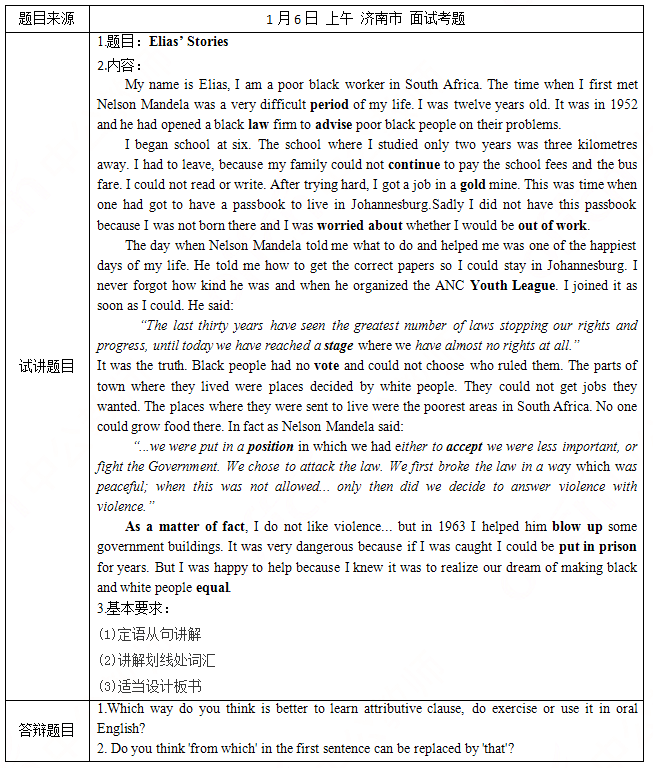
二、考题解析
【教案】
Teaching aims:
Knowledge aims:
(1)Students are able to master the meaning of bold words and phrases: period, law, advise, gold, worried about, out of work, Youth League, stage, stage, position, as a matter of fact, blow up, put in prison, equal
(2)Students can master the usage of adverb in attributive clause.
(3)After this lesson, students can know the difference of usage of adverb in attributive clause and the usage of pronoun in attributive clause.
Ability aim:
After this lesson, students can use grammar of attributive clause in reading and writing.
Emotional aim:
Students are able to love learning English after this lesson.
Key and difficult point:
Key Point: master the meaning of words and phrases :period, law, advise,gold,worried about etc.
Difficult Point: use grammar of attributive clause in reading and writing
Teaching procedures:
Step 1: Warming-up
1. Greetings.
2. Ask students to make several sentences using the grammar of usage of pronoun in attributive clause. Then write a sentence needing to use adverb in attributive clause. And then lead in the new grammar, adverb in attributive clause.
Step 2: Presentation
1.Ask students to open the book and read the passage to guess the meaning the bold words and then paraphrase the bold words with the help of PPT.
2. Then Ask students to find out more complex sentences that the clause is after a noun or pronoun and the words that are used to introduce the sentences: where, when, why or preposition plus which.
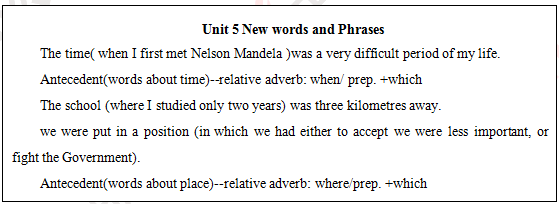
The time( when I first met Nelson Mandela )was a very difficult period of my life.
The school (where I studied only two years) was three kilometres away.
This was time (when one had got to have a passbook )to live in Johannesburg.
we were put in a position (in which we had either to accept we were less important, or fight the Government). ...
Then ask students to find the similarity of these sentences and invite several students to share their ideas. Then lead the students to conclude the rules of relative adverb in attributive clause and preposition plus which in attributive clause. (They all function as adverbials)
Step 3: Practice
1.Make sentences: Ask students to use the grammar that has just learnt to describe the pictures which are presented on the PPT.
2.Combine the sentences: Ask students to combine the sentences according to the grammar in attributive clause.
(1)This is a book. Its cover is blue. (whose)
(2)He is the teacher. He helped me. (who/that)
(3)Beijing is the place. I was born in this place. (where/ in which)
(4)This is the hotel. You will stay at the hotel. (where/at which)
Step4: Production
1.Make stories: Ask students to use the grammar that has just learnt to describe the video.
2.Discussion: Ask students to tell their daily life to use the grammar that has just learnt. And after 5minutes to invite several students to share their daily life.
Step5: Summary and Homework
Summary: ask a student to conclude the content of the lesson and summarize with the whole class.
Homework: write a short passage about his daily life using the grammar that has just learnt.
Blackboard design:
1.Which way do you think is better to learn attributive clause, do exercise or use it in oral English?
2. Do you think 'from which' in the first sentence can be replaced by 'that'?答案:解析:1.
(1)I think, first, the best way to learn attributive clause is tell the definition of this grammar in
sentence. For example, this is a beautiful teacher (who wears the red dress )is our teacher. Then ask students to pay attention to the clause to find the features of this sentence and conclude the attributive clause: noun/pronoun plus a whole sentence. Next tell the usage of pronoun in attributive clause. Last, teach the usage of adverb in attributive clause.
(2) Exercise and oral English should use togerther in practice attributive clasue. Doing exercise can make students master the structure of this grammar easily. And oral English can make students know the real situation of attributive clause in our daily life.
2.
No, I don’t think. From which is an relative adverb from the point of grammar. And that belongs to the pronoun. So it only can be used as the subject, object and so on but can not be used as the adverb or as as phrase. And this sentence doesn’t have the adverb, so we must use from which. -
第6题:
Which best describes an inline view?()
- A、a schema object
- B、a subquery that can contain an ORDER BY clause
- C、another name for a view that contains group functions
- D、a subquery that is part of the FROM clause of another query
正确答案:D -
第7题:
The NLS_SORT parameter sets the default sort method for which of the following operations?()
- A、WHERE clause WHERE
- B、ORDER BY clause
- C、BETWEEN clause
- D、NLSSORT function
- E、NLS_SORT function
正确答案:A,D -
第8题:
单选题Which of the italicized parts functions as a subject?AIt is known to all that cancer is a terrible disease.
BHis first question was whether the monitor had arrived yet.
CThe news that our team won the game excited us all.
DSuccess depends on whether we make enough effort.
正确答案: A解析:
考查名词性从句在句中所做的句子成分。B选项中的斜体部分在句中做表语;C选项中的斜体部分在句中做主语the news的同位语;D选项中的斜体部分在句中做宾语;故选A。 -
第9题:
单选题In the sentence “The thought came to him that maybe the enemy had fled the city”, the italicized part is _____.Athe appositive clause
Bthe attributive clause
Cthe object clause
Dthe subject clause
正确答案: A解析:
从句成分辨析题。阅读题干可知,that引导的从句是对the thought的解释说明,充当the thought的同位语,所以本题应选A。 -
第10题:
单选题All the following sentences have an appositive EXCEPT _____.AI heard that be joined the army.
BThey have no idea at all where he has gone.
CThe thought came to him that Mary had probably fallen ill.
DSeveral years later, word came that Napoleon himself was coming to inspect them.
正确答案: C解析:
考查同位语。A选项中不包含同位语,故选A。 -
第11题:
单选题_____ that Bob had got promoted, his friends came to congratulate him.AHeard
BHaving heard
CHear
DTo hear
正确答案: D解析:
本题考查现在分词短语作状语。句意:得知鲍勃被提升以后,他的朋友们来庆祝他。现在分词作时间状语一般位于句首,表示的动作和谓语动词的动作同时发生,如果分词动作发生在谓语动词之前,用现在分词的完成形式。“听说”发生在“去祝贺”前,是由同一个主语发出,且表示主动,故用having heard。 -
第12题:
单选题In the sentence: “society owed it to the criminal to put into operation a punishment equal to the crime he had committed” the underlined part can be interpreted as: society .Awas in debt to the criminal and must put him into operation as a punishment
Bshould consider punishment as something it must do so that the criminal can get paid backfor his crime
Cowed the criminal equality and must first show it in action
Dowed an operation of equal crime to the criminal
正确答案: C解析:
句意为“社会有责任让犯罪分子得到应有的惩罚”。 -
第13题:
In a SELECT statement that includes a WHERE clause, where is the GROUP BY clause placed in the SELECT statement? ()A. Immediately after the SELECT clause
B. Before the WHERE clause
C. Before the FROM clause
D. After the ORDER BY clause
E. After the WHERE clause
参考答案:E
-
第14题:
Top N analysis requires () and ().A. the use of rowid
B. a GROUP BY clause
C. an ORDER BY clause
D. only an inline view
E. an inline view and an outer query
参考答案:C, E
-
第15题:
Which of the following italicized parts is a subject clause?A.We are quite certain that we will get there in time.
B.He has to face the fact that there will, be no pay rise this year.
C.She said that she had seen the man earlier that morning.
D.It's sheer luck that the miners are still alive after ten days.答案:D解析:考查主语从句。A项是一个表语从旬,是一个主系表的结构,B项是一个同位语从句。that引导的同位语从句补充说明先行阋的内容,C项是一个宾语从句,that引导的宾语从句作谓语动词said的宾语,只有D项是一个主语从句,it是一个形式主语,真正的主语是后面的that从句部分。故选D。 -
第16题:
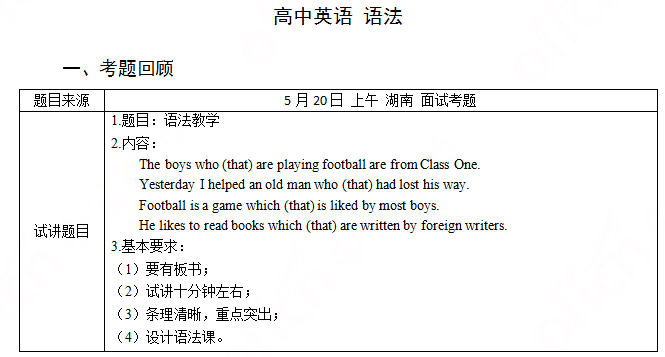
二、考题解析
【教案】
Teaching Aims
Knowledge aims
Students will know the form and usage of attributive clause lead by who, which and that.
Ability aim
Students can enhance their ability of understanding the knowledge which is more professional and difficult.
Emotional aim
After this lesson, students will improve their confidence of learning English.
Teaching Key &Difficult Points
Key point: attributive clause;
Difficult point: How to understand and use the attributive clause.
Teaching procedures
Step 1: Warming up
Show some adverbial clause on the screen, let students look at this sentences carefully and find the similarities among them. After observation, do a conclusion together :“They all describe the verbs like adverbs.”
I will call you as soon as I arrive in Beijing.
Where you work, you should work hard.
My friends like me because I’m honesty.
Step 2: Presentation
Show these four sentences on the blackboard.
1.Students try to translate these sentences. Invite some students to share their answers. The answers are as follows:
正在踢足球的男孩是一班的。
昨天我帮助了一位迷路的老人。
足球是大多数男孩所喜欢的运动。
他喜欢外国作家写的书。
2. Let them observe these two sentence, find the common between them. Tell them the function and meaning of attributive clause.
The rules are shown in the following part:
① The function of attributive clause is to modify the previous word (antecedent).
② When the antecedent is human being, we should use the relative pronoun: who.
③ When the antecedent is something, we should use the relative pronoun: which.
④ No matter the the antecedent is something or someone, the relative pronoun: that can be used.
Step 3: Practice
1.Give them several minutes to make their own sentences using attributive clause.
2.Read the some sentences and try to translate them.
Step 4: Production
Divide them into group of four and in five minutes to discuss the impressive person who has made great influence on you. Try to use the attributive clause.
Step 5: Summary & Homework
1.Ask students to summarize the usage and function of attributive clause.
2.After class, please search more information about attributive clause.
Blackboard design
 答案:解析:暂无解析
 -
第17题:
In a SELECT statement that includes a WHERE clause, where is the GROUP BY clause placed in the SELECT statement?()
- A、Immediately after the SELECT clause
- B、Before the WHERE clause
- C、Before the FROM clause
- D、After the ORDER BY clause
- E、After the WHERE clause
正确答案:E -
第18题:
The NLS_SORT parameter sets the default sort method for which of the following operations?()
- A、 WHERE clause
- B、 ORDER BY clause
- C、 BETWEEN clause
- D、 NLSSORT function
- E、 NLS_SORT function
正确答案:A,D -
第19题:
Top N analysis requires () and ().
- A、the use of rowid
- B、a GROUP BY clause
- C、an ORDER BY clause
- D、only an inline view
- E、an inline view and an outer query
正确答案:C,E -
第20题:
单选题The message came to the villagers________the enemy had already fled the village.Awhich
Bwho
Cthat
Dwhere
正确答案: C解析: -
第21题:
单选题I didn’t know anything about the attributive clause, for I _____ my lesson.Ahad not studied
Bdidn’t study
Chave not studied
Ddon’t study
正确答案: C解析:
时态题。在for引导的原因状语从句中,从句动作发生在主句动作之前,主句是一般过去时,所以从句应为过去完成时,故本题应选A。 -
第22题:
单选题What did Mr. Posthorn think of Felix’s education?AHe thought his father had not encouraged him enough.
BHe was surprised that Felix had managed to learn anything at all.
CHe thought Felix had wasted a great deal of valuable time.
DHe believed that Felix could catch up with the other boys later.
正确答案: B解析:
第二段指出Felix的母亲并不严肃看待Felix在开罗所接受的教育,说回到英国后会补回失去的时间,而第三段开头Mr. Posthorn便表示Felix的父母让Felix在最重要的时刻没去上学,他们应对此感到羞愧。可见Mr. Posthorn认为Felix浪费掉了大量的宝贵时间。 -
第23题:
单选题In the sentence “Father asked us to pick some apples on the farm”, the italicized phrase isAan subject.
Ba verb.
Ca adverbial.
Da complement.
正确答案: B解析:
句子成分题。本题意在考查句子成分中的宾语补足语。宾语补足语对宾语起着补充说明的作用。句中to pick some apples是us的宾语补足语,所以本题应选D。 -
第24题:
单选题Generally speaking, there are six parts of speech in English. They are subject, predicate, object, attributive, adverbial and _____Acase
Bmood
Carticle
Dcomplement
正确答案: A解析:
英语句子的组成部分,包括主语、谓语、宾语、表语、定语、状语、宾语补足语和同位语八种,而通常认为“句子主干主谓宾,枝叶部分定状补。”