
单选题He() for an IT company.A workB worksC working
题目
work
works
working
相似考题
更多“He() for an IT company.”相关问题
-
第1题:
We need a person of ____________ to take over the company.(A) vision
(B) glimpse
(C) look
(D) scene
正确答案:A
解答参考:A.vision:洞察力,眼光,如a leader of vision(有远见的领导);glimpse:粗略的一瞥或一看;look:看;脸色,表情;scene:景色,景象。【译文】我们需要一位具有远见的人来接管公司。 -
第2题:
B
Mr Jackson has a happy family. His wife stopped working after they married.They have two children. One is a daughter,Susan,and the other is a son, Bill.Susan works in a famous university and Bill is a good policeman.' They are both married and they have their own fami- lies. And Mr Jackson became the manager of a company. He can get much money every year.But people find the man always look worried this month. And he-s much fatter than be- fore. Sometimes he-s out of breath when he goes up to his office on the second floor.He often complains that he can't sleep well in the night and eels tired. So his friends asked him to go to see a doctor."Medicine can-t help you, Mr Jackson, the doctor said after he looked him over. "Do more exercise if you want to live longer. ""But what sport can I do?""Playing golf(失球). It’ll be useful to you. "The man, of course, has to listen to the doctor. He goes to play golf on weekends. He enjoys himself there, but he can-t learn it well.One day the ball dropped on an anthill(蚁丘). After many swings(挥动球杆) he demol- ished(毁坏) the anthill, but he still couldn't hit the ball. And only two ants were alive. Soone of them said to the other, "We'd better be on the ball if we don-t want to die!"
( )26. Mr Jackson has___________ .
A. a big family
B. a small company
C.two children
D.two houses
正确答案:C
26.C【解析】从“They have two children”可知, -
第3题:
For this part, assume today’s date is 15 August 2005.
5 (a) Donald is aged 22, single, and about to finish his university education. He has plans to start up a business selling
computer games, and intends to start trading on 1 April 2006, making up accounts to 31 March annually.
He believes that his business will generate cash (equal to taxable profits) of £47,500 in the first year. He
originally intended to operate as a sole trader, but he has recently discovered that as an alternative, he could
operate through a company. He has been advised that if this is the case, he can take a maximum gross salary
of £42,648 out of the company.
Required:
(i) Advise Donald on the income tax (IT), national insurance (NIC) and corporation tax (CT) liabilities he
will incur for the year ended 31 March 2007 trading under each of the two alternative business
structures (sole trade/company). Your advice should be supported by calculations of disposable income
for both alternatives assuming that in the company case, he draws the maximum salary stated.
(7 marks)
正确答案: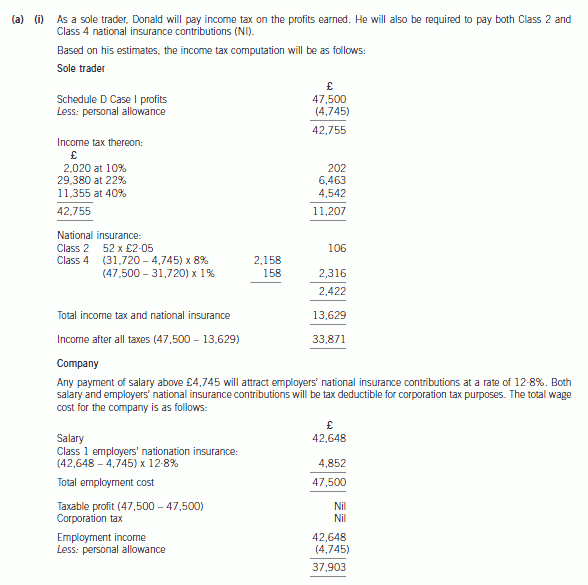
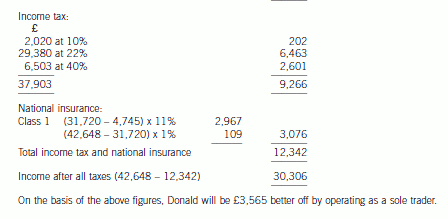
-
第4题:
John Pentanol was appointed as risk manager at H&Z Company a year ago and he decided that his first task was to examine the risks that faced the company. He concluded that the company faced three major risks, which he assessed by examining the impact that would occur if the risk were to materialise. He assessed Risk 1 as being of low potential impact as even if it materialised it would have little effect on the company’s strategy. Risk 2 was assessed as being of medium potential impact whilst a third risk, Risk 3, was assessed as being of very high potential impact.
When John realised the potential impact of Risk 3 materialising, he issued urgent advice to the board to withdraw from the activity that gave rise to Risk 3 being incurred. In the advice he said that the impact of Risk 3 was potentially enormous and it would be irresponsible for H&Z to continue to bear that risk.
The company commercial director, Jane Xylene, said that John Pentanol and his job at H&Z were unnecessary and that risk management was ‘very expensive for the benefits achieved’. She said that all risk managers do is to tell people what can’t be done and that they are pessimists by nature. She said she wanted to see entrepreneurial risk takers in H&Z and not risk managers who, she believed, tended to discourage enterprise.
John replied that it was his job to eliminate all of the highest risks at H&Z Company. He said that all risk was bad and needed to be eliminated if possible. If it couldn’t be eliminated, he said that it should be minimised.
(a) The risk manager has an important role to play in an organisation’s risk management.
Required:
(i) Describe the roles of a risk manager. (4 marks)
(ii) Assess John Pentanol’s understanding of his role. (4 marks)
(b) With reference to a risk assessment framework as appropriate, criticise John’s advice that H&Z should
withdraw from the activity that incurs Risk 3. (6 marks)
(c) Jane Xylene expressed a particular view about the value of risk management in H&Z Company. She also said that she wanted to see ‘entrepreneurial risk takers’.
Required:
(i) Define ‘entrepreneurial risk’ and explain why it is important to accept entrepreneurial risk in business
organisations; (4 marks)
(ii) Critically evaluate Jane Xylene’s view of risk management. (7 marks)
正确答案:(a) (i) Roles of a risk manager
Providing overall leadership, vision and direction, involving the establishment of risk management (RM) policies,
establishing RM systems etc. Seeking opportunities for improvement or tightening of systems.
Developing and promoting RM competences, systems, culture, procedures, protocols and patterns of behaviour. It is
important to understand that risk management is as much about instituting and embedding risk systems as much as
issuing written procedure. The systems must be capable of accurate risk assessment which seem not to be the case at
H&Z as he didn’t account for variables other than impact/hazard.
Reporting on the above to management and risk committee as appropriate. Reporting information should be in a form
able to be used for the generation of external reporting as necessary. John’s issuing of ‘advice’ will usually be less useful
than full reporting information containing all of the information necessary for management to decide on risk policy.Ensuring compliance with relevant codes, regulations, statutes, etc. This may be at national level (e.g. Sarbanes Oxley)
or it may be industry specific. Banks, oil, mining and some parts of the tourism industry, for example, all have internal
risk rules that risk managers are required to comply with.
[Tutorial note: do not reward bullet lists. Study texts both use lists but question says ‘describe’.]
(ii) John Pentanol’s understanding of his role
John appears to misunderstand the role of a risk manager in four ways.
Whereas the establishment of RM policies is usually the most important first step in risk management, John launched
straight into detailed risk assessments (as he saw it). It is much more important, initially, to gain an understanding of
the business, its strategies, controls and risk exposures. The assessment comes once the policy has been put in place.
It is important for the risk manager to report fully on the risks in the organisation and John’s issuing of ‘advice’ will usually
be less useful than full reporting information. Full reporting would contain all of the information necessary for
management to decide on risk policy.
He told Jane Xylene that his role as risk manager involved eliminating ‘all of the highest risks at H&Z Company’ which
is an incorrect view. Jane Xylene was correct to say that entrepreneurial risk was important, for example.
The risk manager is an operational role in a company such as H&Z Company and it will usually be up to senior
management to decide on important matters such as withdrawal from risky activities. John was being presumptuous
and overstepping his role in issuing advice on withdrawal from Risk 3. It is his job to report on risks to senior
management and for them to make such decisions based on the information he provides.(b) Criticise John’s advice
The advice is based on an incomplete and flawed risk assessment. Most simple risk assessment frameworks comprise at least
two variables of which impact or hazard is only one. The other key variable is probability. Risk impact has to be weighed
against probability and the fact that a risk has a high potential impact does not mean the risk should be avoided as long as
the probability is within acceptable limits. It is the weighted combination of hazard/impact and probability that forms the basis
for meaningful risk assessment.
John appears to be very certain of his impact assessments but the case does not tell us on what information the assessment
is made. It is important to recognise that ‘hard’ data is very difficult to obtain on both impact and probability. Both measures
are often made with a degree of assumption and absolute measures such as John’s ranking of Risks 1, 2 and 3 are not as
straightforward as he suggests.
John also overlooks a key strategic reason for H&Z bearing the risks in the first place, which is the return achievable by the
bearing of risk. Every investment and business strategy carries a degree of risk and this must be weighed against the financial
return that can be expected by the bearing of the risk.
(c) (i) Define ‘entrepreneurial risk’
Entrepreneurial risk is the necessary risk associated with any new business venture or opportunity. It is most clearly seen
in entrepreneurial business activity, hence its name. In ‘Ansoff’ terms, entrepreneurial risk is expressed in terms of the
unknowns of the market/customer reception of a new venture or of product uncertainties, for example product design,
construction, etc. There is also entrepreneurial risk in uncertainties concerning the competences and skills of the
entrepreneurs themselves.
Entrepreneurial risk is necessary, as Jane Xylene suggested, because it is from taking these risks that business
opportunities arise. The fact that the opportunity may not be as hoped does not mean it should not be pursued. Any
new product, new market development or new activity is a potential source of entrepreneurial risk but these are also the
sources of future revenue streams and hence growth in company value.(ii) Critically evaluate Jane Xylene’s view of risk management
There are a number of arguments against risk management in general. These arguments apply against the totality of risk
management and also of the employment of inappropriate risk measures.
There is a cost associated with all elements of risk management which must obviously be borne by the company.
Disruption to normal organisational practices and procedures as risk systems are complied with.
Slowing (introducing friction to) the seizing of new business opportunities or the development of internal systems as they
are scrutinised for risk.
‘STOP’ errors can occur as a result of risk management systems where a practice or opportunity has been stopped on
the grounds of its risk when it should have been allowed to proceed. This may be the case with Risk 3 in the case.
(Contrast with ‘GO’ errors which are the opposite of STOP errors.)
There are also arguments for risk management people and systems in H&Z. The most obvious benefit is that an effective
risk system identifies those risks that could detract from the achievements of the company’s strategic objectives. In this
respect, it can prevent costly mistakes by advising against those actions that may lose the company value. It also has
the effect of reassuring investors and capital markets that the company is aware of and is in the process of managing
its risks. Where relevant, risk management is necessary for compliance with codes, listing rules or statutory instruments. -
第5题:
A: What do you do, Polly? B: I work for an IT company.()
参考答案: 正确
-
第6题:
We work in()same company.A.a
B.an
C.the
参考答案:C
-
第7题:
Not only _______ a promise, but he also kept it.
A、did he made
B、he made
C、did he make
D、he makes
正确答案:C
-
第8题:
He holds an important position in the company.( ),I don’t quite trust him.A.Thus
B.Furthermore
C.Otherwise
D.Nevertheless答案:D解析:本题考察连词,题目意为“他在公司中担任重要位置,但是我并不太信任他。”A选项意为“因此,这样”,B选项意为“此外,而且”,C选项意为“否则”,D选项意为“然而”。根据句意,D选项意思正确,强调转折的含义。
-
第9题:
You are the network administrator for Company. A user named Peter runs Windows 2000 Professional on his portable computer. Peter wants to be able to work at home with files that were created in the office on Company’s network. He mapsdrive X to a shared network folder and configures it to reconnect when he logs on to the network. Before Peter logs off the network and leaves the office, he attempts to make drive X available offline. Peter calls you and reports that he does not have the option to make his shared folder available offline. Peter needs to have the files in drive X available offline. What should you instructs Peter to do?()
- A、Ensure that NetBIOS over TCP/IP is enabled on the network server.
- B、Enable Offline Files on the portable computer.
- C、Create an Offline File synchronization schedule.
- D、Create a shortcut to the Offline Files folder.
正确答案:B -
第10题:
单选题—He hasn’t watched the movie So Young, has he?— ______ . He told me it’s very moving and interesting, he’d like to watch it again.AYes, he has
BYes, he hasn’t
CNo, he hasn’t
DNo, he has
正确答案: C解析:
考查反意疑问句的答语。根据回答可知,他看过这个电影。所以用肯定回答,选择A意为“不,他看过”。 -
第11题:
问答题Practice 7 ● Alice Cather, a friend of yours, is going to Birmingham for a year and is looking for a job. This is background information: Education and qualification: 1990—1994, Marketing/Boston university. Working experience: 1994—1996: Salesman/Smith company. 1996-now: Marketing Manager. ● Use the information given above to write a letter to a British businessman you know. Ask him if he can help Alice find a job in Birmingham. (60-80words)正确答案: 【参考范文】
June 4, 2008
Dear Mrs. Lewis,
Alice Cather is one of my old friends, and l would like you to observe closely his education and his working experience. He was an outstanding college student from Boston University, and he majored in marketing. After his graduation, he worked for Smith Company as a salesman with his excellent work records; in l996 he was promoted to be marketing manager. His character is beyond question.
Could you please help him find a job during his stay in Birmingham? Many thanks.
Yours sincerely
Cynthia porter解析: 暂无解析 -
第12题:
问答题根据写作要求,写出一篇作文。 You are Susan. Your company will hold an opening ceremony for a new factory. You are asked to write an invitation letter to David, an important client of your company. The following information should he included:the reasons to invite him; the time for the event;the place for the event;early reply expected.正确答案: Dear David:
It would give us great pleasure to have your presence at the opening ceremony for a new factory. scheduled for 2017.11.20, at the factory.
Your presence would contribute greatly to the success of the ceremony. please let me know as soon as possible if you can come.
Your sincerely lizixian解析: 暂无解析 -
第13题:
替牙he期间上下牙弓的咬合关系发展由()。
A.中性he关系→近中he关系
B.远中he关系→中性he关系
C.近中he关系→中性he关系
D.中性he关系→远中he关系
E.持续中性he关系
【答案】B -
第14题:
(c) Define ‘retirement by rotation’ and explain its importance in the context of Rosh and Company.
(5 marks)
正确答案:
(c) Retirement by rotation.
Definition
Retirement by rotation is an arrangement in a director’s contract that specifies his or her contract to be limited to a specific
period (typically three years) after which he or she must retire from the board or offer himself (being eligible) for re-election.
The director must be actively re-elected back onto the board to serve another term. The default is that the director retires
unless re-elected.
Importance of
Retirement by rotation reduces the cost of contract termination for underperforming directors. They can simply not be
re-elected after their term of office expires and they will be required to leave the service of the board as a retiree (depending
on contract terms).
It encourages directors’ performance (they know they are assessed by shareholders and reconsidered every three years) and
focuses their minds upon the importance of meeting objectives in line with shareholders’ aims.
It is an opportunity, over time, to replace the board membership whilst maintaining medium term stability of membership
(one or two at a time).
Applied to Rosh
Retirement by rotation would enable the board of Rosh to be changed over time. There is evidence that some directors may
have stayed longer than is ideal because of links with other board members going back many years. -
第15题:
(b) (i) Advise Benny of the income tax implications of the grant and exercise of the share options in Summer
Glow plc on the assumption that the share price on 1 September 2007 and on the day he exercises the
options is £3·35 per share. Explain why the share option scheme is not free from risk by reference to
the rules of the scheme and the circumstances surrounding the company. (4 marks)
正确答案:
(b) (i) The share options
There are no income tax implications on the grant of the share options.
In the tax year in which Benny exercises the options and acquires the shares, the excess of the market value of the
shares over the price paid, i.e. £11,500 ((£3·35 – £2·20) x 10,000) will be subject to income tax.
Benny’s financial exposure is caused by the rule within the share option scheme obliging him to hold the shares for a
year before he can sell them. If the company’s expansion into Eastern Europe fails, such that its share price
subsequently falls to less than £2·20 before Benny has the chance to sell the shares, Benny’s financial position may be
summarised as follows:
– Benny will have paid £22,000 (£2·20 x 10,000) for shares which are now worth less than that.
– He will also have paid income tax of £4,600 (£11,500 x 40%). -
第16题:
___ will Mr. Green be able to regain control of the company.A.With hard work
B.In spite of his hard work
C.Only if he works hardly
D.Only with hard work
正确答案:D
-
第17题:
The employee requires that he____the right to know the situation of the company.A)have
B)has
C)having
D)had
参考答案:A
-
第18题:
There are ____ employees and several employers in the company.Aa thousand of
Bthousand
Cthousands of
Dthousands
正确答案:C
-
第19题:
共用题干
How Men Face the Fat Problem
It is a pleasure to see men of a certain age worrying about their weight. Listening to them is not such a pleasure.Because the men are new at the game,they don't hesitate to discuss the fat problem incessantly. However,women of the same age do not discuss the fat problem,especially not in mixed company. They prefer to face the problem with quiet dignity.Discussing the problem might only draw attention to some stray body part that may be successfully tucked away under an article of clothing.
The age at which a man begins to explore the fat problem can vary.The actual problem can manifest itself in the early 30's,but broad-range discussion usually starts later. There are early nonverbal symptoms.I've watched the rugged journalist who shares my apartment sneak by with a Diet Coke.His shirts are no longer neatly tucked in to display a trim waist. Recently he has begun to verbalize his anxiety.He tells me,with a sheepish幼n,that he is taking his suits to Chinatown to have them"tailored."
Still-older men have lost their dignity and rattle on unabashedly. Often,wives and children play important roles in their fat-inspection rituals.Take my oldest brother,a former college football player. His daughter says that several times a day he will stand at attention and call out,"Fat,medium or thin?"She knows the correct answer:medium. Thin would be an obvious stretch,and fat may not get her that new video.According to his wife,he stands in front of the mirror in the morning (before the day's meals take their toll),puts his hands behind his head and lurches into a side bend,then clutches the roll that has developed and says,"Am I getting fatter?"His wife is expected to answer,"You look like you may have lost a few pounds."
And then there are the ex-husbands,a pitiful group.They are extremely vocal.When I go to the movies with one,he confides that he is suffering from great hunger because he is dieting.He hasn't eaten since the pancakes and sausages he wolfed down that morning. He pauses in his monologue while he buys his popcorn.After the movie,we sprint to a restaurant,where he again pauses to devour a basket of bread.Before he orders his chaste salad and soup,he grows plaintive.Do I think he's fat?The journalist used to drink Diet Coke and tuck his shirts in order to keep trim.
A:Right
B:Wrong
C:Not mentioned答案:B解析:本题给出的信息是错误的。原文是第二段的第一、二句:"The age at which a man begins to explore the fat problem can vary.The actual problem can manifest itself in the early 30's,but broad-range discussion usually starts later.”这两句话说明男士开始讨论肥胖问题的时间并不一致。
本题给出的信息是正确的。原文是第一段的第四句:"However, women of the same age do not discuss the fat problem,especially not in mixed company."
文章没有谈到这方面的信息。
本题给出的信息是错误的。原文是第二段的第四、五句:"I've watched the rugged journalist who shares my apartment sneak by with a Diet Coke.His shirts are no longer neatly tucked in to display a trim waist."
本题给出的信息是正确的。从作者下文描述的大哥的例子可以证明此信息是正确的。
本题给出的信息是错误的。原文是第三段的第五、六句:"She knows the correct answer:medium.Thin would be an obvious stretch,and fat may not get her that new video."
文章没有谈到这方面的信息。 -
第20题:
As an experienced technician, you are responsible for Technical Support in your company. One of the trainees is asking you in what might happen if he issues the logging trap information command. Which of the following statement will answer his quest|on?()
- A、Informational and debug messages are logged to the syslog server.
- B、All messages are sent to the logging host, where selections are made.
- C、An information trap is sent to the SNMP server.
- D、All messages from emergencies to informational are sent to the logging host.
正确答案:D -
第21题:
单选题_____ today, he would get there by Friday.AWas he leaving
BIf he is leaving
CWere he to leave
DIf he leaves
正确答案: C解析:
句意:如果他今天出发的话,那么周五就应该到了。这是考查倒装虚拟语气。原来顺序是:If he were to leave today,表示对将要发生动作的虚拟,用过去将来时。 -
第22题:
问答题Practice 4 ● Mr. White is going to order a large amount of commercial computers from your company. He also shows an interest in your company’s electrostatic copier, which is in the charge of Mr. Blair, your colleague. Mr. White would like to bring 8 samples and some specifications back home to make a trial sale. ● Write a note to Mr. Blair, one of your colleagues. ● Telling him the fact that Mr. White is interested in electrostatic copier. ● Mentioning the number he wants to have. ● Suggesting their direct contact. ● Write 30-40 words on your answer sheet.正确答案: 【参考范文】
Dear Mr. Blair,
Mr. White, one of my regular customers, expresses his interest in our electrostatic copier. He wants to take 8 samples and some specifications back home to make a trial marketing. You may contact him directly on 2107316.解析: 暂无解析 -
第23题:
填空题Your daughter is (luck) ____ enough to have large company.正确答案: lucky解析:
本题考查形容词用法。句意:我女儿非常荣幸地被这家大公司录用了。enough既可以用来修饰名词也可以修饰形容词。enough修饰名词时,置于名词前面;修饰形容词时,置于形容词的后面。此处应该填lucky。 -
第24题:
问答题Practice 2 ● You are the General Manager of the Northern Shanghai Import and Export Company. You have arranged to visit a branch office in Luen Wu next week. However, an important client from Hong Kong has just written to tell you that he will be visiting Shanghai next week and would like to meet you for discussions. He says that this is the only time he will be visiting Shanghai during the year, and you know that it is very important for you to see him. ● Write a fax to the manager of the branch office in Luen Wu. ● Tell him or her about the client’s visit. ● Explain why it is important for you to see the Hong Kong client. ● Re-arrange the date of your visit to Luen Wu. ●Write 60-80 words.正确答案: 【参考范文】
Fax to Jack, manager of the branch office in Luen Wu
Dear Jack,
I’ve just received a letter from an important client form Hong Kong, and the letter says he will visit Shanghai next week. We need to meet to discuss some business, and since he cannot re-arrange his visit, I am wondering if we delay my visit to your office until the week concerning 5 October?
Tom Smith解析: 暂无解析