
单选题An American manufacturer of space heaters reported a 1994 fourth-quarter net income (total income minus total costs) of $41 million, compared with $28.3 million in the fourth quarter of 1993. This increase was realized despite a drop in U.S. domestic r
题目
In the fourth quarter of 1994, the manufacturer paid its assembly-line workers no salaries in November or December because of a two-month-long strike, but the company had a sufficient stock of space-heating units on hand to supply its distributors.
In 1993, because of unusually cold weather in the Northeast, the federal government authorized the diversion of emergency funding for purchasing space-heating units to be used in the hardest. hit areas.
Foreign manufacturers of space heaters reported improved fourth-quarter sales in the American market compared with their sales in 1993.
During the fourth quarter of 1994, the manufacturer announced that it would introduce an extra-high-capacity space heater in the following quarter.
In the third quarter of 1994, a leading consumer magazine advocated space heaters as a cost-effective way to heat spaces of less than 100 square feet.
相似考题
参考答案和解析
利润的上升可能是由于销售的增加或是成本的减少,A项反映的是公司成本的减少,故本题应选A项。
更多“单选题An American manufacturer of space heaters reported a 1994 fourth-quarter net income (total income minus total costs) of $41 million, compared with $28.3 million in the fourth quarter of 1993. This increase was realized despite a drop in U.S. domestic r”相关问题
-
第1题:
(b) One of the hotels owned by Norman is a hotel complex which includes a theme park, a casino and a golf course,
as well as a hotel. The theme park, casino, and hotel were sold in the year ended 31 May 2008 to Conquest, a
public limited company, for $200 million but the sale agreement stated that Norman would continue to operate
and manage the three businesses for their remaining useful life of 15 years. The residual interest in the business
reverts back to Norman after the 15 year period. Norman would receive 75% of the net profit of the businesses
as operator fees and Conquest would receive the remaining 25%. Norman has guaranteed to Conquest that the
net minimum profit paid to Conquest would not be less than $15 million. (4 marks)
Norman has recently started issuing vouchers to customers when they stay in its hotels. The vouchers entitle the
customers to a $30 discount on a subsequent room booking within three months of their stay. Historical
experience has shown that only one in five vouchers are redeemed by the customer. At the company’s year end
of 31 May 2008, it is estimated that there are vouchers worth $20 million which are eligible for discount. The
income from room sales for the year is $300 million and Norman is unsure how to report the income from room
sales in the financial statements. (4 marks)
Norman has obtained a significant amount of grant income for the development of hotels in Europe. The grants
have been received from government bodies and relate to the size of the hotel which has been built by the grant
assistance. The intention of the grant income was to create jobs in areas where there was significant
unemployment. The grants received of $70 million will have to be repaid if the cost of building the hotels is less
than $500 million. (4 marks)
Appropriateness and quality of discussion (2 marks)
Required:
Discuss how the above income would be treated in the financial statements of Norman for the year ended
31 May 2008.
正确答案:
(b) Property is sometimes sold with a degree of continuing involvement by the seller so that the risks and rewards of ownership
have not been transferred. The nature and extent of the buyer’s involvement will determine how the transaction is accounted
for. The substance of the transaction is determined by looking at the transaction as a whole and IAS18 ‘Revenue’ requires
this by stating that where two or more transactions are linked, they should be treated as a single transaction in order to
understand the commercial effect (IAS18 paragraph 13). In the case of the sale of the hotel, theme park and casino, Norman
should not recognise a sale as the company continues to enjoy substantially all of the risks and rewards of the businesses,
and still operates and manages them. Additionally the residual interest in the business reverts back to Norman. Also Norman
has guaranteed the income level for the purchaser as the minimum payment to Conquest will be $15 million a year. The
transaction is in substance a financing arrangement and the proceeds should be treated as a loan and the payment of profits
as interest.
The principles of IAS18 and IFRIC13 ‘Customer Loyalty Programmes’ require that revenue in respect of each separate
component of a transaction is measured at its fair value. Where vouchers are issued as part of a sales transaction and are
redeemable against future purchases, revenue should be reported at the amount of the consideration received/receivable less
the voucher’s fair value. In substance, the customer is purchasing both goods or services and a voucher. The fair value of the
voucher is determined by reference to the value to the holder and not the cost to the issuer. Factors to be taken into account
when estimating the fair value, would be the discount the customer obtains, the percentage of vouchers that would be
redeemed, and the time value of money. As only one in five vouchers are redeemed, then effectively the hotel has sold goods
worth ($300 + $4) million, i.e. $304 million for a consideration of $300 million. Thus allocating the discount between the
two elements would mean that (300 ÷ 304 x $300m) i.e. $296·1 million will be allocated to the room sales and the balance
of $3·9 million to the vouchers. The deferred portion of the proceeds is only recognised when the obligations are fulfilled.
The recognition of government grants is covered by IAS20 ‘Accounting for government grants and disclosure of government
assistance’. The accruals concept is used by the standard to match the grant received with the related costs. The relationship
between the grant and the related expenditure is the key to establishing the accounting treatment. Grants should not be
recognised until there is reasonable assurance that the company can comply with the conditions relating to their receipt and
the grant will be received. Provision should be made if it appears that the grant may have to be repaid.
There may be difficulties of matching costs and revenues when the terms of the grant do not specify precisely the expense
towards which the grant contributes. In this case the grant appears to relate to both the building of hotels and the creation of
employment. However, if the grant was related to revenue expenditure, then the terms would have been related to payroll or
a fixed amount per job created. Hence it would appear that the grant is capital based and should be matched against the
depreciation of the hotels by using a deferred income approach or deducting the grant from the carrying value of the asset
(IAS20). Additionally the grant is only to be repaid if the cost of the hotel is less than $500 million which itself would seem
to indicate that the grant is capital based. If the company feels that the cost will not reach $500 million, a provision should
be made for the estimated liability if the grant has been recognised. -
第2题:
(b) (i) Explain, by reference to Coral’s residence, ordinary residence and domicile position, how the rental
income arising in respect of the property in the country of Kalania will be taxed in the UK in the tax year
2007/08. State the strategy that Coral should adopt in order to minimise the total income tax suffered
on the rental income. (7 marks)
正确答案:
(b) (i) UK tax on the rental income
Coral is UK resident in 2007/08 because she is present in the UK for more than 182 days. Accordingly, she will be
subject to UK income tax on her Kalanian rental income.
Coral is ordinarily resident in the UK in 2007/08 as she is habitually resident in the UK.
Coral will have acquired a domicile of origin in Kalania from her father. She has not acquired a domicile of choice in the
UK as she has not severed her ties with Kalania and does not intend to make her permanent home in the UK.
Accordingly, the rental income will be taxed in the UK on the remittance basis.
Any rental income remitted to the UK will fall into the basic rate band and will be subject to income tax at 22% on the
gross amount (before deduction of Kalanian tax). Unilateral double tax relief will be available in respect of the 8% tax
suffered in Kalania such that the effective rate of tax suffered by Coral in the UK on the grossed up amount of income
remitted will be 14%.
In order to minimise the total income tax suffered on the rental income Coral should ensure that it is not brought into or
used in the UK such that it will not be subject to income tax in the UK.
Coral should retain evidence, for example bank statements, to show that the rental income has not been removed from
Kalania. Coral can use the money whilst she is on holiday in Kalania with no UK tax implications. -
第3题:
3 You are the manager responsible for the audit of Lamont Co. The company’s principal activity is wholesaling frozen
fish. The draft consolidated financial statements for the year ended 31 March 2007 show revenue of $67·0 million
(2006 – $62·3 million), profit before taxation of $11·9 million (2006 – $14·2 million) and total assets of
$48·0 million (2006 – $36·4 million).
The following issues arising during the final audit have been noted on a schedule of points for your attention:
(a) In early 2007 a chemical leakage from refrigeration units owned by Lamont caused contamination of some of its
property. Lamont has incurred $0·3 million in clean up costs, $0·6 million in modernisation of the units to
prevent future leakage and a $30,000 fine to a regulatory agency. Apart from the fine, which has been expensed,
these costs have been capitalised as improvements. (7 marks)
Required:
For each of the above issues:
(i) comment on the matters that you should consider; and
(ii) state the audit evidence that you should expect to find,
in undertaking your review of the audit working papers and financial statements of Lamont Co for the year ended
31 March 2007.
NOTE: The mark allocation is shown against each of the three issues.
正确答案:
3 LAMONT CO
(a) Chemical leakage
(i) Matters
■ $30,000 fine is very immaterial (just 1/4% profit before tax). This is revenue expenditure and it is correct that it
has been expensed to the income statement.
■ $0·3 million represents 0·6% total assets and 2·5% profit before tax and is not material on its own. $0·6 million
represents 1·2% total assets and 5% profit before tax and is therefore material to the financial statements.
■ The $0·3 million clean-up costs should not have been capitalised as the condition of the property is not improved
as compared with its condition before the leakage occurred. Although not material in isolation this amount should
be adjusted for and expensed, thereby reducing the aggregate of uncorrected misstatements.
■ It may be correct that $0·6 million incurred in modernising the refrigeration units should be capitalised as a major
overhaul (IAS 16 Property, Plant and Equipment). However, any parts scrapped as a result of the modernisation
should be treated as disposals (i.e. written off to the income statement).
■ The carrying amount of the refrigeration units at 31 March 2007, including the $0·6 million for modernisation,
should not exceed recoverable amount (i.e. the higher of value in use and fair value less costs to sell). If it does,
an allowance for the impairment loss arising must be recognised in accordance with IAS 36 Impairment of Assets.
(ii) Audit evidence
■ A breakdown/analysis of costs incurred on the clean-up and modernisation amounting to $0·3 million and
$0·6 million respectively.
■ Agreement of largest amounts to invoices from suppliers/consultants/sub-contractors, etc and settlement thereof
traced from the cash book to the bank statement.
■ Physical inspection of the refrigeration units to confirm their modernisation and that they are in working order. (Do
they contain frozen fish?)
■ Sample of components selected from the non-current asset register traced to the refrigeration units and inspected
to ensure continuing existence.
■ $30,000 penalty notice from the regulatory agency and corresponding cash book payment/payment per the bank
statement.
■ Written management representation that there are no further penalties that should be provided for or disclosed other
than the $30,000 that has been accounted for. -
第4题:
(b) You are the manager responsible for the audit of Poppy Co, a manufacturing company with a year ended
31 October 2008. In the last year, several investment properties have been purchased to utilise surplus funds
and to provide rental income. The properties have been revalued at the year end in accordance with IAS 40
Investment Property, they are recognised on the statement of financial position at a fair value of $8 million, and
the total assets of Poppy Co are $160 million at 31 October 2008. An external valuer has been used to provide
the fair value for each property.
Required:
(i) Recommend the enquiries to be made in respect of the external valuer, before placing any reliance on their
work, and explain the reason for the enquiries; (7 marks)
正确答案:
(b) (i) Enquiries in respect of the external valuer
Enquiries would need to be made for two main reasons, firstly to determine the competence, and secondly the objectivity
of the valuer. ISA 620 Using the Work of an Expert contains guidance in this area.
Competence
Enquiries could include:
– Is the valuer a member of a recognised professional body, for example a nationally or internationally recognised
institute of registered surveyors?
– Does the valuer possess any necessary licence to carry out valuations for companies?
– How long has the valuer been a member of the recognised body, or how long has the valuer been licensed under
that body?
– How much experience does the valuer have in providing valuations of the particular type of investment properties
held by Poppy Co?
– Does the valuer have specific experience of evaluating properties for the purpose of including their fair value within
the financial statements?
– Is there any evidence of the reputation of the valuer, e.g. professional references, recommendations from other
companies for which a valuation service has been provided?
– How much experience, if any, does the valuer have with Poppy Co?
Using the above enquiries, the auditor is trying to form. an opinion as to the relevance and reliability of the valuation
provided. ISA 500 Audit Evidence requires that the auditor gathers evidence that is both sufficient and appropriate. The
auditor needs to ensure that the fair values provided by the valuer for inclusion in the financial statements have been
arrived at using appropriate knowledge and skill which should be evidenced by the valuer being a member of a
professional body, and, if necessary, holding a licence under that body.
It is important that the fair values have been arrived at using methods allowed under IAS 40 Investment Property. If any
other valuation method has been used then the value recognised in the statement of financial position may not be in
accordance with financial reporting standards. Thus it is important to understand whether the valuer has experience
specifically in providing valuations that comply with IAS 40, and how many times the valuer has appraised properties
similar to those owned by Poppy Co.
In gauging the reliability of the fair value, the auditor may wish to consider how Poppy Co decided to appoint this
particular valuer, e.g. on the basis of a recommendation or after receiving references from companies for which
valuations had previously been provided.
It will also be important to consider how familiar the valuer is with Poppy Co’s business and environment, as a way to
assess the reliability and appropriateness of any assumptions used in the valuation technique.
Objectivity
Enquiries could include:
– Does the valuer have any financial interest in Poppy Co, e.g. shares held directly or indirectly in the company?
– Does the valuer have any personal relationship with any director or employee of Poppy Co?
– Is the fee paid for the valuation service reasonable and a fair, market based price?
With these enquiries, the auditor is gaining assurance that the valuer will perform. the valuation from an independent
point of view. If the valuer had a financial interest in Poppy Co, there would be incentive to manipulate the valuation in
a way best suited to the financial statements of the company. Equally if the valuer had a personal relationship with a
senior member of staff at Poppy Co, the valuer may feel pressured to give a favourable opinion on the valuation of the
properties.
The level of fee paid is important. It should be commensurate with the market rate paid for this type of valuation. If the
valuer was paid in excess of what might be considered a normal fee, it could indicate that the valuer was encouraged,
or even bribed, to provide a favourable valuation. -
第5题:
Net income had the year-over-year decrease due to a net loss in its investment income.()此题为判断题(对,错)。
参考答案:对
-
第6题:
From the functional income statement we can see clearly the total revenue, total cost and the gross profit etc.
A.Right
B.Wrong
C.Doesn't say
正确答案:C
解析:文中只说it shows revenues less cost of goods sold (gross margin) less selling and administrative expenses,并没有说能看到"the total revenue, total cost"。 -
第7题:
In 2011, the total value of goods sold on eBay was $68.6 million-more than $2,100 every second。()此题为判断题(对,错)。
参考答案:√
-
第8题:
In 2014 Mr Yuan inherited an estate of RMB2 million from his uncle who had died two months earlier.
What is the correct treatment of the estate income for individual income tax purposes?
A.The estate income is not taxable
B.The estate income will be taxed as occasional (ad hoc) income
C.The estate income will be taxed as other income
D.The estate income will be taxed as service income
正确答案:A
-
第9题:
Income Income may be national income and personal income. Whereas national income is defined as the total earned income of all the factors of production-namely, profits, interest, rent, wages, and other compensation for labor, personal income may be defined as total money income received by individuals before personal taxes are paid. National income does not equal GNP (Gross National Product) because the factors of production do not receive payment for either capital consumption allowances or indirect business taxes, both of which are included in GNP. The money put aside for capital consumption is for replacement and thus is not counted as income. Indirect taxes include sales taxes, property taxes , and excise taxes that are paid by businesses directly to the government and so reduce the income left to pay for the factors of production. Three-fourths of national income goes for wages, salaries, and other forms of compensation to employees. Whereas national income shows the income that the factors of production earn, personal income measures the income that individuals or households receive. Corporation profits are included in national income because they are earned. Out of these profits, however, corporation profit taxes must be paid to the government, and some money must be put into the business for expansion. Only that part of profits distributed as dividends goes to the individual; therefore, out of corporation profits only dividends count as personal income. The factors of production earn money for social security and unemployment insurance contributions, but this money goes to government (which is not a factor of production), not to individuals. It is therefore part of national income but not part of personal income. On the other hand, money received by individuals when they collect social security or unemployment compensation is not money earned but money received. Interest received on government bonds is also in this category, because much of the money received from the sale of bonds went to pay for war production and that production no longer furnishes a service to the economy. The money people receive as personal income may be either spent or saved. However, not all spending is completely voluntary. A significant portion of our income goes to pay personal taxes. Most workers never receive the money they pay in personal taxes, because it is withheld from their paychecks. The money that individuals are left with after they have met their tax obligations is disposable personal income. Disposable income can be divided between personal consumption expenditures and personal savings. It is important to remember that personal saving is what is left after spending. Which of the following statements is true according to the first paragraph?()
- A、GNP equals national income plus indirect business taxes.
- B、GNP excludes both capital consumption allowances and indirect business taxes.
- C、Personal income is regarded as the total money income received by an individual after his or her taxes are paid.
- D、The money that goes for capital consumption is not regarded as income.
正确答案:D -
第10题:
单选题Mortgage and other financing income decreased $8.8 million to $18.8 for the year ended December 31, 2006.The income in 2006 was reducedAto $ 8.8 million.
Bto $18.8 million.
Cfrom $18.8 million to $8.8 million.
正确答案: A解析:
正确理解“decrease…”和“decrease to…”是本题解题的关键。前者的意思是“减少了…”,后者的意思是“减少到…”。根据原文可以知道“截止到2006年12月31日,抵押借款和其他融资收益减少了880万美元,是1880万美元”。所以,选项B正确。 -
第11题:
单选题Income Income may be national income and personal income. Whereas national income is defined as the total earned income of all the factors of production-namely, profits, interest, rent, wages, and other compensation for labor, personal income may be defined as total money income received by individuals before personal taxes are paid. National income does not equal GNP (Gross National Product) because the factors of production do not receive payment for either capital consumption allowances or indirect business taxes, both of which are included in GNP. The money put aside for capital consumption is for replacement and thus is not counted as income. Indirect taxes include sales taxes, property taxes , and excise taxes that are paid by businesses directly to the government and so reduce the income left to pay for the factors of production. Three-fourths of national income goes for wages, salaries, and other forms of compensation to employees. Whereas national income shows the income that the factors of production earn, personal income measures the income that individuals or households receive. Corporation profits are included in national income because they are earned. Out of these profits, however, corporation profit taxes must be paid to the government, and some money must be put into the business for expansion. Only that part of profits distributed as dividends goes to the individual; therefore, out of corporation profits only dividends count as personal income. The factors of production earn money for social security and unemployment insurance contributions, but this money goes to government (which is not a factor of production), not to individuals. It is therefore part of national income but not part of personal income. On the other hand, money received by individuals when they collect social security or unemployment compensation is not money earned but money received. Interest received on government bonds is also in this category, because much of the money received from the sale of bonds went to pay for war production and that production no longer furnishes a service to the economy. The money people receive as personal income may be either spent or saved. However, not all spending is completely voluntary. A significant portion of our income goes to pay personal taxes. Most workers never receive the money they pay in personal taxes, because it is withheld from their paychecks. The money that individuals are left with after they have met their tax obligations is disposable personal income. Disposable income can be divided between personal consumption expenditures and personal savings. It is important to remember that personal saving is what is left after spending. Which of the following statements is true according to the first paragraph?()AGNP equals national income plus indirect business taxes.
BGNP excludes both capital consumption allowances and indirect business taxes.
CPersonal income is regarded as the total money income received by an individual after his or her taxes are paid.
DThe money that goes for capital consumption is not regarded as income.
正确答案: B解析: 本题的依据是第一段的The money put aside for capital consumption is for replacement and thus is not counted as income 这个句子。对原句的词语选项D用了别的表达方法,但大意仍保持不变。答案为D。 -
第12题:
填空题Last year, customers (buy) ____ a total of 90 million iPods and 2 billion songs from the iTunes store.正确答案: bought解析:
本题考查时态的用法。句意:去年顾客们从iTunes商店买了9千万个iPod播放器以及20亿首歌。last year为时间标志词,说明此处要用动词buy的一般过去时态bought。 -
第13题:
(b) Compute Gloria’s total income tax and national insurance liability for 2006/07. (7 marks)
正确答案: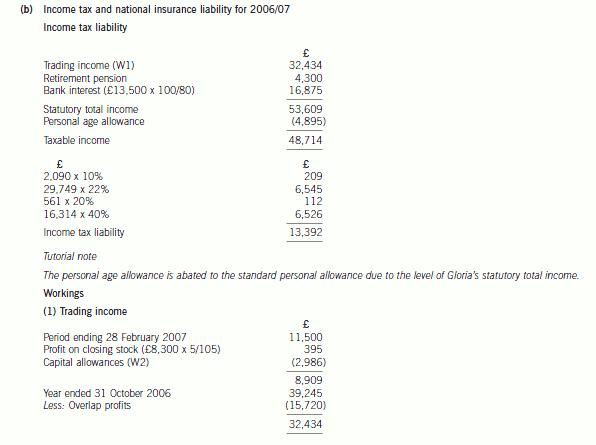
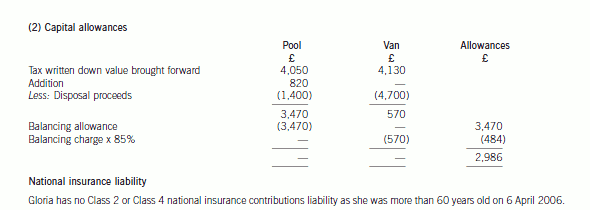
-
第14题:
3 You are the manager responsible for the audit of Keffler Co, a private limited company engaged in the manufacture of
plastic products. The draft financial statements for the year ended 31 March 2006 show revenue of $47·4 million
(2005 – $43·9 million), profit before taxation of $2 million (2005 – $2·4 million) and total assets of $33·8 million
(2005 – $25·7 million).
The following issues arising during the final audit have been noted on a schedule of points for your attention:
(a) In April 2005, Keffler bought the right to use a landfill site for a period of 15 years for $1·1 million. Keffler
expects that the amount of waste that it will need to dump will increase annually and that the site will be
completely filled after just ten years. Keffler has charged the following amounts to the income statement for the
year to 31 March 2006:
– $20,000 licence amortisation calculated on a sum-of-digits basis to increase the charge over the useful life
of the site; and
– $100,000 annual provision for restoring the land in 15 years’ time. (9 marks)
Required:
For each of the above issues:
(i) comment on the matters that you should consider; and
(ii) state the audit evidence that you should expect to find,
in undertaking your review of the audit working papers and financial statements of Keffler Co for the year ended
31 March 2006.
NOTE: The mark allocation is shown against each of the three issues.
正确答案:
3 KEFFLER CO
Tutorial note: None of the issues have any bearing on revenue. Therefore any materiality calculations assessed on revenue are
inappropriate and will not be awarded marks.
(a) Landfill site
(i) Matters
■ $1·1m cost of the right represents 3·3% of total assets and is therefore material.
■ The right should be amortised over its useful life, that is just 10 years, rather than the 15-year period for which
the right has been granted.
Tutorial note: Recalculation on the stated basis (see audit evidence) shows that a 10-year amortisation has been
correctly used.
■ The amortisation charge represents 1% of profit before tax (PBT) and is not material.
■ The amortisation method used should reflect the pattern in which the future economic benefits of the right are
expected to be consumed by Keffler. If that pattern cannot be determined reliably, the straight-line method must
be used (IAS 38 ‘Intangible Assets’).
■ Using an increasing sum-of-digits will ‘end-load’ the amortisation charge (i.e. least charge in the first year, highest
charge in the last year). However, according to IAS 38 there is rarely, if ever, persuasive evidence to support an
amortisation method that results in accumulated amortisation lower than that under the straight-line method.
Tutorial note: Over the first half of the asset’s life, depreciation will be lower than under the straight-line basis
(and higher over the second half of the asset’s life).
■ On a straight line basis the annual amortisation charge would be $0·11m, an increase of $90,000. Although this
difference is just below materiality (4·5% PBT) the cumulative effect (of undercharging amortisation) will become
material.
■ Also, when account is taken of the understatement of cost (see below), the undercharging of amortisation will be
material.
■ The sum-of-digits method might be suitable as an approximation to the unit-of-production method if Keffler has
evidence to show that use of the landfill site will increase annually.
■ However, in the absence of such evidence, the audit opinion should be qualified ‘except for’ disagreement with the
amortisation method (resulting in intangible asset overstatement/amortisation expense understatement).
■ The annual restoration provision represents 5% of PBT and 0·3% of total assets. Although this is only borderline
material (in terms of profit), there will be a cumulative impact.
■ Annual provisioning is contrary to IAS 37 ‘Provisions, Contingent Liabilities and Contingent Assets’.
■ The estimate of the future restoration cost is (presumably) $1·5m (i.e. $0·1 × 15). The present value of this
amount should have been provided in full in the current year and included in the cost of the right.
■ Thus the amortisation being charged on the cost of the right (including the restoration cost) is currently understated
(on any basis).
Tutorial note: A 15-year discount factor at 10% (say) is 0·239. $1·5m × 0·239 is approximately $0·36m. The
resulting present value (of the future cost) would be added to the cost of the right. Amortisation over 10 years
on a straight-line basis would then be increased by $36,000, increasing the difference between amortisation
charged and that which should be charged. The lower the discount rate, the greater the understatement of
amortisation expense.
Total amount expensed ($120k) is less than what should have been expensed (say $146k amortisation + $36k
unwinding of discount). However, this is not material.
■ Whether Keffler will wait until the right is about to expire before restoring the land or might restore earlier (if the
site is completely filled in 10 years).
(ii) Audit evidence
■ Written agreement for purchase of right and contractual terms therein (e.g. to make restoration in 15 years’ time).
■ Cash book/bank statement entries in April 2005 for $1·1m payment.
■ Physical inspection of the landfill site to confirm Keffler’s use of it.
■ Annual dump budget/projection over next 10 years and comparison with sum-of-digits proportions.
■ Amount actually dumped in the year (per dump records) compared with budget and as a percentage/proportion of
the total available.
■ Recalculation of current year’s amortisation based on sum-of-digits. That is, $1·1m ÷ 55 = $20,000.
Tutorial note: The sum-of-digits from 1 to 10 may be calculated long-hand or using the formula n(n+1)/2 i.e.
(10 × 11)/2 = 55.
■ The basis of the calculation of the estimated restoration costs and principal assumptions made.
■ If estimated by a quantity surveyor/other expert then a copy of the expert’s report.
■ Written management representation confirming the planned timing of the restoration in 15 years (or sooner). -
第15题:
(b) You are the audit manager of Petrie Co, a private company, that retails kitchen utensils. The draft financial
statements for the year ended 31 March 2007 show revenue $42·2 million (2006 – $41·8 million), profit before
taxation of $1·8 million (2006 – $2·2 million) and total assets of $30·7 million (2006 – $23·4 million).
You are currently reviewing two matters that have been left for your attention on Petrie’s audit working paper file
for the year ended 31 March 2007:
(i) Petrie’s management board decided to revalue properties for the year ended 31 March 2007 that had
previously all been measured at depreciated cost. At the balance sheet date three properties had been
revalued by a total of $1·7 million. Another nine properties have since been revalued by $5·4 million. The
remaining three properties are expected to be revalued later in 2007. (5 marks)
Required:
Identify and comment on the implications of these two matters for your auditor’s report on the financial
statements of Petrie Co for the year ended 31 March 2007.
NOTE: The mark allocation is shown against each of the matters above.
正确答案:
(b) Implications for auditor’s report
(i) Selective revaluation of premises
The revaluations are clearly material to the balance sheet as $1·7 million and $5·4 million represent 5·5% and 17·6%
of total assets, respectively (and 23·1% in total). As the effects of the revaluation on line items in the financial statements
are clearly identified (e.g. revalued amount, depreciation, surplus in statement of changes in equity) the matter is not
pervasive.
The valuations of the nine properties after the year end provide additional evidence of conditions existing at the year end
and are therefore adjusting events per IAS 10 Events After the Balance Sheet Date.
Tutorial note: It is ‘now’ still less than three months after the year end so these valuations can reasonably be expected
to reflect year end values.
However, IAS 16 Property, Plant and Equipment does not permit the selective revaluation of assets thus the whole class
of premises would need to have been revalued for the year to 31 March 2007 to change the measurement basis for this
reporting period.
The revaluation exercise is incomplete. Unless the remaining three properties are revalued before the auditor’s report on
the financial statements for the year ended 31 March 2007 is signed off:
(1) the $7·1 revaluation made so far must be reversed to show all premises at depreciated cost as in previous years;
OR
(2) the auditor’s report would be qualified ‘except for’ disagreement regarding non-compliance with IAS 16.
When it is appropriate to adopt the revaluation model (e.g. next year) the change in accounting policy (from a cost model
to a revaluation model) should be accounted for in accordance with IAS 16 (i.e. as a revaluation).
Tutorial note: IAS 8 Accounting Policies, Changes in Accounting Estimates and Errors does not apply to the initial
application of a policy to revalue assets in accordance with IAS 16.
Assuming the revaluation is written back, before giving an unmodified opinion, the auditor should consider why the three
properties were not revalued. In particular if there are any indicators of impairment (e.g. physical dilapidation) there
should be sufficient evidence on the working paper file to show that the carrying amount of these properties is not
materially greater than their recoverable amount (i.e. the higher of value in use and fair value less costs to sell).
If there is insufficient evidence to confirm that the three properties are not impaired (e.g. if the auditor was prevented
from inspecting the properties) the auditor’s report would be qualified ‘except for’ on grounds of limitation on scope.
If there is evidence of material impairment but management fail to write down the carrying amount to recoverable
amount the auditor’s report would be qualified ‘except for’ disagreement regarding non-compliance with IAS 36
Impairment of Assets.
-
第16题:
—() — In most cases, it is the total income received.A. What does taxable income refer to?
B. Why do you want to know taxable income?
C. When do you start to learn taxable income?
参考答案:A
-
第17题:
The other main source of revenue for a bank is fee income, or called ______ income.
A.interest
B.commission
C.service
D.net
正确答案:B
解析:句意:银行另一项主要收人来源于手续费。fee income-和commission income都指手续费,是银行不需要动用自己资金获得的收入,是与利息不同的一种收入来源。 -
第18题:
Merchandise inventory at the end of the year was understated. Which of the following statements correctly states the effect of the error.()A.net income is understated
B.net income is overstated
C.merchandise inventory reported on the balance sheet is overstated
D.cost of merchandise sold is understated
正确答案:A
-
第19题:
The following trial balance relates to Sandown at 30 September 2009:
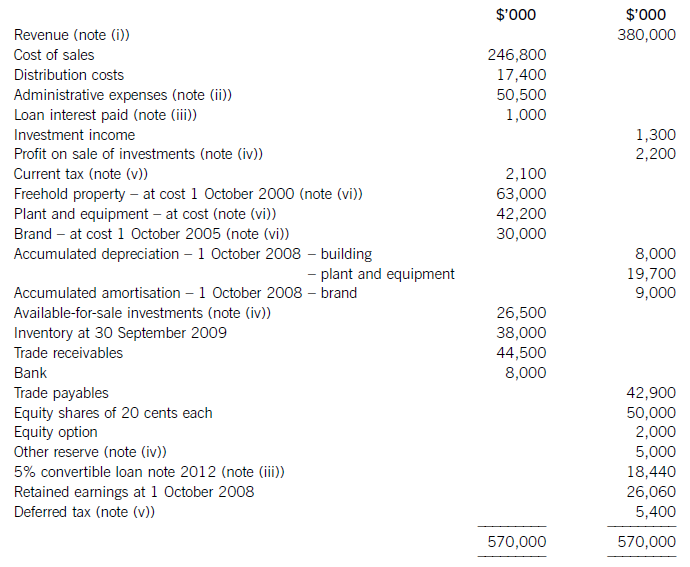
The following notes are relevant:
(i) Sandown’s revenue includes $16 million for goods sold to Pending on 1 October 2008. The terms of the sale are that Sandown will incur ongoing service and support costs of $1·2 million per annum for three years after the sale. Sandown normally makes a gross profit of 40% on such servicing and support work. Ignore the time value of money.
(ii) Administrative expenses include an equity dividend of 4·8 cents per share paid during the year.
(iii) The 5% convertible loan note was issued for proceeds of $20 million on 1 October 2007. It has an effective interest rate of 8% due to the value of its conversion option.
(iv) During the year Sandown sold an available-for-sale investment for $11 million. At the date of sale it had a
carrying amount of $8·8 million and had originally cost $7 million. Sandown has recorded the disposal of the
investment. The remaining available-for-sale investments (the $26·5 million in the trial balance) have a fair value of $29 million at 30 September 2009. The other reserve in the trial balance represents the net increase in the value of the available-for-sale investments as at 1 October 2008. Ignore deferred tax on these transactions.
(v) The balance on current tax represents the under/over provision of the tax liability for the year ended 30 September 2008. The directors have estimated the provision for income tax for the year ended 30 September 2009 at $16·2 million. At 30 September 2009 the carrying amounts of Sandown’s net assets were $13 million in excess of their tax base. The income tax rate of Sandown is 30%.
(vi) Non-current assets:
The freehold property has a land element of $13 million. The building element is being depreciated on a
straight-line basis.
Plant and equipment is depreciated at 40% per annum using the reducing balance method.
Sandown’s brand in the trial balance relates to a product line that received bad publicity during the year which led to falling sales revenues. An impairment review was conducted on 1 April 2009 which concluded that, based on estimated future sales, the brand had a value in use of $12 million and a remaining life of only three years.
However, on the same date as the impairment review, Sandown received an offer to purchase the brand for
$15 million. Prior to the impairment review, it was being depreciated using the straight-line method over a
10-year life.
No depreciation/amortisation has yet been charged on any non-current asset for the year ended 30 September
2009. Depreciation, amortisation and impairment charges are all charged to cost of sales.
Required:
(a) Prepare the statement of comprehensive income for Sandown for the year ended 30 September 2009.
(13 marks)
(b) Prepare the statement of financial position of Sandown as at 30 September 2009. (12 marks)
Notes to the financial statements are not required.
A statement of changes in equity is not required.
正确答案:
(i)IAS18Revenuerequiresthatwheresalesrevenueincludesanamountforaftersalesservicingandsupportcoststhenaproportionoftherevenueshouldbedeferred.Theamountdeferredshouldcoverthecostandareasonableprofit(inthiscaseagrossprofitof40%)ontheservices.Astheservicingandsupportisforthreeyearsandthedateofthesalewas1October2008,revenuerelatingtotwoyears’servicingandsupportprovisionmustbedeferred:($1·2millionx2/0·6)=$4million.Thisisshownas$2millioninbothcurrentandnon-currentliabilities. -
第20题:
During this period American car manufacturers set about improving their products and work efficiency.As a result,the yearly income of the average family increased from 1950 to 1975 faster than the price of cars.For this reason( )a new car takes a smaller part of a family s total earmnings today.A.bringing
B.obtain
C.bought
D.purchasing答案:D解析:purchase,买(正式用语)。 -
第21题:
Income Income may be national income and personal income. Whereas national income is defined as the total earned income of all the factors of production-namely, profits, interest, rent, wages, and other compensation for labor, personal income may be defined as total money income received by individuals before personal taxes are paid. National income does not equal GNP (Gross National Product) because the factors of production do not receive payment for either capital consumption allowances or indirect business taxes, both of which are included in GNP. The money put aside for capital consumption is for replacement and thus is not counted as income. Indirect taxes include sales taxes, property taxes , and excise taxes that are paid by businesses directly to the government and so reduce the income left to pay for the factors of production. Three-fourths of national income goes for wages, salaries, and other forms of compensation to employees. Whereas national income shows the income that the factors of production earn, personal income measures the income that individuals or households receive. Corporation profits are included in national income because they are earned. Out of these profits, however, corporation profit taxes must be paid to the government, and some money must be put into the business for expansion. Only that part of profits distributed as dividends goes to the individual; therefore, out of corporation profits only dividends count as personal income. The factors of production earn money for social security and unemployment insurance contributions, but this money goes to government (which is not a factor of production), not to individuals. It is therefore part of national income but not part of personal income. On the other hand, money received by individuals when they collect social security or unemployment compensation is not money earned but money received. Interest received on government bonds is also in this category, because much of the money received from the sale of bonds went to pay for war production and that production no longer furnishes a service to the economy. The money people receive as personal income may be either spent or saved. However, not all spending is completely voluntary. A significant portion of our income goes to pay personal taxes. Most workers never receive the money they pay in personal taxes, because it is withheld from their paychecks. The money that individuals are left with after they have met their tax obligations is disposable personal income. Disposable income can be divided between personal consumption expenditures and personal savings. It is important to remember that personal saving is what is left after spending. This passage is mainly about()
- A、the difference between national income and GNP
- B、the difference between national income and personal income
- C、the concept of income
- D、the difference between disposable income and nondisposable income
正确答案:B -
第22题:
单选题According to the passage, the income gap between rich and poor could widen again as ______.Athe unemployment rate is lowered
Bthe increase of benefits is independent of price increase
Cthe income tax rate is increasing
Dthe increase of benefits is only based on prices
正确答案: A解析:
题目问的是:根据文章,富人和穷人间的收入差距可能会因为什么再次扩大?文章第2段提到“Some long-term sick...grow relatively poorer if... raise benefits only in line with prices.”,以及第5段提到“it could widen again if the real value of earnings accelerated away from the real value of prices-linked benefits”,表明了如果福利只与价格挂钩,不顾人们收入的真正价值,贫富差距很可能会拉大。故D正确。 -
第23题:
单选题Income Income may be national income and personal income. Whereas national income is defined as the total earned income of all the factors of production-namely, profits, interest, rent, wages, and other compensation for labor, personal income may be defined as total money income received by individuals before personal taxes are paid. National income does not equal GNP (Gross National Product) because the factors of production do not receive payment for either capital consumption allowances or indirect business taxes, both of which are included in GNP. The money put aside for capital consumption is for replacement and thus is not counted as income. Indirect taxes include sales taxes, property taxes , and excise taxes that are paid by businesses directly to the government and so reduce the income left to pay for the factors of production. Three-fourths of national income goes for wages, salaries, and other forms of compensation to employees. Whereas national income shows the income that the factors of production earn, personal income measures the income that individuals or households receive. Corporation profits are included in national income because they are earned. Out of these profits, however, corporation profit taxes must be paid to the government, and some money must be put into the business for expansion. Only that part of profits distributed as dividends goes to the individual; therefore, out of corporation profits only dividends count as personal income. The factors of production earn money for social security and unemployment insurance contributions, but this money goes to government (which is not a factor of production), not to individuals. It is therefore part of national income but not part of personal income. On the other hand, money received by individuals when they collect social security or unemployment compensation is not money earned but money received. Interest received on government bonds is also in this category, because much of the money received from the sale of bonds went to pay for war production and that production no longer furnishes a service to the economy. The money people receive as personal income may be either spent or saved. However, not all spending is completely voluntary. A significant portion of our income goes to pay personal taxes. Most workers never receive the money they pay in personal taxes, because it is withheld from their paychecks. The money that individuals are left with after they have met their tax obligations is disposable personal income. Disposable income can be divided between personal consumption expenditures and personal savings. It is important to remember that personal saving is what is left after spending. This passage is mainly about()Athe difference between national income and GNP
Bthe difference between national income and personal income
Cthe concept of income
Dthe difference between disposable income and nondisposable income
正确答案: D解析: 文章主要讲收入的两大分类及其区别。这一点可以从文章的第一句话看出。文章第一段的第一句话常常是文章的论点句。因此A,C和D均不是完整的答案。答案为B。 -
第24题:
单选题An American manufacturer of space heaters reported a 1994 fourth-quarter net income (total income minus total costs) of $41 million, compared with $28.3 million in the fourth quarter of 1993. This increase was realized despite a drop in U.S. domestic retail sales of space-heating units toward the end of the fourth quarter of 1994 as a result of unusually high temperatures. Which of the following, if true, would contribute most to an explanation of the increase in the manufacturer’s net income?AIn the fourth quarter of 1994, the manufacturer paid its assembly-line workers no salaries in November or December because of a two-month-long strike, but the company had a sufficient stock of space-heating units on hand to supply its distributors.
BIn 1993, because of unusually cold weather in the Northeast, the federal government authorized the diversion of emergency funding for purchasing space-heating units to be used in the hardest. hit areas.
CForeign manufacturers of space heaters reported improved fourth-quarter sales in the American market compared with their sales in 1993.
DDuring the fourth quarter of 1994, the manufacturer announced that it would introduce an extra-high-capacity space heater in the following quarter.
EIn the third quarter of 1994, a leading consumer magazine advocated space heaters as a cost-effective way to heat spaces of less than 100 square feet.
正确答案: E解析:
利润的上升可能是由于销售的增加或是成本的减少,A项反映的是公司成本的减少,故本题应选A项。