
问答题Passage 3Sydney 2000 Olympics The cost of staging the year 2000 Olympics in Sydney was estimated to be a staggering $960 million, but the city was preparing to reap the financial benefits that ensued from holding such an international event by emulati
题目
相似考题
参考答案和解析
(由题干中的1993和2000games可以定位到原文第2段的第一句“At precisely 4:20 am on Friday the 24th of September 1993, it was announced that Sydney had beaten four other competing cities around the world…”, 可知悉尼战胜了其他4个城市,因此包括悉尼在内1993年申奥的城市应该有5个。所以答案为5/5 cities/Five/Five cities。)
2. $ 25 million
(该题的关键词是revised budget和cost,据此可以定位到原文第三段第一句“…the bid came in$1 million below the revised budget and$5 million below the original budget of$29 million…”,从这句话中可知,最初预算是$29 million,修改后的预算比最初预算少$5 million,因此,可知修改后的预算是$24million。)
3. every Australian taxpayer/Australian taxpayer
(本题的关键词是contributed to the bid,根据关键词定位到原文第三段最后一句“The Federal Government’s grant of $5 million meant, in effect, that the Sydney bid was financed by every Australian taxpayer”,题干和原文表达基本一致所以很容易看出正确答案为Every Australian taxpayer/Australian taxpayer。)
4. in economic turmoil
(根据题干中的关键词the State of Victoria和Melbourne可对应到原文第五段“However, the dubiousness of the benefits that Melbourne, an unsuccessful bidder for the 1988 Olympic Games, received at a time when the State of Victoria was still in economic turmoil meant many corporate bodies were unenthusiastic”,意思是“1988年申办奥运会时,维多利亚州仍然处在经济混乱期”。故答案为in economic turmoil。)
5. 4/four
(根据题干中的关键词Secretary of the NSW Labor Council可对应到原文倒数第三段,考生仔细阅读不难找出文中一共列举了四种成就,因此正确答案为4。注意这里只需要填4种即可,不需将这四种成就列举出来。)
更多“问答题Passage 3Sydney 2000 Olympics The cost of staging the year 2000 Olympics in Sydney was estimated to be a staggering $960 million, but the city was preparing to reap the financial benefits that ensued from holding such an international event by emulati”相关问题
-
第1题:
(c) On 1 May 2007 Sirus acquired another company, Marne plc. The directors of Marne, who were the only
shareholders, were offered an increased profit share in the enlarged business for a period of two years after the
date of acquisition as an incentive to accept the purchase offer. After this period, normal remuneration levels will
be resumed. Sirus estimated that this would cost them $5 million at 30 April 2008, and a further $6 million at
30 April 2009. These amounts will be paid in cash shortly after the respective year ends. (5 marks)
Required:
Draft a report to the directors of Sirus which discusses the principles and nature of the accounting treatment of
the above elements under International Financial Reporting Standards in the financial statements for the year
ended 30 April 2008.
正确答案:
(c) Acquisition of Marne
All business combinations within the scope of IFRS 3 ‘Business Combinations’ must be accounted for using the purchase
method. (IFRS 3.14) The pooling of interests method is prohibited. Under IFRS 3, an acquirer must be identified for all
business combinations. (IFRS 3.17) Sirus will be identified as the acquirer of Marne and must measure the cost of a business
combination at the sum of the fair values, at the date of exchange, of assets given, liabilities incurred or assumed, in exchange
for control of Marne; plus any costs directly attributable to the combination. (IFRS 3.24) If the cost is subject to adjustment
contingent on future events, the acquirer includes the amount of that adjustment in the cost of the combination at the
acquisition date if the adjustment is probable and can be measured reliably. (IFRS 3.32) However, if the contingent payment
either is not probable or cannot be measured reliably, it is not measured as part of the initial cost of the business combination.
If that adjustment subsequently becomes probable and can be measured reliably, the additional consideration is treated as
an adjustment to the cost of the combination. (IAS 3.34) The issue with the increased profit share payable to the directors
of Marne is whether the payment constitutes remuneration or consideration for the business acquired. Because the directors
of Marne fall back to normal remuneration levels after the two year period, it appears that this additional payment will
constitute part of the purchase consideration with the resultant increase in goodwill. It seems as though these payments can
be measured reliably and therefore the cost of the acquisition should be increased by the net present value of $11 million at
1 May 2007 being $5 million discounted for 1 year and $6 million for 2 years. -
第2题:
According to the passage,in the late 1960's some residents of Boston were concerned with which aspect of skyscrapers?
A. The noise from their construction.
B. The removal of trees from building sites.
C. The harmful effects on the city's grass.
D. The high cost of rentable office space.
正确答案:C
[解析] 由倒数第二段第二句可知,“摩天楼产生的阴影对城市绿地有害”,答案为C。
-
第3题:
You are an audit manager at Rockwell & Co, a firm of Chartered Certified Accountants. You are responsible for the audit of the Hopper Group, a listed audit client which supplies ingredients to the food and beverage industry worldwide.
The audit work for the year ended 30 June 2015 is nearly complete, and you are reviewing the draft audit report which has been prepared by the audit senior. During the year the Hopper Group purchased a new subsidiary company, Seurat Sweeteners Co, which has expertise in the research and design of sugar alternatives. The draft financial statements of the Hopper Group for the year ended 30 June 2015 recognise profit before tax of $495 million (2014 – $462 million) and total assets of $4,617 million (2014: $4,751 million). An extract from the draft audit report is shown below:
Basis of modified opinion (extract)
In their calculation of goodwill on the acquisition of the new subsidiary, the directors have failed to recognise consideration which is contingent upon meeting certain development targets. The directors believe that it is unlikely that these targets will be met by the subsidiary company and, therefore, have not recorded the contingent consideration in the cost of the acquisition. They have disclosed this contingent liability fully in the notes to the financial statements. We do not feel that the directors’ treatment of the contingent consideration is correct and, therefore, do not believe that the criteria of the relevant standard have been met. If this is the case, it would be appropriate to adjust the goodwill balance in the statement of financial position.
We believe that any required adjustment may materially affect the goodwill balance in the statement of financial position. Therefore, in our opinion, the financial statements do not give a true and fair view of the financial position of the Hopper Group and of the Hopper Group’s financial performance and cash flows for the year then ended in accordance with International Financial Reporting Standards.
Emphasis of Matter Paragraph
We draw attention to the note to the financial statements which describes the uncertainty relating to the contingent consideration described above. The note provides further information necessary to understand the potential implications of the contingency.
Required:
(a) Critically appraise the draft audit report of the Hopper Group for the year ended 30 June 2015, prepared by the audit senior.
Note: You are NOT required to re-draft the extracts from the audit report. (10 marks)
(b) The audit of the new subsidiary, Seurat Sweeteners Co, was performed by a different firm of auditors, Fish Associates. During your review of the communication from Fish Associates, you note that they were unable to obtain sufficient appropriate evidence with regard to the breakdown of research expenses. The total of research costs expensed by Seurat Sweeteners Co during the year was $1·2 million. Fish Associates has issued a qualified audit opinion on the financial statements of Seurat Sweeteners Co due to this inability to obtain sufficient appropriate evidence.
Required:
Comment on the actions which Rockwell & Co should take as the auditor of the Hopper Group, and the implications for the auditor’s report on the Hopper Group financial statements. (6 marks)
(c) Discuss the quality control procedures which should be carried out by Rockwell & Co prior to the audit report on the Hopper Group being issued. (4 marks)
正确答案:(a) Critical appraisal of the draft audit report
Type of opinion
When an auditor issues an opinion expressing that the financial statements ‘do not give a true and fair view’, this represents an adverse opinion. The paragraph explaining the modification should, therefore, be titled ‘Basis of Adverse Opinion’ rather than simply ‘Basis of Modified Opinion’.
An adverse opinion means that the auditor considers the misstatement to be material and pervasive to the financial statements of the Hopper Group. According to ISA 705 Modifications to Opinions in the Independent Auditor’s Report, pervasive matters are those which affect a substantial proportion of the financial statements or fundamentally affect the users’ understanding of the financial statements. It is unlikely that the failure to recognise contingent consideration is pervasive; the main effect would be to understate goodwill and liabilities. This would not be considered a substantial proportion of the financial statements, neither would it be fundamental to understanding the Hopper Group’s performance and position.
However, there is also some uncertainty as to whether the matter is even material. If the matter is determined to be material but not pervasive, then a qualified opinion would be appropriate on the basis of a material misstatement. If the matter is not material, then no modification would be necessary to the audit opinion.
Wording of opinion/report
The auditor’s reference to ‘the acquisition of the new subsidiary’ is too vague; the Hopper Group may have purchased a number of subsidiaries which this phrase could relate to. It is important that the auditor provides adequate description of the event and in these circumstances it would be appropriate to name the subsidiary referred to.
The auditor has not quantified the amount of the contingent element of the consideration. For the users to understand the potential implications of any necessary adjustments, they need to know how much the contingent consideration will be if it becomes payable. It is a requirement of ISA 705 that the auditor quantifies the financial effects of any misstatements, unless it is impracticable to do so.
In addition to the above point, the auditor should provide more description of the financial effects of the misstatement, including full quantification of the effect of the required adjustment to the assets, liabilities, incomes, revenues and equity of the Hopper Group.
The auditor should identify the note to the financial statements relevant to the contingent liability disclosure rather than just stating ‘in the note’. This will improve the understandability and usefulness of the contents of the audit report.
The use of the term ‘we do not feel that the treatment is correct’ is too vague and not professional. While there may be some interpretation necessary when trying to apply financial reporting standards to unique circumstances, the expression used is ambiguous and may be interpreted as some form. of disclaimer by the auditor with regard to the correct accounting treatment. The auditor should clearly explain how the treatment applied in the financial statements has departed from the requirements of the relevant standard.
Tutorial note: As an illustration to the above point, an appropriate wording would be: ‘Management has not recognised the acquisition-date fair value of contingent consideration as part of the consideration transferred in exchange for the acquiree, which constitutes a departure from International Financial Reporting Standards.’
The ambiguity is compounded by the use of the phrase ‘if this is the case, it would be appropriate to adjust the goodwill’. This once again suggests that the correct treatment is uncertain and perhaps open to interpretation.
If the auditor wishes to refer to a specific accounting standard they should refer to its full title. Therefore instead of referring to ‘the relevant standard’ they should refer to International Financial Reporting Standard 3 Business Combinations.
The opinion paragraph requires an appropriate heading. In this case the auditors have issued an adverse opinion and the paragraph should be headed ‘Adverse Opinion’.
As with the basis paragraph, the opinion paragraph lacks authority; suggesting that the required adjustments ‘may’ materially affect the financial statements implies that there is a degree of uncertainty. This is not the case; the amount of the contingent consideration will be disclosed in the relevant purchase agreement, so the auditor should be able to determine whether the required adjustments are material or not. Regardless, the sentence discussing whether the balance is material or not is not required in the audit report as to warrant inclusion in the report the matter must be considered material. The disclosure of the nature and financial effect of the misstatement in the basis paragraph is sufficient.
Finally, the emphasis of matter paragraph should not be included in the audit report. An emphasis of matter paragraph is only used to draw attention to an uncertainty/matter of fundamental importance which is correctly accounted for and disclosed in the financial statements. An emphasis of matter is not required in this case for the following reasons:
– Emphasis of matter is only required to highlight matters which the auditor believes are fundamental to the users’ understanding of the business. An example may be where a contingent liability exists which is so significant it could lead to the closure of the reporting entity. That is not the case with the Hopper Group; the contingent liability does not appear to be fundamental.
– Emphasis of matter is only used for matters where the auditor has obtained sufficient appropriate evidence that the matter is not materially misstated in the financial statements. If the financial statements are materially misstated, in this regard the matter would be fully disclosed by the auditor in the basis of qualified/adverse opinion paragraph and no emphasis of matter is necessary.
(b) Communication from the component auditor
The qualified opinion due to insufficient evidence may be a significant matter for the Hopper Group audit. While the possible adjustments relating to the current year may not be material to the Hopper Group, the inability to obtain sufficient appropriate evidence with regard to a material matter in Seurat Sweeteners Co’s financial statements may indicate a control deficiency which the auditor was not aware of at the planning stage and it could indicate potential problems with regard to the integrity of management, which could also indicate a potential fraud. It could also indicate an unwillingness of management to provide information, which could create problems for future audits, particularly if research and development costs increase in future years. If the group auditor suspects that any of these possibilities are true, they may need to reconsider their risk assessment and whether the audit procedures performed are still appropriate.
If the detail provided in the communication from the component auditor is insufficient, the group auditor should first discuss the matter with the component auditor to see whether any further information can be provided. The group auditor can request further working papers from the component auditor if this is necessary. However, if Seurat Sweeteners has not been able to provide sufficient appropriate evidence, it is unlikely that this will be effective.
If the discussions with the component auditor do not provide satisfactory responses to evaluate the potential impact on the Hopper Group, the group auditor may need to communicate with either the management of Seurat Sweeteners or the Hopper Group to obtain necessary clarification with regard to the matter.
Following these procedures, the group auditor needs to determine whether they have sufficient appropriate evidence to draw reasonable conclusions on the Hopper Group’s financial statements. If they believe the lack of information presents a risk of material misstatement in the group financial statements, they can request that further audit procedures be performed, either by the component auditor or by themselves.
Ultimately the group engagement partner has to evaluate the effect of the inability to obtain sufficient appropriate evidence on the audit opinion of the Hopper Group. The matter relates to research expenses totalling $1·2 million, which represents 0·2% of the profit for the year and 0·03% of the total assets of the Hopper Group. It is therefore not material to the Hopper Group’s financial statements. For this reason no modification to the audit report of the Hopper Group would be required as this does not represent a lack of sufficient appropriate evidence with regard to a matter which is material to the Group financial statements.
Although this may not have an impact on the Hopper Group audit opinion, this may be something the group auditor wishes to bring to the attention of those charged with governance. This would be particularly likely if the group auditor believed that this could indicate some form. of fraud in Seurat Sweeteners Co, a serious deficiency in financial reporting controls or if this could create problems for accepting future audits due to management’s unwillingness to provide access to accounting records.
(c) Quality control procedures prior to issuing the audit report
ISA 220 Quality Control for an Audit of Financial Statements and ISQC 1 Quality Control for Firms that Perform. Audits and Reviews of Historical Financial Information, and Other Assurance and Related Services Agreements require that an engagement quality control reviewer shall be appointed for audits of financial statements of listed entities. The audit engagement partner then discusses significant matters arising during the audit engagement with the engagement quality control reviewer.
The engagement quality control reviewer and the engagement partner should discuss the failure to recognise the contingent consideration and its impact on the auditor’s report. The engagement quality control reviewer must review the financial statements and the proposed auditor’s report, in particular focusing on the conclusions reached in formulating the auditor’s report and consideration of whether the proposed auditor’s opinion is appropriate. The audit documentation relating to the acquisition of Seurat Sweeteners Co will be carefully reviewed, and the reviewer is likely to consider whether procedures performed in relation to these balances were appropriate.
Given the listed status of the Hopper Group, any modification to the auditor’s report will be scrutinised, and the firm must be sure of any decision to modify the report, and the type of modification made. Once the engagement quality control reviewer has considered the necessity of a modification, they should consider whether a qualified or an adverse opinion is appropriate in the circumstances. This is an important issue, given that it requires judgement as to whether the matters would be material or pervasive to the financial statements.
The engagement quality control reviewer should ensure that there is adequate documentation regarding the judgements used in forming the final audit opinion, and that all necessary matters have been brought to the attention of those charged with governance.
The auditor’s report must not be signed and dated until the completion of the engagement quality control review.
Tutorial note: In the case of the Hopper Group’s audit, the lack of evidence in respect of research costs is unlikely to be discussed unless the audit engagement partner believes that the matter could be significant, for example, if they suspected the lack of evidence is being used to cover up a financial statements fraud.
-
第4题:
40 years ago the idea of disabled people doing sport was never heard of. But when the annual games for the disabled were started at Stoke Mandeville, England in 1948 by Sir Ludwig Guttmann, the situation began to change.
Sir Ludwig Guttmann, who had been driven to England in 1939 from Nazi Germany, had
been asked by the British government to set up an injuries center at Stoke Mandeville Hospital near London. His ideas about treating injuries included sport for the disabled.
In the first games just two teams of injured soldiers took part. The next year, 1949, five teams took part. From those beginnings, things have developed fast. Teams now come from abroad to Stoke Mandeville every year. In 1960 the first Olympics for the Disabled were held in Rome, in the same place as the normal Olympic Games. Now, every four years the Olympic Games for the Disabled are held, if possible, in the same place as the normal Olympic Games, although they are organized separately. In other years Games for the Disabled are still held at Stoke Mandeville. In the 1984 wheelchair Olympic Games, 1064 wheelchair athletes from about 40 countries took part.
Unfortunately, they were held at Stoke Mandeville and not in Los Angeles, along with the other Olympics.
TheGameshavebeenagreatsuccessinpromotinginternationalfriendshipandunderstanding, and in proving that being disabled does not mean you can't enjoy sport. One small source of disappointment for those who organize and take part in the games, however, has been the unwillingness of the International Olympic Committee to include disabled events at Olympic Games for the able-bodied. Perhaps a few more years are still needed to convince those fortunate enough not to be disabled that their disabled fellow athletes should not be excluded.
From the passage, we may conclude that the writer is __________ .A.one of the organizers of the game for the disabled
B.a disabled person who once took part in the games
C.against holding the games for the disabled
D.in favor of holding the games for the disabled答案:D解析:最后一段第一句提到了残疾人运动会发挥的巨大作用,可见作者对此是支持的。故选D。 Passage 2 -
第5题:
共用题干
第二篇
Star Quality
A new anti-cheating system for counting the judges' scores in ice skating is flawed,
according to leading sports specialists.Ice skating's governing body announced the new
rules last week after concerns that a judge at the Winter Olympics may have been unfairly
influenced,
Initially the judges in the pairs figure-skating event at the Winter Olympics in Salt Lake
City voted 5 to 4 to give the gold medal to a Russian pair,even though they had a fall during
their routine.But the International Skating Union suspended the French judge for falling to
reveal that she had been put under pressure to vote for the Russians.The International
Olympics Committee then decided to give a second gold to the Canadian runners-up
(亚军).
The ISU,skating's governing body,now says it intends to change the rules.In
future 14 judges will judge each event,but only 7 of their scores一selected at random一will
count.
The ISU won't finally approve the new system until it meets in June but already
U.K.Sport,the British Government's sports body,has expressed reservations."I remain
to be convinced that the random selection system would offer the guarantees that everyone
concerned with ethical sport is looking for",says Jerry Bingham,U.K.Sport's head of
ethics(伦理).
A random system can still be manipulated,says Mark Dixon,a specialist on sports
statistics from the Royal Statistical Society in London."The score of one or two judges who
have been nobbled(受到贿赂)may still be in the seven selected."
Many other sports that have judges,including diving,gymnastics,and synchronized
swimming,have a system that discards the highest and lowest scores.If a judge was
under pressure to favour a particular team,they would tend to give it very high scores and
mark down the opposition team,so their scores wouldn't count.It works for diving,says
Jeff Cook,a member of the international government body's technical committee."If you
remove those at the top and bottom you're left with those in the middle,so you're getting a
reasonable average."
Since the 2000 Olympics in Sydney,diving has tightened up in its system still further.
Two separate panels of judges score different rounds of diving during top competitions.
Neither panel knows the scores given by the other."We have done this to head off any
suggestion of bias,"says Cook:
Bingham urged the ISU to consider other options."This should involve examining the
way in which other sports deal with the problem of adjudicating(裁定)on matter of style
and presentation,"he says.What does Jerry Bingham express by saying"I remain to be convinced"?
A:His anger.
B:His criticism.
C:His agreement.
D:His doubt.答案:D解析: -
第6题:
共用题干
Going Back to Its Birthplace
No sporting event takes hold of the world's attention and imagination like the Olympic
Games.The football World Cup fascinates fans in Europe and South America;baseball's
World Series is required viewing in North America;and the World Table Tennis
Championships attracts the most interest in Asia.
But the Olympics belong to the whole world.Now,after travelling to 17 countries over
108 years,the summer Games are returning to Athens,the place where the first modern
Olympics was held.
Participation in the Games is looked on not only as an achievement,but also as an
honour. The 1 6 days between August 1 3 and 29 will see a record 202 countries compete,
up from Sydney's 199.Afghanistan is back,having been banned from Sydney because the
Taliban government didn't let women do sports.There is also a place for newcomers East
Timor and Kiribati.
A total of 10,500 athletes will compete in 28 sports,watched by 5.3 million ticket-
paying viewers as well as a television audience of 4 billion.
Athens is to use its rich history and culture to make the Olympics as special as
possible.The Games will open with cycling events which start in front of the Parthenon and
Acropolis monuments.The final event will be a historic men's marathon following the original
route run by Phidippides in 490 BC to bring news of victory over the Persians.
The ancient stadium at Olympia,first used for the Games nearly three centuries ago,
will stage the shot put competitions.And the Panathenian Stadium,where the first modern
Olympics was held,is to host the archery(射箭)events.
If the well-known ancient sites deliver a great sense of history to the Games,the 39
new venues add a modern touch to the city of Athens.The main Olympic stadium,with a
giant glass and steel roof, is the landmark(标志)building of the Olympics.
"We believe that we will organize a'magical'Games,"said Athens 2004 President
Gianna Angelopoulos-Daskalaki. "Our history with the Olympic Games goes back nearly
3,000 years,and Athens 2004 could be the best ever."Participation in the Olympic Games is looked upon as an honor as well as an achievement.
A:Right.
B:Wrong
C:Not mentioned答案:A解析: -
第7题:
共用题干
Going Back to Its Birthplace
No sporting event takes hold of the world's attention and imagination like the Olympic
Games.The football World Cup fascinates fans in Europe and South America;baseball's
World Series is required viewing in North America;and the World Table Tennis
Championships attracts the most interest in Asia.
But the Olympics belong to the whole world.Now,after travelling to 17 countries over
108 years,the summer Games are returning to Athens,the place where the first modern
Olympics was held.
Participation in the Games is looked on not only as an achievement,but also as an
honour. The 1 6 days between August 1 3 and 29 will see a record 202 countries compete,
up from Sydney's 199.Afghanistan is back,having been banned from Sydney because the
Taliban government didn't let women do sports.There is also a place for newcomers East
Timor and Kiribati.
A total of 10,500 athletes will compete in 28 sports,watched by 5.3 million ticket-
paying viewers as well as a television audience of 4 billion.
Athens is to use its rich history and culture to make the Olympics as special as
possible.The Games will open with cycling events which start in front of the Parthenon and
Acropolis monuments.The final event will be a historic men's marathon following the original
route run by Phidippides in 490 BC to bring news of victory over the Persians.
The ancient stadium at Olympia,first used for the Games nearly three centuries ago,
will stage the shot put competitions.And the Panathenian Stadium,where the first modern
Olympics was held,is to host the archery(射箭)events.
If the well-known ancient sites deliver a great sense of history to the Games,the 39
new venues add a modern touch to the city of Athens.The main Olympic stadium,with a
giant glass and steel roof, is the landmark(标志)building of the Olympics.
"We believe that we will organize a'magical'Games,"said Athens 2004 President
Gianna Angelopoulos-Daskalaki. "Our history with the Olympic Games goes back nearly
3,000 years,and Athens 2004 could be the best ever."The first modern Olympics was held nearly three centuries ago.
A:Right
B:Wrong
C:Not mentioned答案:B解析: -
第8题:
The International festival of music and the arts is held every year in the city of()
正确答案:Edinburgh -
第9题:
问答题Passage 1 The cost of staging the year 2000 Olympics in Sydney is estimated to be a staggering $ 9 million, but (1) the city is preparing to the financial benefits that come from holding such an international event by equaling the commercial success of Los Angeles, the only city yet to have made a demonstrable profit from the Games in 1984. At precisely 4:20 a.m. on Friday the 24th of September 1993, it was announced that Sydney had beaten five other competing cities around the world, and Australians everywhere, not only Sydneysiders, were justifiably proud of the result. (2) But, if Sydney had lost the bid, would the taxpayers of New South Wales and of Australia have approved of governments spending millions of dollars in a failed and costly exercise? There may have been some consolation in the fact that the bid came in $ l million below the revised budget and $ 5 million below the original budget of $ 29 million formulated in mid-1991. However, the final cost was the considerable sum of $ 24 million, the bulk of which was paid for by corporate and community contributions, merchandising, licensing, and the proceeds of lotteries, with the NSW Government, which had originally been willing to spend up to $ 10 million, contributing some $ 2 million. (3) The Federal Government’s grant of $ 5 million meant, in effect, that the Sydney bid was financed by every Australian taxpayer. Prior to the announcement of the winning city, there was considerable debate about the wisdom of taking financial risks of this kind at a time of economic recession. (4) Others argued that 70% of the facilities were already in place, and all were on government-owned land, removing some potential areas of conflict which troubled previous Olympic bidders. The former NSW Premier, Mr. Nick Greiner, went on record as saying that the advantage of having the Games… “is not that you are going to have $ 7.4 billion in extra gross domestic product over the next 14 years.” (5) I think the real point is the psychological change, the gaining of confidence, apart from the other more obvious reasons, such as the building of sporting facilities, tourism, and things of that nature.正确答案: 1. 悉尼正在准备通过举办这样的国际盛会而收获同洛杉矶一样的经济利益,1984年的洛杉矶奥运会使洛杉矶成为举办奥运会以来获利最多的一个城市。
(reap“收获,获得”,demonstrable“可论证的,显而易见的”,后半句采用意译的方法,“the only city yet to have made a demonstrable profit from the Games in 1984”翻译为“1984年的洛杉矶奥运会使洛杉矶成为举办奥运会以来获利最多的一个城市”。)
2. 但是,如果悉尼申奥失败的话,新南威尔士州和澳大利亚的纳税人会同意政府花上百万美元在这一次失败而昂贵的演练上吗?
(lost the bid“投标失败”,这里指申奥失败,taxpayer“纳税人”,approve of“赞同,同意”,exercise在这里意义为“演练”更合适。)
3. 联邦政府批准的500万美元,实际上意味着悉尼申奥得到每位澳大利亚纳税人的经济支持。
(in effect“实际上”,grant of“扶助”,在这里意译为“批准”,be financed by“由…”资助。)
4. 其他人认为70%的奥运设施已经到位了,而且都处于政府所有的土地上,这就消除了困扰以前申奥城市的潜在地区冲突。
(government-owned“政府所有的”,areas of conflict“地区冲突”,remove“消除”,在该句末尾的bidder指代的是申奥的城市,所以不宜翻译为“投标者”。)
5. 我认为,举办奥运会除了能够带来一些显而易见的好处,比如,体育场馆的修建,旅游业的发展和此类事情之外,其真正的意义在于心理的变化,人们获得了自信。
(apart from“除了……”,obvious reasons在此处意译为“显而易见的好处”。)解析: 暂无解析 -
第10题:
单选题Which of the following statements is TRUE according to the passage?ATo build a structure like the City Hall will cost $2.5 million today.
BThe clock tower stands parallel with the center of the City Hall.
COld City Hall was once pulled down in the development of the city.
DOld City Hall is now a historical site.
正确答案: A解析: -
第11题:
问答题Directions: In this section, there is one passage followed by a summary. Read the passage carefully and complete the summary below by choosing a maximum of three words from the passage to fill in the spaces 66-70. Remember to write the answers on the Answer Sheet. Questions 1-5 are based on the following passage. In August 2008, athletes from the United States and around the world will compete in the Beijing Olympics. But did you know that in September of next year, disabled athletes will compete in the Paralympic Games in Beijing? The Olympics and the Paralympics are separate movements. But they have always been held in the same year, and since 1988, they have also been held in the same city. The International Olympic Committee and the International Paralympic Committee signed an agreement in 2001 to secure this connection. The next winter games will take place in Vancouver, Canada, in 2010. The Paralympic Games grew out of a sports competition held in 1948 in England and a doctor named Ludwig Guttmann organized it for men who suffered spinal cord injuries in World War II. Four years later, it became an international event as competitors from the Netherlands took part. Then, in 1960, the first Paralympics were held in Rome. 400 athletes from 23 countries competed. By 2004, the Paralympic Games in Athens had almost 4000 athletes from 136 countries, who may have physical or mental limitations and may be blind or in wheelchairs. Yet sometimes they perform better than athletes without disabilities. In 1968, Eunice Kennedy Shriver, the sister of former President John F. Kennedy, started the Special Olympics, which are just for children and adults with mental limitations and whose programs currently serve more than two million people in 160 countries. In November 2006, in Mumbai, India, teams competed in the First Special Olympics International Cricket Cup. In addition to India, there were men’s teams from Afghanistan, Australia, Bangladesh, Nepal, Pakistan, Sri Lanka and the West Indies. There were also women’s cricket teams from India and Pakistan. There are many organizations in the United States that help people with disabilities play sports. Wheelchair tennis is a popular sport. So is basketball. In fact, there are more than one hundred professional teams playing wheelchair basketball thanks to the special wheelchairs for athletes that are lightweight and designed for quick moves. For people who want to go really fast in their chairs, there is a Power Wheelchair Racing Association. In the state of Utah there is a place called the National Ability Center, which teaches all kinds of sports to people with all kinds of physical and mental disabilities and even gives friends and family members a chance to try a sport as if they were disabled. A reporter from the Washington Post wanted to know what it would be like for a blind person to use a climbing wall. So, protected by a safety line, the newspaper reporter closed his eyes and started to feel for places to put his hands and feet. Trainers on the ground urged him on: “Take your time. You can do it.” Finally he reached the top. At the National Ability Center people can learn to ride horses and mountain bikes. They can try winter mountain sports, and learn scuba diving and other water activities. The center also prepares athletes for the Paralympics. These days, the first place many people go when they want to travel is the Internet, where they can get information about hotels, transportation and services like tour companies. The Internet can also help travelers find special services for the disabled. For example, there are groups that help young people with disabilities travel to different countries. Susan Sygall, who uses a wheelchair herself, leads an organization called Mobility International USA, and has traveled to more than twenty-five countries to talk about the rights of people with disabilities. She says people with disabilities are all members of a global family and working together across borders is the most powerful way of making changes. Summary: The Olympics and the Paralympics are 1 but they have always been held in the same year and also in the same city since 1988 when the International Olympic Committee and the International Paralympic Committee signed an agreement in 2001 to secure this connection.The Paralympic Games grew out of a sports competition organized by a doctor named 2 in 1948 in England for men injured in World War II. In 1952, it became an 3 and in 1960, the first Paralympics were held in Rome for people who may have physical or mental limitations or may be blind or in wheelchairs.The 4 was started in 1968 in the United States by Eunice Kennedy Shriver just for children and adults with mental limitations and to help people with disabilities play sports and enjoy other activities, many 5 are founded, such as the Power Wheelchair Racing Association, the National Ability Center and Mobility International USA.正确答案:
1.separate movements 由原文第二段第一句话可知奥运会和残奥会是两项分开的运动盛会。
2.Ludwig Guttmann 由第三段第一句话可知。
3.international event 由第三段中Then, in 1960, the first Paralympics were held in Rome. 400 athletes from 23 countries competed 可知,为脊髓病患者举办的运动会在1960年变成世界性的运动会。
4.Special Olympics 由第四段可知,特殊运动会发源于1968年。
5.organizations 由文中第五段可知,世界各国建立了很多组织,帮助残障人士进行各项运动。解析: 暂无解析 -
第12题:
单选题Which of the following is the main idea of this passage?AThe city inspires talented people.
BThe city hurts your brain.
CThe city has many pleasures and benefits.
DThe city seriously affects the natural balance.
正确答案: C解析: -
第13题:
(b) Seymour offers health-related information services through a wholly-owned subsidiary, Aragon Co. Goodwill of
$1·8 million recognised on the purchase of Aragon in October 2004 is not amortised but included at cost in the
consolidated balance sheet. At 30 September 2006 Seymour’s investment in Aragon is shown at cost,
$4·5 million, in its separate financial statements.
Aragon’s draft financial statements for the year ended 30 September 2006 show a loss before taxation of
$0·6 million (2005 – $0·5 million loss) and total assets of $4·9 million (2005 – $5·7 million). The notes to
Aragon’s financial statements disclose that they have been prepared on a going concern basis that assumes that
Seymour will continue to provide financial support. (7 marks)
Required:
For each of the above issues:
(i) comment on the matters that you should consider; and
(ii) state the audit evidence that you should expect to find,
in undertaking your review of the audit working papers and financial statements of Seymour Co for the year ended
30 September 2006.
NOTE: The mark allocation is shown against each of the three issues.
正确答案:
(b) Goodwill
(i) Matters
■ Cost of goodwill, $1·8 million, represents 3·4% consolidated total assets and is therefore material.
Tutorial note: Any assessments of materiality of goodwill against amounts in Aragon’s financial statements are
meaningless since goodwill only exists in the consolidated financial statements of Seymour.
■ It is correct that the goodwill is not being amortised (IFRS 3 Business Combinations). However, it should be tested
at least annually for impairment, by management.
■ Aragon has incurred losses amounting to $1·1 million since it was acquired (two years ago). The write-off of this
amount against goodwill in the consolidated financial statements would be material (being 61% cost of goodwill,
8·3% PBT and 2·1% total assets).
■ The cost of the investment ($4·5 million) in Seymour’s separate financial statements will also be material and
should be tested for impairment.
■ The fair value of net assets acquired was only $2·7 million ($4·5 million less $1·8 million). Therefore the fair
value less costs to sell of Aragon on other than a going concern basis will be less than the carrying amount of the
investment (i.e. the investment is impaired by at least the amount of goodwill recognised on acquisition).
■ In assessing recoverable amount, value in use (rather than fair value less costs to sell) is only relevant if the going
concern assumption is appropriate for Aragon.
■ Supporting Aragon financially may result in Seymour being exposed to actual and/or contingent liabilities that
should be provided for/disclosed in Seymour’s financial statements in accordance with IAS 37 Provisions,
Contingent Liabilities and Contingent Assets.
(ii) Audit evidence
■ Carrying values of cost of investment and goodwill arising on acquisition to prior year audit working papers and
financial statements.
■ A copy of Aragon’s draft financial statements for the year ended 30 September 2006 showing loss for year.
■ Management’s impairment test of Seymour’s investment in Aragon and of the goodwill arising on consolidation at
30 September 2006. That is a comparison of the present value of the future cash flows expected to be generated
by Aragon (a cash-generating unit) compared with the cost of the investment (in Seymour’s separate financial
statements).
■ Results of any impairment tests on Aragon’s assets extracted from Aragon’s working paper files.
■ Analytical procedures on future cash flows to confirm their reasonableness (e.g. by comparison with cash flows for
the last two years).
■ Bank report for audit purposes for any guarantees supporting Aragon’s loan facilities.
■ A copy of Seymour’s ‘comfort letter’ confirming continuing financial support of Aragon for the foreseeable future. -
第14题:
(a) The following information relates to Crosswire a publicly listed company.
Summarised statements of financial position as at:
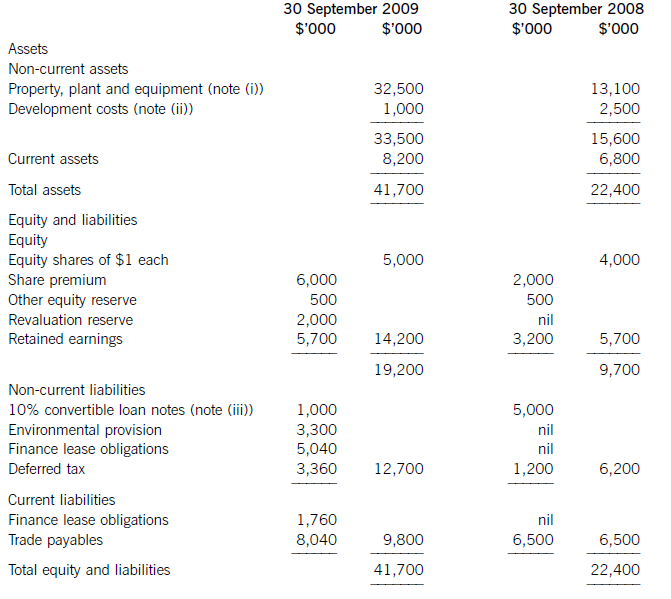
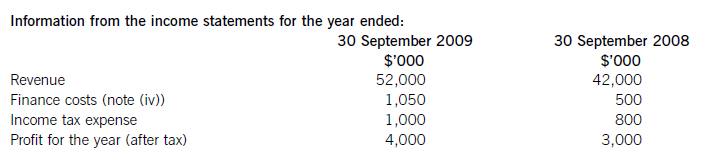
The following information is available:
(i) During the year to 30 September 2009, Crosswire embarked on a replacement and expansion programme for its non-current assets. The details of this programme are:
On 1 October 2008 Crosswire acquired a platinum mine at a cost of $5 million. A condition of mining the
platinum is a requirement to landscape the mining site at the end of its estimated life of ten years. The
present value of this cost at the date of the purchase was calculated at $3 million (in addition to the
purchase price of the mine of $5 million).
Also on 1 October 2008 Crosswire revalued its freehold land for the first time. The credit in the revaluation
reserve is the net amount of the revaluation after a transfer to deferred tax on the gain. The tax rate applicable to Crosswire for deferred tax is 20% per annum.
On 1 April 2009 Crosswire took out a finance lease for some new plant. The fair value of the plant was
$10 million. The lease agreement provided for an initial payment on 1 April 2009 of $2·4 million followed
by eight six-monthly payments of $1·2 million commencing 30 September 2009.
Plant disposed of during the year had a carrying amount of $500,000 and was sold for $1·2 million. The
remaining movement on the property, plant and equipment, after charging depreciation of $3 million, was
the cost of replacing plant.
(ii) From 1 October 2008 to 31 March 2009 a further $500,000 was spent completing the development
project at which date marketing and production started. The sales of the new product proved disappointing
and on 30 September 2009 the development costs were written down to $1 million via an impairment
charge.
(iii) During the year ended 30 September 2009, $4 million of the 10% convertible loan notes matured. The
loan note holders had the option of redemption at par in cash or to exchange them for equity shares on the
basis of 20 new shares for each $100 of loan notes. 75% of the loan-note holders chose the equity option.
Ignore any effect of this on the other equity reserve.
All the above items have been treated correctly according to International Financial Reporting Standards.
(iv) The finance costs are made up of:
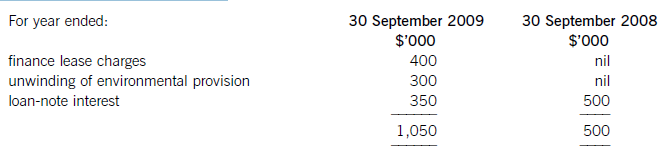
Required:
(i) Prepare a statement of the movements in the carrying amount of Crosswire’s non-current assets for the
year ended 30 September 2009; (9 marks)
(ii) Calculate the amounts that would appear under the headings of ‘cash flows from investing activities’
and ‘cash flows from financing activities’ in the statement of cash flows for Crosswire for the year ended
30 September 2009.
Note: Crosswire includes finance costs paid as a financing activity. (8 marks)
(b) A substantial shareholder has written to the directors of Crosswire expressing particular concern over the
deterioration of the company’s return on capital employed (ROCE)
Required:
Calculate Crosswire’s ROCE for the two years ended 30 September 2008 and 2009 and comment on the
apparent cause of its deterioration.
Note: ROCE should be taken as profit before interest on long-term borrowings and tax as a percentage of equity plus loan notes and finance lease obligations (at the year end). (8 marks)
正确答案:
(i)Thecashelementsoftheincreaseinproperty,plantandequipmentare$5millionforthemine(thecapitalisedenvironmentalprovisionisnotacashflow)and$2·4millionforthereplacementplantmakingatotalof$7·4million.(ii)Ofthe$4millionconvertibleloannotes(5,000–1,000)thatwereredeemedduringtheyear,75%($3million)ofthesewereexchangedforequitysharesonthebasisof20newsharesforeach$100inloannotes.Thiswouldcreate600,000(3,000/100x20)newsharesof$1eachandsharepremiumof$2·4million(3,000–600).As1million(5,000–4,000)newshareswereissuedintotal,400,000musthavebeenforcash.Theremainingincrease(aftertheeffectoftheconversion)inthesharepremiumof$1·6million(6,000–2,000b/f–2,400conversion)mustrelatetothecashissueofshares,thuscashproceedsfromtheissueofsharesis$2million(400nominalvalue+1,600premium).(iii)Theinitialleaseobligationis$10million(thefairvalueoftheplant).At30September2009totalleaseobligationsare$6·8million(5,040+1,760),thusrepaymentsintheyearwere$3·2million(10,000–6,800).(b)TakingthedefinitionofROCEfromthequestion:Fromtheaboveitcanbeclearlyseenthatthe2009operatingmarginhasimprovedbynearly1%point,despitethe$2millionimpairmentchargeonthewritedownofthedevelopmentproject.ThismeansthedeteriorationintheROCEisduetopoorerassetturnover.Thisimpliestherehasbeenadecreaseintheefficiencyintheuseofthecompany’sassetsthisyearcomparedtolastyear.Lookingatthemovementinthenon-currentassetsduringtheyearrevealssomemitigatingpoints:Thelandrevaluationhasincreasedthecarryingamountofproperty,plantandequipmentwithoutanyphysicalincreaseincapacity.Thisunfavourablydistortsthecurrentyear’sassetturnoverandROCEfigures.TheacquisitionoftheplatinummineappearstobeanewareaofoperationforCrosswirewhichmayhaveadifferent(perhapslower)ROCEtootherpreviousactivitiesoritmaybethatitwilltakesometimefortheminetocometofullproductioncapacity.Thesubstantialacquisitionoftheleasedplantwashalf-waythroughtheyearandcanonlyhavecontributedtotheyear’sresultsforsixmonthsatbest.Infutureperiodsafullyear’scontributioncanbeexpectedfromthisnewinvestmentinplantandthisshouldimprovebothassetturnoverandROCE.Insummary,thefallintheROCEmaybeduelargelytotheabovefactors(effectivelythereplacementandexpansionprogramme),ratherthantopooroperatingperformance,andinfutureperiodsthismaybereversed.ItshouldalsobenotedthathadtheROCEbeencalculatedontheaveragecapitalemployedduringtheyear(ratherthantheyearendcapitalemployed),whichisarguablymorecorrect,thenthedeteriorationintheROCEwouldnothavebeenaspronounced. -
第15题:
It can be inferred from the passage that international students in the programs __.
A. get full scholarship
B. pay no tuition
C. get no financial support
D. earn more money
正确答案:C
-
第16题:
Which statement about Yao Ming is NOT true?A.He missed the Athens Olympics.
B.He is an NBA player.
C.He fractured his left foot.
D.He is an international figure.答案:C解析: -
第17题:
共用题干
Going Back to Its Birthplace
No sporting event takes hold of the world's attention and imagination like the Olympic
Games.The football World Cup fascinates fans in Europe and South America;baseball's
World Series is required viewing in North America;and the World Table Tennis
Championships attracts the most interest in Asia.
But the Olympics belong to the whole world.Now,after travelling to 17 countries over
108 years,the summer Games are returning to Athens,the place where the first modern
Olympics was held.
Participation in the Games is looked on not only as an achievement,but also as an
honour. The 1 6 days between August 1 3 and 29 will see a record 202 countries compete,
up from Sydney's 199.Afghanistan is back,having been banned from Sydney because the
Taliban government didn't let women do sports.There is also a place for newcomers East
Timor and Kiribati.
A total of 10,500 athletes will compete in 28 sports,watched by 5.3 million ticket-
paying viewers as well as a television audience of 4 billion.
Athens is to use its rich history and culture to make the Olympics as special as
possible.The Games will open with cycling events which start in front of the Parthenon and
Acropolis monuments.The final event will be a historic men's marathon following the original
route run by Phidippides in 490 BC to bring news of victory over the Persians.
The ancient stadium at Olympia,first used for the Games nearly three centuries ago,
will stage the shot put competitions.And the Panathenian Stadium,where the first modern
Olympics was held,is to host the archery(射箭)events.
If the well-known ancient sites deliver a great sense of history to the Games,the 39
new venues add a modern touch to the city of Athens.The main Olympic stadium,with a
giant glass and steel roof, is the landmark(标志)building of the Olympics.
"We believe that we will organize a'magical'Games,"said Athens 2004 President
Gianna Angelopoulos-Daskalaki. "Our history with the Olympic Games goes back nearly
3,000 years,and Athens 2004 could be the best ever."The Panathenian Stadium is the landmark building of Olympics.
A:Right
B:Wrong
C:Not mentioned答案:B解析: -
第18题:
共用题干
第二篇
Star Quality
A new anti-cheating system for counting the judges' scores in ice skating is flawed,
according to leading sports specialists.Ice skating's governing body announced the new
rules last week after concerns that a judge at the Winter Olympics may have been unfairly
influenced,
Initially the judges in the pairs figure-skating event at the Winter Olympics in Salt Lake
City voted 5 to 4 to give the gold medal to a Russian pair,even though they had a fall during
their routine.But the International Skating Union suspended the French judge for falling to
reveal that she had been put under pressure to vote for the Russians.The International
Olympics Committee then decided to give a second gold to the Canadian runners-up
(亚军).
The ISU,skating's governing body,now says it intends to change the rules.In
future 14 judges will judge each event,but only 7 of their scores一selected at random一will
count.
The ISU won't finally approve the new system until it meets in June but already
U.K.Sport,the British Government's sports body,has expressed reservations."I remain
to be convinced that the random selection system would offer the guarantees that everyone
concerned with ethical sport is looking for",says Jerry Bingham,U.K.Sport's head of
ethics(伦理).
A random system can still be manipulated,says Mark Dixon,a specialist on sports
statistics from the Royal Statistical Society in London."The score of one or two judges who
have been nobbled(受到贿赂)may still be in the seven selected."
Many other sports that have judges,including diving,gymnastics,and synchronized
swimming,have a system that discards the highest and lowest scores.If a judge was
under pressure to favour a particular team,they would tend to give it very high scores and
mark down the opposition team,so their scores wouldn't count.It works for diving,says
Jeff Cook,a member of the international government body's technical committee."If you
remove those at the top and bottom you're left with those in the middle,so you're getting a
reasonable average."
Since the 2000 Olympics in Sydney,diving has tightened up in its system still further.
Two separate panels of judges score different rounds of diving during top competitions.
Neither panel knows the scores given by the other."We have done this to head off any
suggestion of bias,"says Cook:
Bingham urged the ISU to consider other options."This should involve examining the
way in which other sports deal with the problem of adjudicating(裁定)on matter of style
and presentation,"he says.Who won the gold medal in the pairs figure-skating event?
A:The Russian pair.
B:The Canadian pair.
C:Both the Russian pair and the Canadian pair.
D:The French pair.答案:C解析: -
第19题:
We are looking forward to()the Beijing Olympics.
Ahost
Bhosting
Cbe hosted
Dbe hosting
B
略 -
第20题:
问答题The modern Olympic Games are the leading international sporting event nowadays. However, there are constant voices to call for stopping the Olympic Games. The followings are opinions on whether we should abolish the Olympics from different media. Read them carefully and write your response in about 300 words, in which you should: 1. summarize briefly the arguments on both sides; 2. give your comment. Marks will be awarded for content relevance, content sufficiency, organization and language quality. Failure to follow the above instructions may result in a loss of marks.http://camilla.com.au/ The Olympic charter’s call for a “peaceful society” and the “preservation of human dignity” is a very noble one, but its means are rather odd. Through fierce athletic competition between nations, individual rivalries between athletes, who, training for 75% of their waking life, probably play a very little role in their society anyway. The Olympics is an arena for individual achievement: however, if someone is to win a race, others must lose. Emphasis is not placed on athletes improving their personal best but on who wins. Having many nations come together shows worldwide solidarity, but it is a strange sort of solidarity, nations united by their athletes in Lycra and branded shoes. The cultures of nations are shown by little more than flag waving and the appearance of their mascots.The Guardian The original “spirit” of the Olympics was supposedly that of sporting competition between amateurs who competed for the honor of doing so, and to test themselves against the best sportspeople from around the world. However, the Olympics has become ever more commercialized, high-jacked by corporations and turned into a giant advertising hoarding. The kinds of moneys and rewards potentially available from excelling on the international stage has served to incentivise not only professionalization, also corruption and cheating. The professed aspirations of the Olympic movement and the grubby reality of the contemporary Olympics are now utterly opposed.The New York Times Citizens of the host city, often uninterested in the Olympic spectacle, can end up having to foot the bill by paying extra taxes, or having their existing taxes routed away from other services. The construction of Olympic facilities, company investment and the regeneration of areas in host cities can be very disruptive, pricing local residents and shopkeepers out of their areas. Building an Olympic site can necessitate the demolition of homes and historical places. Previous Olympics have shown that Olympic resources, when the games are over, do not always benefit the host city or society. Olympic sites can become ghost towns, so characteristic of the year they were built in as to be aesthetically odd, impractical, inhospitable and unfashionable a decade later.TIME The athletes competing in the Olympic games have worked hard for years, showing dedication to achieving physical greatness. They keep to a strict diet, and put in hundreds of hours training in a week, all for the honor of competing against the best athletes in the world. Those that are caught cheating are dealt with harshly, which teaches against honesty and dedication to one’s dreams. Athletes dedicate the best part of their lives to this ideal, by constantly improving their performance. Individual performance stands here for “celebration of collective values”—including that of fair competition. Individual athletes represent whole nations—their competing actualizes transnational togetherness and the search for commonality and global cooperation. Above all, the Olympic spirit is a beacon of hope. Countless times the games have instilled hope and togetherness in many. In a world of growling animosity, it is encouraging to see a sense of peace and togetherness gather every four years.正确答案:
【参考范文】
The Olympic Games Shouldn’t Be Abolished There are different voices about whether the modern Olympic Games should be abolished. As the article covered on The Guardian,the modern Olympic Games are highly commercialized, prohibitively costly, and void of social benefits. So these people think that this global event should better be cancelled. On the other hand, the Olympic Games advocate world peace, friendship and hope, media like TIME believes that it is of great significance to hold Olympic Games. As a huge sports fan, I am strongly against the idea of abolishing this global sports gala.
The movement should have its own place in the international community mainly for three reasons. Firstly, the Olympic Games provide an international arena for players from all over the world to compete with each other, show human talents and challenge physical limit. Through participating in the Olympic Games, people break more and more records. It is someone’s dream to win an Olympic medal after years of training and whenever we meet problems, we will draw upon the spirit of “faster, higher and stronger”. Besides, the Games can also promote mutual communication between different countries. Thirdly, the influx of foreign visitors would greatly facilitate the development of the economy in the host city and in order to make the full use of Olympic facilities, we are building more practical facilities.
In conclusion, we humanity would suffer a great loss if modern Olympic Games be abolished. As for some fixable issues, such as resources wasting, we are figuring out ways to deal with that with the help of modern technology. It is unwise to throw the baby out with the bath water. The Olympic Games are a vital platform for us to excel ourselves and forge abounds cross national borders.解析:
【审题构思】
本篇文章就是否应该取消奥运会展开讨论,文章共涉及四家媒体的看法,其中前一则报道认为应该取消奥运会,最后一则报道则认可奥运会的存在价值。根据题目的要求,考生可采取以下的布局:
第一段:总结新闻报道涉及的主要观点,并说明理由,如取消奥运会主要是考虑到奥运变得越来越商业化,且成本高、社会效益低等,而支持奥运会则是认为奥运给人带来希望,有助于世界和平;提出个人见解,即奥运会不应被取消。
第二段:指出奥运会两个重要贡献。其一,奥运会是重要平台,展示人类无尽的才能与潜力;其二,奥运会能够促进各过交流;第三,奥运会能在一定程度上促进主办国经济发展。
第三段:总结全文,奥运会在当今世界仍然有着重要的作用。 -
第21题:
单选题He is()about his chances of winning a gold medal in the Olympics next year.Aoptimistic
Boptional
Coutstanding
Dobvious
正确答案: B解析: 暂无解析 -
第22题:
填空题The International festival of music and the arts is held every year in the city of()正确答案: Edinburgh解析: 暂无解析 -
第23题:
单选题We will show how the International Olympics have commercialized internationally, and are financed from corporate and private sponsorships and how this funding scenario can be used to fund new projects.Awithin
Binto
Cthrough
Dthan
正确答案: B解析: 固定搭配题。句意:我们将展示国际奥林匹克运动会如何已在世界范围内商业化,并且如何通过社团和私人赞助商筹措资金;我们还将展示这种积聚基金的方法如何运用于投资新的计划。finance在这里意为“筹措资金”,因此答案为C。