
问答题Some parents believe that a weeklyallowance help children to appreciate the importance of good moneymanagement A B C Dskills. No error E
题目
相似考题
更多“问答题Some parents believe that a weeklyallowance help children to appreciate the importance of good moneymanagement A B C Dskills. No error E”相关问题
-
第1题:
Many children, parents are away working in big cities,are taken good care of in the village.
A.theirB.whose
C.ofthemD.withwhom
正确答案:B
-
第2题:
Children in the United States are exposed to many influences other than that of their families. Television is the most significant of these influences, because the habit of watching television usually begins before children start attending school.
Parents are concerned about the lack of quality in television programs for children. The degree of violence in many of these shows also worries them. Studies indicate that, when children are exposed to violence, they may become aggressive or insecure.
Parents are also concerned about the commercials (商业广告) that their children see on television. Many parents would like to see fewer commercials during programs for children. And some parents feel that these shows should not have any commercials at all because young minds are not mature enough to deal with the claims made by advertisers.
Educational television has no commercials and has programs for children that many parents approve of. The most famous of these is Sesame Street, which tries to give preschool children a head start in learning the alphabet (字母) and numbers. It also tries to teach children useful things about the world in which they live.
Even though most parents and educators give Sesame Street and shows like it high marks for quality, some critics argue that all television, whether educational or not, is harmful to children. These critics feel that the habit of watching hours of television every day turns children into bored and passive (被动的) consumers of their world rather than encouraging them to become active explorers of it
1). Which of the following statements is not based on the passage?
A. Parents are worried about the influence from television on their children.
B. Television has much influence on children.
C. Both parents and their children like watching educational television.
D. Some critics think that television is no good for children.
2). In what ways do children suffer from television?
A. They become the victims of social violence.
B. They spend hours watching television instead of doing school work.
C. The programs make the children lose interest in the world.
D. The programs make the children spend too much of their parents’ money.
3). Parents would not like their children to see commercials because ______
A. they think that their children are not old enough to handle advertising
B. commercials teach children alphabet and numbers
C. commercials help to sell products
D. they don’t like commercials
4). Educational television is widely appreciated because _____
A. it does have the same commercials as others
B. it offers programs for both children and their parents
C. many parents like the programs it offers for their children
D. children can learn some school subjects before they go to school
5). Which of the following can best serve as the title of the passage?
A. Watching Too Much Television Is Harmful to Young Minds.
B. Television Is More Harmful than Educational.
C. Television’s Influence on Children.
D. More Education Television.
正确答案:1.C2.A3.A4.D5.A
-
第3题:
We can infer from the passage that().A、most parents believe reading to be beneficial to children B、efforts to get kids interested in reading have been fruitful
C、most children will turn to reading with TV sets switched off
D、extracurricular activities promote children's intelligence
正确答案: B
-
第4题:
Which of the following statements would the writer agree to?
A. It is important to have the right food for children。
B. It is a good idea to have the TV on during dinner。
C. Parents should talk to each of their children frequently。
D. Elder children should help the younger ones at dinner
正确答案:C对错判断题。A原文没有提到,B和D可以用排除法排除。 -
第5题:
共用题干
Home Schooling
All children in the United States have to receive an education,but the law does not say they have to be educated at school. A number of parents prefer not to send their children to school.
______(46)There are about 300,000 home-schoolers in the United States today.Some parents prefer teaching their children at home because they do not believe that public schools teach the correct religious values;others believe they can provide a better educational experience for their children by teaching them at home.______(47)
David Guterson and his wife teach their three children at home.Guterson says that his children learn very differently from children in school.______(48)For example,when there is heavy snowfall on a winter day,it may start a discussion or reading about climate,snow removal (去除)equipment , Alaska , polar bears(北极熊),and winter tourism. A spring evening when the family is out watching the stars is a good time to ask questions about satellites and the space program.______(49)
Home schooling is often more interesting than regular schools,but critics say that home-schoolers are outsiders who might be uncomfortable mixing with other people in adult life. ______(50)However,most parents don't have the time or the desire to teach their children at home,so schools will continue to be where most children get their formal education.______(49)
A: Interestingly,results show that home-schooled children quite often do better than average on national tests in reading and math.
B: Critics also say that most parents are not well qualified to teach their children.
C: Learning starts with the children's interests and questions.
D: Children who are educated at home are known as“home-schoolers.”
E: In some countries,however,children are educated by their parents.
F: If the Brazilian rain forests are on the TV news,it could be a perfect time to talk about how rain forests influence the climate,and how deserts are formed.答案:F解析:空前讲到很多家长不愿把孩子送到学校里去接受教育。空后面说目前美国有大约 30万儿童是“home-schoolers”。所以空中应该引入“home-schoolers”这个词。因此D项正确。
空前说有些家长喜欢在自己家里教孩子,因为他们认为公立学校不能教给孩子正确的宗教价值观,一些家长认为孩子在家里接受的教育会好一点,选项中只有A项最合适。因此A项正确。
空前说Guterson认为孩子在家里的学习方式与在学校里有很多不同。空中内容就应该是与学习方式有关的。因此C项正确。
空前主要叙述如何从孩子们感兴趣的问题出发教孩子学习。F项通过举例说明如何通过孩子们感兴趣的话题来教育他们。因此F项正确。
空前一句主要讲批评者认为孩子在学校之外与成人交往可能有些不适应的地方。 B项内容仍是批评者的态度,与前句连贯,因此B项正确。 -
第6题:
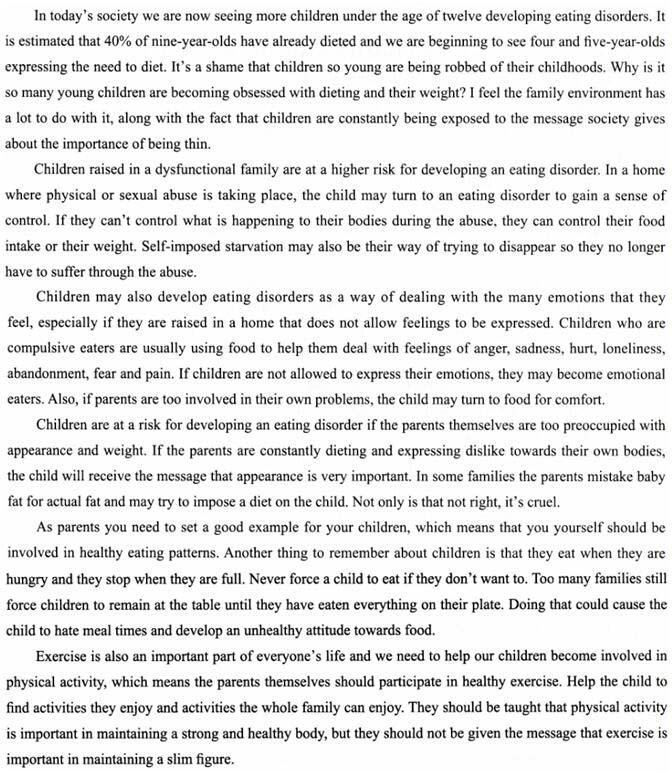
When the children are doing body exercises,the parents should NOT( )A.explain the importance of physical activity in keeping people shaped and slim
B.also take part in the activities by themselves
C.try to find out activities that are suitable for the children
D.encourage the children to participate in physical activities答案:A解析:
-
第7题:
Questions 16 to 20 are based on the following passage. In a time of low academic achievement by children in the United States, many Americans are turning to Japan, a country of high academic achievement and economic success, for possible answers. However, the answers provided by Japanese preschools are not the ones Americans expected to find. In most Japanese preschools, surprisingly little emphasis is put on academic instruction. In one investigation, 300 Japanese and 210 American preschool teachers, child development specialists, and parents were asked about various aspects of early childhood education. Only 2 percent of the Japanese respondents (答问卷者) listed “to give children a good start academically” as one of their top three reasons for a society to have preschools. In contrast, over half the American respondents chose this as one of their top three choices. To prepare children for successful careers in first grade and beyond, Japanese schools do not teach reading, writing, and mathematics, but rather skills such as persistence, concentration, and the ability to function as a member of a group. The vast majority of young Japanese children are taught to read at home by their parents. In the recent comparison of Japanese and American preschool education, 91 percent of Japanese respondents chose providing children with a group experience as one of their top three reasons for a society to have preschools. Sixty-two percent of the more individually oriented (强调个性发展的) Americans listed group experience as one of their top three choices. An emphasis on the importance of the group seen in Japanese early childhood education continues into elementary school education. Like in America, there is diversity in Japanese early childhood education. Some Japanese kindergartens have specific aims, such as early musical training or potential development. In large cities, some kindergartens are attached to universities that have elementary and secondary schools. Some Japanese parents believe that if their young children attend a university-based program, it will increase the children’s chances of eventually being admitted to top-rated schools and universities. Several more progressive programs have introduced free play as a way out for the heavy intellectualizing in some Japanese kindergartens. Most Americans surveyed believe that preschools should also attach importance to ()
- A、problem solving
- B、group experience
- C、parental guidance
- D、individually-oriented development
正确答案:B -
第8题:
Questions 16 to 20 are based on the following passage. In a time of low academic achievement by children in the United States, many Americans are turning to Japan, a country of high academic achievement and economic success, for possible answers. However, the answers provided by Japanese preschools are not the ones Americans expected to find. In most Japanese preschools, surprisingly little emphasis is put on academic instruction. In one investigation, 300 Japanese and 210 American preschool teachers, child development specialists, and parents were asked about various aspects of early childhood education. Only 2 percent of the Japanese respondents (答问卷者) listed “to give children a good start academically” as one of their top three reasons for a society to have preschools. In contrast, over half the American respondents chose this as one of their top three choices. To prepare children for successful careers in first grade and beyond, Japanese schools do not teach reading, writing, and mathematics, but rather skills such as persistence, concentration, and the ability to function as a member of a group. The vast majority of young Japanese children are taught to read at home by their parents. In the recent comparison of Japanese and American preschool education, 91 percent of Japanese respondents chose providing children with a group experience as one of their top three reasons for a society to have preschools. Sixty-two percent of the more individually oriented (强调个性发展的) Americans listed group experience as one of their top three choices. An emphasis on the importance of the group seen in Japanese early childhood education continues into elementary school education. Like in America, there is diversity in Japanese early childhood education. Some Japanese kindergartens have specific aims, such as early musical training or potential development. In large cities, some kindergartens are attached to universities that have elementary and secondary schools. Some Japanese parents believe that if their young children attend a university-based program, it will increase the children’s chances of eventually being admitted to top-rated schools and universities. Several more progressive programs have introduced free play as a way out for the heavy intellectualizing in some Japanese kindergartens. We learn from the first paragraph that many Americans believe ()
- A、Japanese parents are more involved in preschool education than American parents
- B、Japan’s economic success is a result of its scientific achievements
- C、Japanese preschool education emphasizes academic instruction
- D、Japan’s higher education is superior to theirs
正确答案:C -
第9题:
单选题Questions 16 to 20 are based on the following passage. In a time of low academic achievement by children in the United States, many Americans are turning to Japan, a country of high academic achievement and economic success, for possible answers. However, the answers provided by Japanese preschools are not the ones Americans expected to find. In most Japanese preschools, surprisingly little emphasis is put on academic instruction. In one investigation, 300 Japanese and 210 American preschool teachers, child development specialists, and parents were asked about various aspects of early childhood education. Only 2 percent of the Japanese respondents (答问卷者) listed “to give children a good start academically” as one of their top three reasons for a society to have preschools. In contrast, over half the American respondents chose this as one of their top three choices. To prepare children for successful careers in first grade and beyond, Japanese schools do not teach reading, writing, and mathematics, but rather skills such as persistence, concentration, and the ability to function as a member of a group. The vast majority of young Japanese children are taught to read at home by their parents. In the recent comparison of Japanese and American preschool education, 91 percent of Japanese respondents chose providing children with a group experience as one of their top three reasons for a society to have preschools. Sixty-two percent of the more individually oriented (强调个性发展的) Americans listed group experience as one of their top three choices. An emphasis on the importance of the group seen in Japanese early childhood education continues into elementary school education. Like in America, there is diversity in Japanese early childhood education. Some Japanese kindergartens have specific aims, such as early musical training or potential development. In large cities, some kindergartens are attached to universities that have elementary and secondary schools. Some Japanese parents believe that if their young children attend a university-based program, it will increase the children’s chances of eventually being admitted to top-rated schools and universities. Several more progressive programs have introduced free play as a way out for the heavy intellectualizing in some Japanese kindergartens. Why do some Japanese parents send their children to university-based kindergartens?()AThey can do better in their future studies.
BThey can accumulate more group experience there.
CThey can be individually oriented when they grow up.
DThey can have better chances of getting a first-rate education
正确答案: B解析: 暂无解析 -
第10题:
问答题Some people believe that a college or university education should be available to all students. Others believe that higher education should be available only to good students. Which view do you agree with and why?正确答案:
Most universities require the completion of a secondary, or high school education for admission. They also require proof of academic performance to guarantee that the student has the knowledge and skills needed to successfully complete their higher education. I believe that if a student has a poor academic record through their primary and secondary education,they should not be allowed to attend university.
In the first place, a university education should be considered a privilege, not a right. A consistent effort must be made through the first two lower stages of a person’s education in order for them to earn the right to study in university. When I was in high school, I saw many students skip class regularly to shop, smoke drugs, or just because they “didn’t feel like” going to class. The obvious result was low grades. These students were all at least 17 or 18 years old, old enough to understand the value of their education. However, they did not value their secondary education and therefore,in my opinion, should not have the opportunity to study in university.
In the second place, because education is cumulative, a student must work consistently through primary and secondary school to master facts and establish a foundation of knowledge in order to meet the demanding academic requirements of university courses. In primary and secondary school, students have the opportunity to develop their writing skills and analytical abilities, both essential to learn to cope with the challenges of higher learning. For students without the appropriate skills,success is unlikely. One university I attended published statistics showing a 50% dropout rate for first year students; the main reason listed was that the students were unprepared for the rigor of university life.
In the third place, the limited educational resources at present in China make it almost impossible to provide every student with a college or university education. This means that students have to fight for their admission to the colleges and universities. As long as the present competition for higher education goes, it is not realistic to talk about letting every student have higher education. Competition for a successful walk through the single—plank bridge of college entrance examination is the most fair way to determine that privilege to higher education in China.
Many people take their education for granted. In my high school, most people only needed to make a little effort to maintain an A or B average, but there were still many people who weren’t willing to make any effort at all. I am sure that these people without proven track records should not, have the privilege of attending university’ especially when higher education resources are not abundant.解析:
文章引文段作者用I believe that…明确表明了论点,即初等和中等教育阶段成绩差的学生不应被大学录取。正文部分作者从三方面论证自己的观点:高等教育应该是特权,而不是权利;上大学应该具有足够的知识积累;中国的现状不允许给每个人都提供高等教育。在论据方面用到了逻辑推理、举例、列数字等方法。文章结尾部分简洁明了,与首段形成了照应。 -
第11题:
问答题Practice 4 The line of demarcation between the adult and the child world is drawn in many ways. For instance, many American parents may be totally divorced from the church, or entertain grave doubts about the existence of God, but they send their children to Sunday school and help them to pray. American parents struggle in a competitive world where sheer cunning and falsehood are often rewarded and respected, but they feed their children with nursery tales in which the morally good is pitted against the bad, and in the end the good inevitably is successful and the bad inevitably punished. When American parents are in serious domestic trouble, they maintain a front of sweetness and light before their children. Even if American parents suffer a major business or personal catastrophe, they feel obliged to turn to their children and say, “Honey, everything is going to be all right.” This American desire to keep the children’ s world separate from that of the adult is exemplified also by the practice of delaying transmission of the news to children when their parents have been killed in an accident. Thus, in summary, American parents face a world of reality while many of their children live in a near-ideal unreal realm where the rules of the parental world do not apply, are watered down, or are even reversed.正确答案: 【参考译文】
成人世界和儿童世界在许多方面泾渭分明。比如说,许多美国人可能从来不去教堂,或者对上帝是否存在十分怀疑,但是他们却会把孩子送到主日学校,教会他们祈祷。美国人生存的社会充满竞争,尔虞我诈才能名利双收,但是在他们教育孩子的幼儿故事里,在好人与坏人的斗争中最终却总是善有善报、恶有恶报。如果美国人出现严重的家庭危机,在孩子们面前,他们表面上却仍然是温柔可亲。即使工作、生活遭遇重大挫折,他们也认为有必要对孩子说:“宝贝儿,一切都会好起来的。”如果大人遭遇事故身亡,不会立刻把噩耗告诉孩子,这种做法也可以说明美国人希望让孩子的世界和成人的世界分离开来。因此,总的来说,美国人生活在现实的世界中,孩子则生活在一个几乎完美的天地里,这里成人世界的规则则不适用,淡化了,甚至完全相反。解析: 暂无解析 -
第12题:
问答题Some people think that parents should plan their children's leisure time carefully. Others believe that children should decide for themselves how to spend their free time. Which opinion do you agree? Write a composition of about 400 words to state your view.正确答案:
Childhood is a decisive period in the process of one's growth. Therefore, many people think that parents should carefully plan not only their children's school education but also their spare time. Other people, however, argue that children should have the freedom to plan their own extracurricular life. On balance, I would side with those parents who respect children's freedom and independence.
If children have the freedom to make decisions on how to spend their spare time and develop their interests, they will gradually form a sense of responsibility and become more capable in the world. Take myself as a good example. My parents are like good teachers and helpful friends in my life. As I remember, they never excessively interfered with my life and always left enough freedom to me so that I could embark upon what I liked to do in my spare time. They quite understood that my weekdays were occupied with a heavy workload, and that only in my spare time I could have a change of pace. Meanwhile, although mutual understanding and tolerance were an important part of my childhood life, in no way does it mean that they spoiled me. They were austere teachers when I made mistakes, and helpful friends when I came across difficulties. Owing to their understanding, tolerance, guidance, and above all, love, I have grown up to be a person of self-confidence, optimism, and independence, ready to meet any challenges in my life. Without the free family environment that my parents carefully designed for me, I wouldn't have lived such a happy life.
On the contrary, some parents expect too much of their children, depriving them of all their independence and freedom. These parents would rather sacrifice their children's interests and happiness for nothing but good scores, thus resulting in serious misunderstanding between parents and children. Some parents even went so far as to plan their children's schedule, filling every minute with study task. In this ease, children are deprived of happiness because they are bound hand and foot by endless homework, numerous exams and boring evening or weekend classes. Furthermore, having no freedom to plan their own life, these children are more likely to become introvert, heavily dependent on their parents when they grow up. This will definitely affect their growth. For one thing, since they have no opportunity to develop their independent thinking and explore their potential, they will find it very difficult to adjust themselves to the competitive society. For another, confining them in an ivory tower will make it hard for them to communicate with others. This will affect their career development in the future because the communication between people plays a major role in the workplace, and is one of the most important elements in achieving career success. Obviously, parents' excessive interference with children's after-school life, if carried to the extreme, can cause serious damage to both their happy childhood and their career in the future.
To sum up, I believe that parents should leave enough freedom and privacy to their children with a view to cultivating their character. As long as parents allow their children the necessary freedom accompanied by careful guidance, their children will grow up to be independent, responsible and successful.解析:
题目要求对“家长是否应该决定孩子课余时间干什么”的问题发表看法。范文作者在引言段表明家长应该尊重孩子的自由。第二段作者以自己的经历为例说明孩子自己做决定的好处。第三段阐述家长做决定的坏处,其中使用On the contrary、Furthermore、For one thing…For another等表达使行文更加流畅。最后一段总结全文。 -
第13题:
Parents ___much importance to education. They will do their best to give their children that priceless gift.
A.attach
B.pay
C.link
D.apply
正确答案:A
-
第14题:
Parents transmit some of their()to their children.
A. characteristics
B. character
C. characteristic
参考答案:A
-
第15题:
______, parents must set a good example for their children.()A、 Generally
B、 Obviously
C、 Fortunately
D、 Unnecessarily
参考答案:B -
第16题:
According to the surveys in the U. S., _____.
[A] bullying among adults is also rising [B] parents are not supervising their children well
[C] parents seldom believe bullies [D] most parents resort to calling to deal with bullying
正确答案:B
-
第17题:

Which of the following is the suggestion that the author gives to the parents?( )A.Parents must encourage the children to express their feelings.
B.Parents must be deeply involved in their children’s problems.
C.Parents must pay more attention to their outlook to show their children the importance of appearance and weight.
D.Parents must teach their children to eat everything in their plates.答案:A解析:
-
第18题:

Which of the following is the suggestion that the author gives to the parents?( )A.Parents must encourage the children to express their feelings
B.Parents must be deeply involved in their children’s problems
C.Parents must pay more attention to their outlook to show their children the importance of appearance and weight
D.Parents must teach their children to eat everything in their plates答案:A解析:
-
第19题:
Questions 16 to 20 are based on the following passage. In a time of low academic achievement by children in the United States, many Americans are turning to Japan, a country of high academic achievement and economic success, for possible answers. However, the answers provided by Japanese preschools are not the ones Americans expected to find. In most Japanese preschools, surprisingly little emphasis is put on academic instruction. In one investigation, 300 Japanese and 210 American preschool teachers, child development specialists, and parents were asked about various aspects of early childhood education. Only 2 percent of the Japanese respondents (答问卷者) listed “to give children a good start academically” as one of their top three reasons for a society to have preschools. In contrast, over half the American respondents chose this as one of their top three choices. To prepare children for successful careers in first grade and beyond, Japanese schools do not teach reading, writing, and mathematics, but rather skills such as persistence, concentration, and the ability to function as a member of a group. The vast majority of young Japanese children are taught to read at home by their parents. In the recent comparison of Japanese and American preschool education, 91 percent of Japanese respondents chose providing children with a group experience as one of their top three reasons for a society to have preschools. Sixty-two percent of the more individually oriented (强调个性发展的) Americans listed group experience as one of their top three choices. An emphasis on the importance of the group seen in Japanese early childhood education continues into elementary school education. Like in America, there is diversity in Japanese early childhood education. Some Japanese kindergartens have specific aims, such as early musical training or potential development. In large cities, some kindergartens are attached to universities that have elementary and secondary schools. Some Japanese parents believe that if their young children attend a university-based program, it will increase the children’s chances of eventually being admitted to top-rated schools and universities. Several more progressive programs have introduced free play as a way out for the heavy intellectualizing in some Japanese kindergartens. Why do some Japanese parents send their children to university-based kindergartens?()
- A、They can do better in their future studies.
- B、They can accumulate more group experience there.
- C、They can be individually oriented when they grow up.
- D、They can have better chances of getting a first-rate education
正确答案:D -
第20题:
Questions 16 to 20 are based on the following passage. In a time of low academic achievement by children in the United States, many Americans are turning to Japan, a country of high academic achievement and economic success, for possible answers. However, the answers provided by Japanese preschools are not the ones Americans expected to find. In most Japanese preschools, surprisingly little emphasis is put on academic instruction. In one investigation, 300 Japanese and 210 American preschool teachers, child development specialists, and parents were asked about various aspects of early childhood education. Only 2 percent of the Japanese respondents (答问卷者) listed “to give children a good start academically” as one of their top three reasons for a society to have preschools. In contrast, over half the American respondents chose this as one of their top three choices. To prepare children for successful careers in first grade and beyond, Japanese schools do not teach reading, writing, and mathematics, but rather skills such as persistence, concentration, and the ability to function as a member of a group. The vast majority of young Japanese children are taught to read at home by their parents. In the recent comparison of Japanese and American preschool education, 91 percent of Japanese respondents chose providing children with a group experience as one of their top three reasons for a society to have preschools. Sixty-two percent of the more individually oriented (强调个性发展的) Americans listed group experience as one of their top three choices. An emphasis on the importance of the group seen in Japanese early childhood education continues into elementary school education. Like in America, there is diversity in Japanese early childhood education. Some Japanese kindergartens have specific aims, such as early musical training or potential development. In large cities, some kindergartens are attached to universities that have elementary and secondary schools. Some Japanese parents believe that if their young children attend a university-based program, it will increase the children’s chances of eventually being admitted to top-rated schools and universities. Several more progressive programs have introduced free play as a way out for the heavy intellectualizing in some Japanese kindergartens. Free play has been introduced in some Japanese kindergartens in order to ()
- A、broaden children’s horizon
- B、cultivate children’s creativity
- C、lighten children’s study load
- D、enrich children’s knowledge
正确答案:C -
第21题:
单选题The first and most important thing parents should do to help their children is _____.Ato provide them with a safer environment
Bto lower their expectations for them
Cto get them more involved socially
Dto set a good model for them to follow
正确答案: A解析:
细节题。第四段阐述了当务之急是培养孩子更加懂得个人主义的限度,加强社会的联系,才能保护个人免遭精神压力。C项符合原文。 -
第22题:
单选题It is better for parents _____.Ato praise and encourage their children more often
Bto be hard on their children
Cto leave their children alone with nothing to do
Dto give their children as much help as possible
正确答案: C解析:
推理题。文章主要是讲述如何培养孩子的智力的问题,父母如何做才能有利于孩子的智力发展呢?相关段落是第二和第三段;A选项“经常称赞并鼓励孩子”和原文“So it is probably better for parents to say very positive (helpful) things to their children”意思相符。B选项“对孩子要求非常严厉苛刻”;C选项“让孩子无所事事”;D选项“给予孩子尽可能多的帮助”。 -
第23题:
问答题练习1 Parents in China are always trying to help their children, even to make the most important decision for them, regardless of what the children really want, because parents believe it’s all for the benefit of their children. This has led to the result that the children’s growth and education tend to give way to their parents’ wishes. Once the parents decide to sign up an after school class for their children in order to increase their chance of being admitted to a good school, they will stick on their decision, even their children have no interest in it at all. In America, however, parents tend to respect their children, especially when making decisions. Perhaps it is commendable that Chinese parents lay much importance on education, but Chinese parents still need to keep the balance between the parents and children in the perspective of education as the American parents do.正确答案: 在中国,父母总是试图帮助他们的孩子,甚至为他们做重要的决定,而不管孩子想要什么,因为父母相信这样做是为了孩子好。结果,孩子的成长和教育往往屈从于父母的愿望。一旦父母决定为他们的孩子报名参加一个课外班,以增加他们被好学校录取的机会,他们会坚持自己的决定,即使他们的孩子根本不感兴趣。然而在美国,父母往往尊重孩子的意见,尤其是在做决定的时候。也许中国父母非常重视教育是值得称赞的。但是,他们应该向美国父母学习在涉及教育时如何平衡父母与孩子之间的关系。解析:
本题考查的翻译要点有:①regardless of,即不管某种情况;②for the benefit of sb意为“为了某人好”;③give way to表示“屈从于”;④lay much importance on意为“非常重视”;⑤keep the balance between…and…意为“保持……与……之间的平衡”;⑥in the perspective of表示“在……方面,涉及……”。