
单选题________aims to help students to pay attention to teaching content efficiently at the beginning of the class.A Lead-inB PresentationC PreparationD Practice
题目
Lead-in
Presentation
Preparation
Practice
相似考题
更多“________aims to help students to pay attention to teaching c”相关问题
-
第1题:
a language lesson plan usually has the following components: background information, teaching aims, language contents and skills, stages and procedures, teaching aids, assignments and _________.
:A. teachers’ after-lesson reflection
B. students’ after-lesson reflection
C. teachers’ after-lesson feedback
D. students’ after-lesson feedback
正确答案是:A
-
第2题:
After teaching sounds, a teacher makes a test that aims to find out which sounds students are not able to pronounce. This test belongs to__________.A. aptitude test
B. proficiency test
C. achievement test
D. diagnostic test答案:D解析:考查教学评价。教了语音之后,教师做测试以便检查学生哪些音不会发,这属于诊断性测验(diagnostic test)。aptitude test“能力倾向测验”,proficiency test“水平测试”,achievement test“成就测试”。 -
第3题:
______ aims to help students to pay attention to teaching contents efficiently at the beginning of the class.A.Lead-in
B. Presentation
C. Preparation
D.Practice答案:A解析:考查教学环节。
本题问的是上课一开始旨在帮助学生注意教学内容,由关键词“at the beginning of the class”可知,应选导入,导入为教学环节的第一步。综上,A选项正确。
B选项,Presentation,呈现新知识环节,故排除。
C选项,Preparation,准备,并非教学环节,故排除。
D选项,Practice,练习环节,故排除。
故正确答案为A项。 -
第4题:
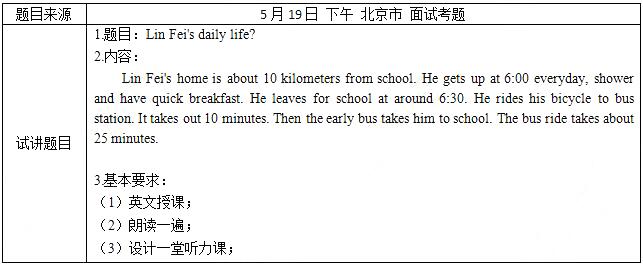
二、考题解析
【教案】
Teaching Aims:
Knowledge aim: Students will be able to describe their daily life and acquire some knowledge about listening strategies.题目来源于考生回忆
Ability aim: Students can obtain the main idea quickly from the listening material and develop the ability of grasping detail information.
Emotional aim: Students can foster the interest and desire of learning English, and be fond of taking part in kinds of practical activities.
Teaching Key Points:
Students can get the main idea and useful information from the listening material.
Teaching Difficult Points:
Students can apply these skills in their listening and apply these expression in their daily communication.
Teaching Methods:
Communicative teaching method, task-based teaching method, audio-lingual teaching method.
Teaching Aids:题目来源于考生回忆
PPT, Blackboard, recorder and so on
Teaching Procedures:
Step 1: Warming up
1.Greetings
2.Sing an English song It' my life, invite the whole students to clap when singing together and lead to the topic.
Step 2: Pre-listening
1.Free talk: Give students three minutes to talk about their own daily life and invite them to share it.
2.Prediction: Let students work in pairs and ask them to predict Lin Fei's daily life.
Step 3: While-listening
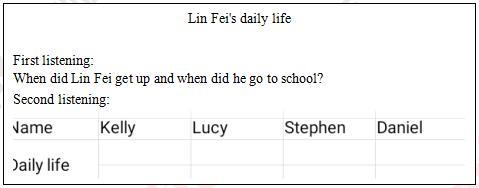
1. Listen to the tape for the first time and ask them when Lin Fei gets up and when he goes to school, then let students to share answers.题目来源于考生回忆
2.Listen to the tape for the second time and ask them to fill in the chart, then invite them to share their answers.
Step 4: Production
1.Retelling: Ask students to retell Lin Fei's daily life with the help of the chat in their own words, and teacher will give them 3 minutes to prepare it and 3 minutes later, invite some students to share their retelling in the front.
2.Survey: Let students discuss their own daily life in the group of four and make a report in the form of chart. 8 minutes later teacher invites some groups to share the result of their reports.
Step 5: Summary & Homework
Summary : Invite a little teacher to help teacher make a summary of this class.
Homework: Let students introduce their daily life to their parents and make a share in the next class.
Blackboard design:
 答案:解析:暂无解析
 -
第5题:
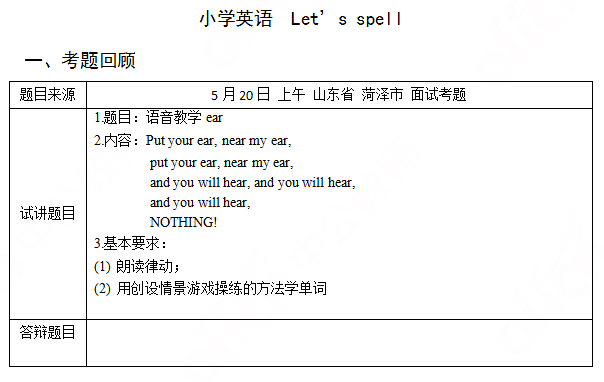
二、考题解析
【教案】
Teaching aims:
Knowledge aim: Students can understand the pronunciation of “ear”, and get some simple spelling rules.
Ability aim: Students can read the words with the pronunciation of “ear” correctly by listening and speaking. Ability of listening and speaking will be improved.
Emotional aim: Students can increase their interests in learning English.
Key and difficult point:
Key points: Students can understand the pronunciation of “ear”, and how how to read the words contain “ear”, such as hear, near and etc.
Difficult points: Students can master the pronunciation of “ear” and read the related words correctly.
Teaching procedure:
Step 1: Warming-up
Greeting the students.
Sing a song: Head shoulder keens and toes.
Step 2: Presentation
1. Show the chant and ask the students the question: Can you find the same letter combination in these words?
2. Listen to the tape and let students pay attention to the pronunciation of “ear”, and then ask the students question: what does “ear” sounds like in these words?
3. Teacher the pronunciation of “ear” ,and let students pay attention to the teacher’s mouth.
4. Game: Play the finger show to practice the new words.
Step 3: Practice
Find more words with “ear” such as tear, dear, clear... and ask students to try to read by themselves and then invite some of them to share with the class. The teacher should act the role of monitor.
Step4: Production
1. Ask students to make up their own sentences by using the words learned today, such as “He hears the bad news,and then his tears falls down. ”.
2. Reading competition: let students to read the chant as quickly as possible, and then let students choose the best one.
Step5: Summary and homework
1. Summary: ask students summary what have learned in the class.
2. Homework:
(1) read these word after class.
(2) Find more words with “ear” and make another chant.
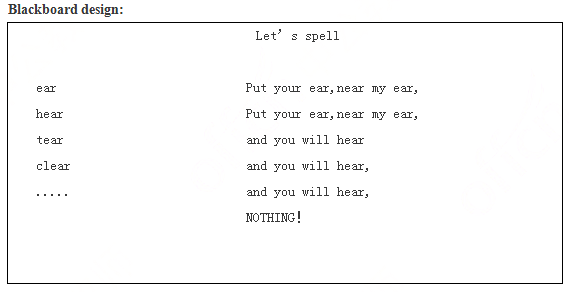 答案:解析:暂无解析
 -
第6题:

二、考题解析
【教案】
Teaching Aims:
Knowledge aims:
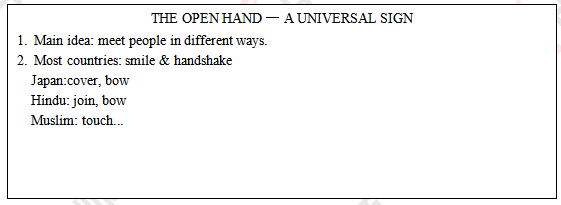
(1) Students will master two difficult words,such as universal, unfamiliar.
(2) Students will learn knowledge about body language.
Ability aim: Students are able to understand the meaning of body language in their daily life and can improve the ability in scanning and skimming.
Emotional aim: Students can show their feelings with body language in reality.
Teaching Key Points:
Students can know the meaning of various body languages.
Teaching Difficult Points:
Students are able to express their feelings with body language in reality..
Teaching Methods:
Communicative teaching method, task-based teaching method, situational teaching method.
Teaching Aids:
PPT, Blackboard and so on
Teaching Procedures:
Step 1: Warming up
1.Greetings
2.Play a clip from a popular American TV series Lie to me (many body languages are shown in it), invite two students to talk about their feelings.
Step 2: Pre-reading
1.Let’s say. Lead students to talk about body languages that we usually see in our daily life.
Step 3: While-reading
1.Fast reading. Read the passage for the first time and ask students to summarize the main idea.
2.Careful reading. Read the passage for the second time with questions.
(1) How many body languages are mentioned in the passage when we meet others?
(2) what is the difference in different countries? Talk it in details.
Step 4: Post-reading
Divide all students into several groups and give them five minutes to discuss other body languages that we usually use. After that, invite three students to share.
Step 5: Summary & Homework
Summary : students look at the blackboard and summarize this class.
Homework:students surf the internet and collect more information about body language..
Blackboard design:
 答案:解析:暂无解析
 -
第7题:
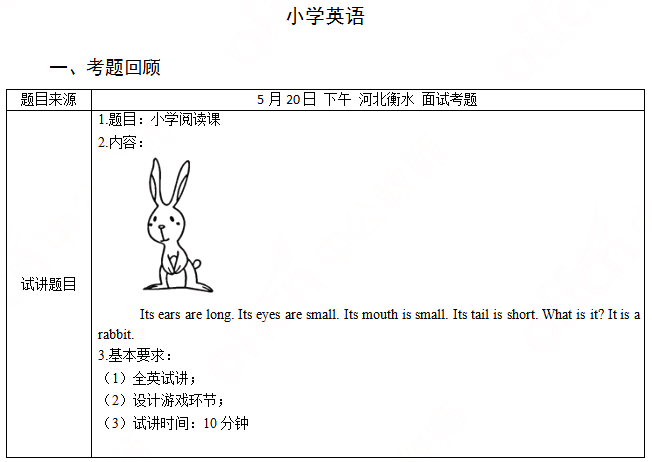
二、考题解析
【教案】
Teaching Aims:
Knowledge aim: Students will master the words “long, small,short, ears, eyes mouth,tail...”
Ability aim: Students can get the key information about rabbit and use the words to describe other animals.
Emotional aim: Students will improve their interest in English.
Teaching Key Points:
Students can understand the meaning of the words“long, small short” and use them to describe other animals.
Teaching Difficult Points:
Cultivate students awareness of loving animals and protecting animals.
Teaching Methods:
TPR teaching method, Communicative teaching method, task-based teaching method.
Teaching Aids:
Pictures, Blackboard and so on.
Teaching Procedures:
Step 1: Warming up
1.Greetings
2.Let students guess a riddle about rabbits. (Teacher need to make some actions to help students guess the answer- rabbit) and then lead in the topic “A rabbit”.
Step 2: Pre-reading
1. Show Students different pictures of rabbits to let students discover the common points.
2. Invite two students to try to describe rabbits in their own words.
3. Teach students these words “ tail, mouth ,ears,eyes”
Step 3: While-reading
1.Let students read the sentences and circle the words that are used to describe rabbits and invite one student to share.
2.Read them again and find out what part of the rabbits do they describe? After that,invite two students to write and draw a picture on the blackboard.
Step 4: Post-reading
Make a survey: Let students work in group of four. They’ll be given 15 minutes to ask each other about what are they favorite animals and fill in the survey table. After that, invite some students to share their survey result by intimating the animals in front of the blackboard.
Step 5: Summary & Homework
Summary: Invite a student to be a small teacher, to make a summary about what we have learned today.
Homework: Draw a picture of your favorite animals and share it to your friends.
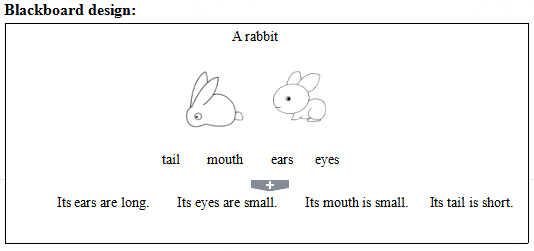 答案:解析:暂无解析
 -
第8题:
问答题◆Topic 9: Primary Functions of University Education Questions for Reference: 1. Most people think that teachers should teach students how to judge right and wrong and how to behave well. Please discuss this view. 2. Why do you think lots of teachers pay much more attention to teaching students academic subjects than other aspects? 3. What’s your opinion of the primary functions of university education? Why do you think so?正确答案: 【参考答案】
There is no doubt that helping students find a job is one of the primary functions of university education, but universities do exist for other purposes such as improving students’ analytical skills and raising students’ moral standards.
A university education can be seen as a process of improving students’ analytical thinking. The variety of courses offered at university inspires students in various ways, therefore improving their analytical ability. For example, science courses such as math and biology help students develop a rational way of thinking whereas arts courses such as literature let students ponder over issues from a logical, multi-dimensional perspective; and courses in social sciences force students to recognize the ideas that have been traditionally assumed to be acceptable and unproblematic. With the development of these types of analytical thinking, graduates can face future challenges with more confidence and enthusiasm.
Also, university education is expected to improve students’ moral standards. This is rooted in universities? Belief that students’ awareness of responsibility towards their community and their country is of high importance. In this ever-degrading society and civilization, students are encouraged actively participate in improving the local community. A university that provides care and facilities for physically disadvantaged students may inspire the graduates to better handle situations in the future where they may have to interact with the disabled community. A successful university education is supposed to produce morally sound graduates, therefore increasing their employability.
In conclusion, university education not only helps students locate a decent job but will also develop other qualities such as enhancing their analytical skills and cultivating their hunger and spirit for life.解析: 暂无解析 -
第9题:
单选题After teaching sounds, a teacher makes a test that aims to find out which sounds students are and are not able to pronounce. This test belongs to _____.Aaptitude test
Bproficiency test
Cachievement test
Ddiagnostic test
正确答案: D解析:
学习过语音之后,教师做测试以便检查学生哪些音会发,哪些音不会发,这属于diagnostic test(诊断性测验)的内容。 -
第10题:
单选题In English teaching,teachers should NOT pay attention to_______.Aproviding independent learning and communicating opportunities for students
Bcorrecting students'mistakes and errors in the process of learning immediately
Cencouraging students to discuss,cooperate,experience,practice,and explore the way to master English
Dcultivating students'interest
正确答案: A解析: -
第11题:
单选题The teacher should focus students' attention on ____, not only the use oflanguage form in teaching speaking.Alanguage meaning
Baccent
Corigin of language
Dinterlocutor
正确答案: A解析: -
第12题:
单选题_____ method of teaching writing pays great attention to the accuracy of the final product but ignores the process, which the students go through to reach the final goal.AForm-oriented
BProduct-oriented
CContent-oriented
DProcess-oriented
正确答案: A解析:
结果定向的教学模式对写作最后的成果十分重视,但是对写作过程重视不够,不利于写作能力的培养。 -
第13题:
In English teaching, teachers should NOT pay attention to__________.A.providing independent learning and communicating opportunities for students
B.correcting students' mistakes and errors in the process of learning immediately
C.encouraging students to discuss, cooperate, experience, practice, and explore the way to master English
D.cultivating students' interest答案:B解析:考查英语教学方式。B项不正确,学习过程中不应马上纠正学生的错误。 -
第14题:
__________method of teaching writing pays great attention to the accuracy of the finalproduct but ignores the process, which the students go through to reach the final goal.A.Form-oriented
B.Product-oriented
C.Content-oriented
D.Process-oriented答案:B解析:考查写作教学。重结果的教学模式对写作最后的成果十分重视,但是却忽视了对写作过程的监控,不利于写作能力的培养。 -
第15题:
______ aims to help students to pay attention to teaching contents efficiently at the beginning of the class.A.Lead-in
B.Presentation
C.Preparation
D.Practice答案:A解析:考查教学环节。
本题问的是上课一开始旨在帮助学生注意教学内容,由关键词“at the beginning of the class”可知,应选导入,导入为教学环节的第一步。综上,A选项正确。
B选项,Presentation,呈现新知识环节,故排除。
C选项,Preparation,准备,并非教学环节,故排除。
D选项,Practice,练习环节,故排除。
故正确答案为A项。 -
第16题:

二、考题解析
【教案】
Teaching aims:
Knowledge aim:
Students can express their opinion and give others solutions on the topic.
Ability aim:
Students can develop their logical thinking ability through writing.
Emotional aim:
Students will know how to get along with their parents and then love and cherish their family.
Key and difficult point:
Key Point: Students make clear about how to give others suggestions. .
Difficult Point: Students can understanding the deep meaning of family.
Teaching procedure:
Step 1: Warming-up
1. Greetings.
2. Sing a song : Five Hundred Miles, then ask students the theme of the song, if they don’t know, the teacher will tell them that the song is used to express the feeling of wandering one missing his families.
Step 2: Pre-writing
1. The teacher read the letter to students and let students pay attention to the feeling of the author.
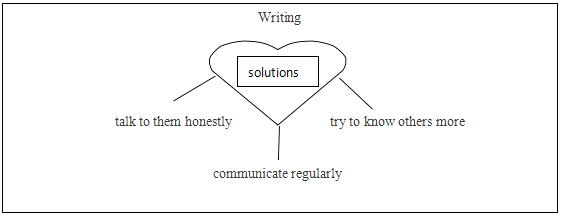
2. Brainstorming: tell students they should write a letter to the author, and what they should do is to have a discussion on the topic what the author should do to get along with her parents, and they are supposed to give as many suggestions as possible.
3. Then invite some students to write down their ideas on the blackboard.
4. Analysis the format of letter briefly.
Step 3: While-writing
Drafting: According to the analysis above, give students 15 minutes to write a letter to the author. First, remind them of the preparations we made during pre-writing. Secondly, go into them and give them some instructions when they are writing and ask them pay attention to grammar, punctuation, spelling and so on.
Step4: Post-writing
1. Peer editing: After the drafting, ask students to check the ideas or the logical development. Pay attention to the grammar, spelling and punctuation of their writings.
2. Sample show: choose several passages for them to learn and give them some evaluations from the advantages and disadvantages.Then ask them to rectify their own writings according the evaluations.
Step5: Summary and Homework
Summary: ask a student to conclude the content of the lesson and summarize with the whole class.
Homework: ask students to talk about their own problems honestly with their parents and try to solve them together.
Blackboard design:
1. Please talk about the principles of teaching writing?
2. What’s your favorite book?答案:解析:1.
There are several principles in writing: appropriate approaches; integration principle; communicative principle; realistic principle; procedural principle.
2.
Among all the books I have read, A Dream of Red Mansions, one of the four great works in China, an encyclopedia of the ancient Chinese life, is my favorite. What attracts me most in this book are the fabulous communication skills, which provokes me with great inspiration. Take Baochai for instance, though she was nice and considerate to everyone, when she was attacked by ridicules, she would fight back forcefully without hesitation. And her retort was always sparkling with wisdom, which I appreciate so much, and which I believe is indispensable in daily work. I believe that when we are challenged by some sharp questions, we should take Baochai as an example to make a tactful reply. -
第17题:
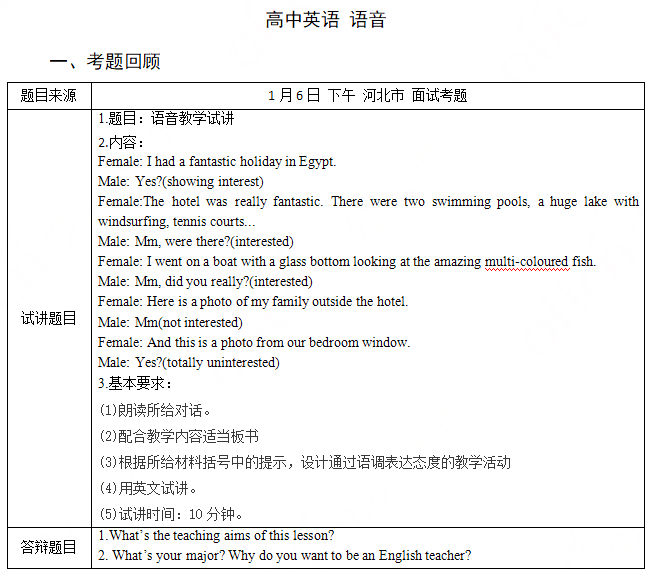
二、考题解析
【教案】
Teaching aims:
Knowledge aim:
Students can master the intonation of showing their attitudes.
Ability aim:
After this lesson, students can practice their listening and speaking ability through group work.
Emotional aim:
Students are able to love learning English after this lesson.
Key and difficult point:
Key Point: master the intonation of showing their attitudes.
Difficult Point: cultivate the interest of students’ learning English.
Teaching procedures:
Step 1: Warming-up
1. Greetings.
2. Play a video about a person who is shopping at a store and has a conversation with the shop assistant. And ask students to answer some questions: Does this customer want to buy the clothes? Give the reason
Step 2: Presentation
1.Ask students to listen the conversation carefully and the teacher reads the conversation that today needs to learn and ask students:
Which part does the male show the interest? Give the reason
And which part does the male show the uninterested? Give the reason
2.Then present the conversation on the PPT, and ask students to listen to the conversation again, pay attention to the intonation of male’s answers. And ask students to answer some questions:
When male shows the interest to the content of female’s saying, what kind of intonation does he use? Uninterested, what’s intonation?
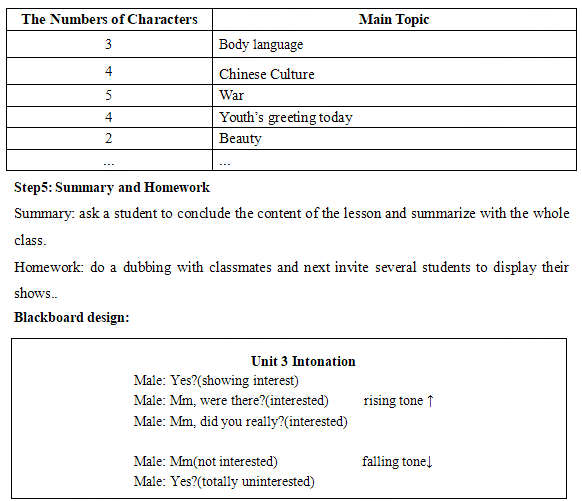
3. Then lead the students to conclude the rules of intonations of showing their attitudes. At the same time, write the male’s words on the blackboard with the help of symbols of rising tone and falling tone.
Step 3: Practice
1.Ask students to read this conversation after the tape.
2.Role-play: Ask students to practice this conversation with their partner and after 5 minutes, invite some students to read this conversation for all the students.
3. Dubbing: Ask students to look at a short video about a conversation between a Chinese student and another foreign student. But this video only has the frames, but doesn’t have the sound, which needs students to finish dubbing with their deskmates in given 10 minutes. Then invite several students to show their conversation with all the students.
Step4: Production
Make stories: Ask students to use the knowledge of intonation to make a short story according to the chart. Before this, divide the students into several groups with different persons and ask the representatives to get their topic through the way of random draw.
1.What’s the teaching aims of this lesson?
2. What’s your major? Why do you want to be an English teacher?答案:解析:1.
There are three aims: knowledge aim,ability aim and emotional aim.
Knowledge aim:
Students can master the intonation of showing their attitudes.
Ability aim:
After this lesson, students can practice their listening and speaking ability through group work.
Emotional aim:
Students are able to love learning English after this lesson.
2.
My major is medicine. But I like English. And my biggest hobby is learning and speaking English. In my daily life, I like to go abroad to travel and reading English novels. I think English is more useful and attracting for me than my major, medicine. -
第18题:
一、标题不可缺少
What are you doing?
二、教学目标撰写要以学生为主语
Teaching aims:
(1) Knowledge aims
Students can master the key sentence structure “what are you doing?” .
(2) Ability aims
Students can communicate with their partners by using the new sentence.
(3)Emotional aims
Students will be more interested in sharing their ideas with others and take part the group activity.
Teaching key point
Master the new sentence structure.
Teaching difficult point
Describe what other people are doing.
Teaching Methods:
Situational teaching method, task-based teaching method
Teaching Aids:
PPT
三、教学过程要完成清晰
Teaching procedure
Step 1 Warming-up
At the beginning of class, ask students a question about what do they usually do on weekend. Students may have different answer like go to the zoo, stay at home and so on. Then teacher ask: “do you want to know what others are doing now?” to lead to the topic today, and write it down on the blackboard.
(step can give students chances to speak English ,and get a good preparation for the next step—the presentation part, student’s interest will be aroused as they can share the things they know with others in English. It can also help nurture students’ confidence.)
Step 2 Pre-reading
Show the picture about the Larry’s home, letting students guessing what happened and predict the content about the reading material.
(Justification: guessing part will focus students’ attention on the main topic of the reading passage. It prepares students to think critically about the topic and provides them with the opportunity to connect some aspect of the topic to their own lives)
Step3while-reading
Fast-reading
Ask students to read the short passage quickly and conclude the main idea.
(Justification: train students’ reading ability of scanning for the general information of the passage.)
Careful reading
1.ask students to read the passage again and answer the following questions:
What is Larry doing?
What is dad doing?
What’s grandpa doing?
2. Ask students to finish the sentence on the textbook.
(Justification: in this part, students’ analyzing and summarizing ability can be trained. In the process of answering, students can get the detailed information, which can help students understand the sentence.)
Step4 post-reading
1.play the tape and ask students to read the short passage after the tape and pay attention to the pronunciation of the words and sentences.
2.let students do the group work, it is a role play, four in a group. One of them call another one and ask what he or she is doing. After that, volunteers can show their performance before the class.
(Justification: this part can activate the atmosphere of the class and arouse students’interest at the same time. It helps students strengthen what they have learned during this lesson.)
Step 5summary and homework
Summary: do the summary together with students and let them have a clear clue about what we have learned
Homework: try to use the new knowledge to communicate with their partners after class.
(Justification: summary and homework can help students consolidate the knowledge what they have learned in the class, the homework can train students ability )
四、板书设计不可少
Blackboard design:
What are you doing?
What is Larry doing?
What is dad doing?
What’s grandpa doing?答案:解析: -
第19题:
Teaching materials should agree with or reflect the teaching(),aims, objectives and teaching methods.
principles
略 -
第20题:
单选题In English teaching, teachers should NOT pay attention to ________.Aproviding independent learning and communicating opportunities for students
Bcorrecting students' mistakes and erors in the process of learning immediately
Cencouraging students to discuss, cooperate, experience, practice, and explore the way to master English
Dcultivating students' interest
正确答案: B解析: -
第21题:
填空题Teaching materials should agree with or reflect the teaching(),aims, objectives and teaching methods.正确答案: principles解析: 暂无解析 -
第22题:
单选题The teacher would use to help students communicate in teaching speaking.Asubstitution drills
Bgroup discussion
Clistening and acting
Dreading aloud
正确答案: A解析: -
第23题:
单选题After teaching sounds, a teacher makes a test that aims to find out which sounds students are not able to pronounce. This test belongs to_________Aaptitude test
Bproficiency test
Cachievement test
Ddiagnostic test
正确答案: C解析: -
第24题:
单选题____ aims to help students to pay attention to teaching content efficiently at the beginning of the class.ALead-in
BPresentation
CPreparation
DPractice
正确答案: B解析: