
单选题Passage 2Everyone knows that English departments are in trouble, but you can't appreciate just how much trouble until you read the new report from the Modern Language Association. The report is about Ph.D. programs, which have been in decline since 200
题目
Cheerful.
Gloomy.
Complicated.
Queer.
相似考题
更多“Passage 2Everyone knows that English departments are in trou”相关问题
-
第1题:
We can inter from the passage that Chinese English__________ .
A.is clear and natural to non-native speakers
B.is vivid and direct to non-native speakers
C.has a verv bad reputation in America
D.may bring inconvenience in America
正确答案:D:由文中作者母亲的经历可以推测出
-
第2题:
Child_____he is, he knows a lot about English literature.A. as
B. although
C. then
D. so
正确答案:A
-
第3题:
Passage Five
In order to learn a foreign language well, it is necessary to overcome the fear of making mistakes. If the primary goal (目标) of language use is communication (交际), then mistakes are secondary considerations that may be dealt with gradually. On the other hand, students should not ignore their mistakes. The language learner may observe how native speakers express themselves, and how native expressions differ from the way the learner might say them. For example, a Spanish speaker who has been saying "I do it" to express willingness to do something in the immediate future, could, by communicating with native speakers of English, observe that native speakers actually say "I'll do it". The result can serve as a basis for the student to change his way of using the present tense in English. But a student who is unwilling to communicate in the first place would lose this opportunity to learn by trial and error.
52. According to the passage, the present tense in English is ______.
A. not used to express one's readiness to do something in the immediate future
B. used with some verbs but not with others to express future intention
C. basically the same in English as it is in Spanish
D. not the most difficult problem for foreign students
正确答案:A
52.答案为A 此考题为细节题。根据文章中的...a Spanish speaker who has been saying“I do it”to express willingness to do something in the immediate future,could,by communicating with native speakers of English,observe that native,speakers actually say“I'll do it”,可肯定A正确。 -
第4题:
English teachers often ask students to__________ a passage to get the gist of it.A.skim
B.scan
C.predict
D.infer答案:A解析:考查英语阅读策。读(skim)和寻读(scan)都是快速阅读的方式,读的主要目的是获取文章的大意.寻读的目的是从文章中查寻特定的细节内容。 -
第5题:
my frienD tolD me that( )
A the English language is diffiCult
B English is diffiCult
C the English is diffiCult
D what English is diffiCult答案:A解析: -
第6题:
At least how many tests were carried out by the scientists referred to in this passageA.Three
B.Two
C.Only one
D.No one knows答案:A解析: -
第7题:
单选题Based on the information in the passage, which of the following would be the most accurate statement about Dubliners and Finnegan’s Wake?ADubliners contains one of the greatest short stories in the English language, and Finnegan’s Wake is the greatest story in the English language.
BMany of the chief characters in Finnegan’s Wake were earlier introduced in Dubliners.
CThe linguistic experimentation of Dubliners paved the way for the “night language” of Finnegan’s Wake.
DDubliners is a longer book than Finnegan’s Wake.
EDubliners is a more accessible book than Finnegan’s Wake
正确答案: E解析:
推断题。文章第二段第三句中提到:Dubliners (1914), Joyce’s most accessible work;最后一段第三句中提到:Finnegan’s Wake…employs its own “night language” of puns, foreign words, and literary allusions,所以可知本题应选E项。 -
第8题:
单选题What’s the passage about?AA description of an English book.
BA description of an English course.
CA description of life in Los Angeles.
DA description of weekend visits to San Francisco.
正确答案: A解析:
根据对短文的整体理解以及文章的第一句话“We provide summer English courses and you will enjoy learning about American culture and improve your English.”可知本文是对一门英语课程的介绍。 -
第9题:
问答题Practice 5 Listen to the following passage. Write in English a short summary of around 150-200 words of what you have heard. You will hear the passage only once and then you will have 25 minutes to finish your summary. This part of the test carries 20 points. You may need to scribble a few notes to write your summary. _____________________________________________________________________________________________________________________________________________________________________________________________正确答案: 【文章梗概】
本文的主题是测谎仪。文章认为目前测谎仪已有渗透到日常生活中的趋势,但目前仍没有研究表明测谎仪真的有效。几个世纪以来世界各国人们都在孜孜不倦地寻求通过物理手段检测谎言的仪器。随着科技的发展,声音分析器开始流行,这种仪器工作原理并不复杂,而且使用简单、携带方便。现在仍有先进产品上市,前景良好。美国政府对测谎仪的使用制定了双重标准,一方面政府加大使用测谎仪的力度,一方面命令法庭禁用经测谎仪得到的结果。
【参考答案】
综述内容应包括5个主要点信息和9个次要点信息中的5个。下划线部分为主要点, 斜体部分为次要点。
Lie detectors, those controversial assessors of truth, are making their way into everyday life. Insurance companies use them to help catch people filing fraudulent claims. Suspicious spouses use hand-hand versions to judge whether their significant others are cheating. Interrogators for the U.S. government use them to double-check analyses of who might be terrorists.
Polygraphs, which have been used for decades, have been joined by new systems that purportedly analyze a person's voice, blush, pupil size and even brain waves for signs of deception. The devices range from costly experimental devices that use strings of electrodes or thermal imaging to $19.95 palm-sized versions.
No studies haVe ever proven that lie detectors work. Many show that they assess truth as accurately as a coin flip; in other words, not at all. Still, some people have come to depend on them. The recent proliferation of lie detectors has reignited a decades-old debate over the ethics and politics of when and how they should be used and whether such important questions as guilt or innocence should be left to machines.
Mankind has looked for centuries for a physical indicator that would expose a liar. The Romans studies the entrails of suspected liars. In China, rice was shoved into the mouths of interviewees to measure how dry they were—the drier the mouth, the more likely the person was lying, it was thought. Other cultures tried various chemical concoctions, but they worked no better than chance.
Especially since September 11, law enforcement agencies consider lie detection systems critical to their investigations. The CIA, FBI and Defense Department have spent millions of dollars on them. In an unusual plea made soon after the terrorist auacks, the government asked for the public’s help in building counterterrorism technologies, among them a portable polygraph.
In the United States, there is a double standafd when it comes to the use of polygraphs. Although the so-called lie detector is considered an important law enforcement tool, polygraph data are inadmissible as evidence in a court of law. The U.S. Supreme Court forbade private companies from using them to screen job applicants, but allowed the government to use them for the same purpose.
As debate about polygraphs rages, the devices are being phased out in favor of voice analyzers, which are more portable and easier to use. A voice analyzer device typically consists of a telephone and microphone attached to a computer that packs neatly in a briefcase, or attached to any PC with the proper software installed. Most of the analyzers can be used in person or over the phone. Conversations can be tested in real time or recorded for later analysis.
First, the questioner asks an interviewee about something he or she would have no reason to lie about, such as “When’s your birthday?” Then he asks what he really wants to ask. The device makes an assessment about whether the subjects is telling the truth based on the differences between the inaudible microtremors in the voice during the first round of questioning and those in the second.
The federal government officially says it does not use these voice lie detectors. Still, the voice technology has its true believers, among them more than 1.200 police departments nationwide and tens of thousands of consumers.
The slightly more sophisticated Truster software program that runs on a desktop computer gives text rating of truthfulness. The companies that market these technologies say they are more than 80 percent accurate.
Though skeptical, Rick Garloff, a 35-year-old American, still said even if the systems are not great lie detectors, they are wonderful lie deterrents. He once used the Truster on his 9-year-old son, to see if he had forgotten to close a door, accidentally letting the dog in. His son claimed no. But the lie detection system said yes. When confronted, his son confessed.
【解 析】
一、主干内容表达部分:
这部分内容为文章的主干内容,是综述的主要点信息。
1. Lie detectors, those controversial assessors of truth, are making their way into everyday life.
[分析]本句开宗明义,点明文章的主题,是全文的框架性内容。
2. No studies have ever proven that lie detectors work.
[分析]本句位于段落首,是全段中心句,而且本段所讨论的内容也是全文主要论点之一,因此该句是全文的框架性内容。
3. Mankind has looked for centuries for a physical indicator that would expose a liar.
[分析]本句位于段落首,是全段中心句,而且本段所讨论的内容即测谎仪的历史追溯也是全文主要内容,为文章论点的提出奠定基础,因此该句是全文的框架性内容。
4. In the United States, there is a double standard when it comes to the use of polygraphs.
[分析]本句位于段落首,是全段中心句。人类对测谎仪的使用态度是全文讨论的重点内容,因此该句为全文的框架性内容。
5. As debate about polygraphs rages, the devices ale being phased out in favor of voice analyzers, which are more portable and easier to use.
[分析]本句位于段落首,是全段中心句。测谎仪发展的主流和趋势是全文讨论的重点内容,因此该句为全文的框架性内容。
二、支持性细节表达部分
这部分内容为主要点的重要支持性细节,是综述的次要点信息。
1. Polygraphs, which have been used for decades, have been joined by new systems that purportedly analyze a person’s voice, blush, pupil size and even brain waves for signs of deception.
[分析]本句简单介绍普遍认为的测谎仪工作原理,丰满了全文框架性内容,是重要的支持性细节。
2. The recent proliferation of lie detectors has reignited a decades-old debate over the ethics and politics of when and how they should be used and whether such important questions as guilt or innocent should be left to machines.
[分析]本句是对全文主要观点的进一步阐释,引发全文讨论的重点,是重要的支持性细节。
3. Especially since September 11, law enforcement agencies consider lie detection systems critical to their investigations.
[分析]本句位于段首,是全段中心句,以典型人物的具体事例强调了文章主要观点,有力地支持了文章的扩展,是重要的支持性细节。
4. The government asked for the public’s help in building counterterrorism technologies,among them a portable polygraph.
[分析]本句位于段尾,是全段总结句,进一步证明了该段中心句内容,为全文主要观点提供了有力的证据,是重要的支持性细节。
5. Although the so-called lie detector is considered an important law enforcement tool, polygraph data ale inadmissible as evidence in a court of law.
[分析]本句是对全文主要观点的进一步解释和说明,是主要观点的具体化,因此是重要的支持性细节。
6. Most of the analyzers can be used in person or over the phone. Conversations can be tested in real time or recorded for later analysis.
[分析]本句是对全文主要内容,即测谎仪发展的主流和趋势的进一步解释和说明,因此是重要的支持性细节。
7. The device makes an assessment about whether the subjects is telling the truth based on the differences between the inaudible microtremors in the voice during the first round of questioning and those in the second.
[分析]本句是对主流测谎产品工作原理的介绍,丰满了全文主要内容,因此是重要的支持性细节。
8. The federal government officially says it does not use these voice lie detectors. Still, the voice technology has its true believers.
[分析]本句是对全文主要内容的扩展和延伸,从市场角度证明了测谎仪的流行,丰富了全文主要内容,因此是重要的支持性细节。
9. The slightly more sophisticated Truster software program that runs on a desktop computer gives text rating of truthfulness.
[分析]本句介绍了测谎仪的流行产品及市场情况,暗示了测谎仪的前景。使对主题的讨论充满意义,丰满了全文主要内容,因此是重要的支持性细节。
【录音原文】
Lie detectors, those controversial assessors of truth, are making their way into everyday life. Insurance companies use them to help catch people filing fraudulent claims. Suspicious spouses use hand-hand versions to judge whether their significant others are cheating. Interrogators for the US government use them to double check analysis of who might be terrorists.
Polygraphs, which have been used for decades, have been joined by new systems that purportedly analyze a person’s voice, blush, pupil size and even brain waves for signs of deception. The devices range from costly experimental devices that use strings of electrodes or thermal imaging to $19.95 palm-sized versions.
No studies have ever proven that lie detectors work. Many show that they assess truth as accurately as a coin flip; in other words, not at all. Still, some people have come to depend on them. The recent proliferation of lie detectors has reignited a decades-old debate over the ethics and politics of when and how they should be used and whether such important questions as guilt or innocence should be left to machines.
Mankind has looked for centuries for a physical indicator that would expose a liar. The Romans studied the entrails of suspected liars. In China, rice was shoved into the mouths of interviewees to measure how dry they were—the drier the mouth, the more likely the person was lying, it was thought. Other cultures tried various chemical concoctions, but they worked no better than chance.
Especially since September 11, law enforcement agencies consider lie detection systems critical to their investigations. The CIA, FBI and Defense Department have spent millions of dollars on them. In an unusual plea made soon after the terrorist attacks, the government asked for the public’s help in building counterterrorism technologies, among them a portable polygraph.
In the United States, there is a double standard when it comes to the use of polygraphs. Although the so-called lie detector is considered an important law enforcement tool, polygraph data are inadmissible as evidence in a court of law. The US Supreme Court forbade private companies from using them to screen job applicants, but allowed the government to use them for the same purpose.
As debate about polygraphs rages, the devices are being phased out in favor of voice analyzers, which are more portable and easier to use. A voice analyzer device typically consists of a telephone and microphone attached to a computer that packs neatly in a briefcase, or attached to any PC with the proper software installed. Most of the analyzers can be used in person or over the phone. Conversations can be tested in real time or recorded for later analysis.
First, the questioner asks an interviewee about something he or she would have no reason to lie about, such as “When’s your birthday?” Then he asks what he really wants to ask. The device makes an assessment about whether the subject is telling the truth based on the differences between the inaudible microtremors in the voice during the first round of questioning and those in the second.
The federal government officially says it does not use these voice lie detectors. Still, the voice technology has its true believers, among them more than 1,200 police departments nationwide and tens of thousands of consumers.
The slightly more sophisticated Truster software program that runs on a desktop computer gives text rating of truthfulness. The companies that market these technologies say they are more than 80 percent accurate.
Though skeptical, Rick Garloff, a 35-year-old American, still said even if the systems are not great lie detectors, they are wonderful lie deterrents. He once used the Truster on his 9-year-old son, to see if he had forgotten to close a door, accidentally letting the dog in. His son claimed no. But the lie detection system said yes. When confronted, his son confessed.解析: 暂无解析 -
第10题:
单选题Click the Exhibit button and examine the data in the EMPLOYEES and DEPARTMENTS tables.You want to retrieve all employees, whether or not they have matching departments in the departments table. Which query would you use?()ASELECT last_name, department_name FROM employees NATURAL JOIN departments;
BSELECT last_name, department_name FROM employees JOIN departments ;
CSELECT last_name, department_name FROM employees e JOIN departments d ON (e.department_id = d.department_id);
DSELECT last_name, department_name FROM employees e RIGHT OUTER JOIN departments d ON (e.department_id = d.department_id);
ESELECT last_name, department_name FROM employees FULL JOIN departments ON (e.department_id = d.department_id);
FSELECT last_name, department_name FROM employees e LEFT OUTER JOIN departments d ON (e.department_id = d.department_id);
正确答案: B解析: 暂无解析 -
第11题:
单选题The passage has discussed the rise in English use on the Continent from the following perspectives EXCEPT _____.Aeconomics
Bnational security
Cthe emergence of the Internet
Dthe changing functions of the European Community
正确答案: A解析:
本题可用排除法。第六段倒数第三句“…which made English a key language for business”可见商业经济也是英语兴起的一个原因,排除A。倒数第四段第三句提到“European Community”带来的影响,排除D。倒数第三段提到“net”的影响,故排除C。 -
第12题:
单选题We may conclude from the passage that the four media luna departments ______.Aare mainly from western highlands
Bget united to fight against Mr. Morales’s presidency
Cwant bigger share of gas export
Dhave priority over the other three levels of autonomous organization
正确答案: C解析:
题目问的是:我们能从文中得知四大媒体的月神部门什么信息?从文章倒数第2段“... continue to demand a bigger share of the proceeds of gas exports.”,可知他们要求拥有天然气出口的更大股份。故选C。 -
第13题:
He ________ ________ to learn English well.A.knows...how
B.know...how
C.knows...what
D.knew...what
参考答案:A
-
第14题:
For any Englishman there can never be any discussion as to who is the world's greatest writer. Only one name can possibly suggest itself to him:that of William Shakespeare.
Every Englishman has some knowledge of his work. All of us use words and phrases from Shakespeare's writings that have become a part of the English-speaking people.
Shakespeare, more perhaps than any other writer, made full use of the English language. Most of us use about five thousand words in our normal employment of English; Shakespeare in his works used about twenty-five thousand!
There is probably no better way for a foreigner (or an Englishman!) to appreciate the richness and variety of the English language than by studying the various ways in which Shakespeare uses it. Such a study is well worth the effort (it is not, of course, recommended to beginners), even though some aspects of English usage, and the meaning of many words, have changed since Shakespeare's day.
1). From the first two sentences of the passage we can conclude that ________.
A. it can't be discussed about who is the world's greatest dramatist
B. Shakespeare is regarded as the greatest writer
C. Englishmen like to discuss about who is the world's greatest writer
D. it can't be discussed about who is the world's greatest poet
2). According to the passage many English words and phrases that we use today are from _____.
A. Englishmen
B. English speaking people
C. Shakespeare's works
D. ancient people
3). To learn the richness of the English language, people should ______.
A. write and read more
B. be glad to be a foreigner
C. learn from an English man
D. read Shakespeare's plays
4). The author does not suggest beginners reading Shakespeare's plays probably because _____.
A. only Englishmen can understand his plays
B. some of English usage and the meaning of many words have changed
C. the works are too difficult for a beginner
D. the works are for native speakers
5). In this passage the author wants to _______.
A. tell how great a writer Shakespeare is
B. tell that some aspects of English usage have changed since Shakespeare's day
C. tell that some English words are out of use now
D. show the richness of English language
正确答案:BCDCA
-
第15题:
English teachers often ask students to __________ a passage to get the gist of it.A.skim
B.scan
C.predict
D.describe答案:A解析:考查英语阅读策。读(skim)指快速阅读文章以了解其内容大意(gist)的阅读方法。换句话说,读是要求读者有选择地进行阅读,可跳过某些细节,以求抓住文章(gist)的大概,从而加快阅读速度。因此选A。 -
第16题:
下面是某英语教师在阅读课English Around the World的教学片段.
T: Now, you will have 5 minutes to read the passage for the first time, and then I want you to tell me the different ideas in each paragraph, and then you need to answer the questions on the black board.
Why did English begin to be spoken in many other countries?
Do you know the background of Shakespeare?
Why can Indian people speak fluent English?
You can read the passage now!
结合教学实例进行分析:?
(1)教师的活动设计存在什么问题?该问题可能会导致什么负面结果?(10分)
(2)针对存在的问题提出相应的改进建议。(10分)
(3)谈一谈你对阅读课读后环节的理解,以本实例为依据可以设置哪些读后活动?(10分)答案:解析:(1)该教师的授课环节属于读中环节,在本教学片段中.教师在读中环节让学生们第一次阅读课文之后既要回答文章每段的大意还要回答一些细致的问题。没有很好地为学生分清层次。学生在一遍阅读中很可能无法兼顾大意与细节,从而无法获取有效的信息,这不利于培养学生正确的阅读策.也可能会影响学生阅读的积极性.
(2)一般我们在操作读中环节的时候都会分成两个部分,先是快速阅读(fast reading),给学生们少量的时间,让学生快速读课文之后回答一些较为简单的问题,例如文章的主题是什么,大意是什么.或者简要归纳每段的段落大意等;之后是仔细阅读(careful reading),这个时候再让同学们进行二次阅读,然后回答一些关于文章细节理解的问题。
(3)读后环节是教师在带领学生分析清楚了文章的大意之后可以针对文章的论点论据组织一些小组讨论或辩论赛,或者是找同学对文章进行简单的复述,在这个环节既可以检查学生对知识的掌握程度也可以锻炼学生的小组合作能力和口语表达能力. -
第17题:
小学英语?阅读
一、考题回顾
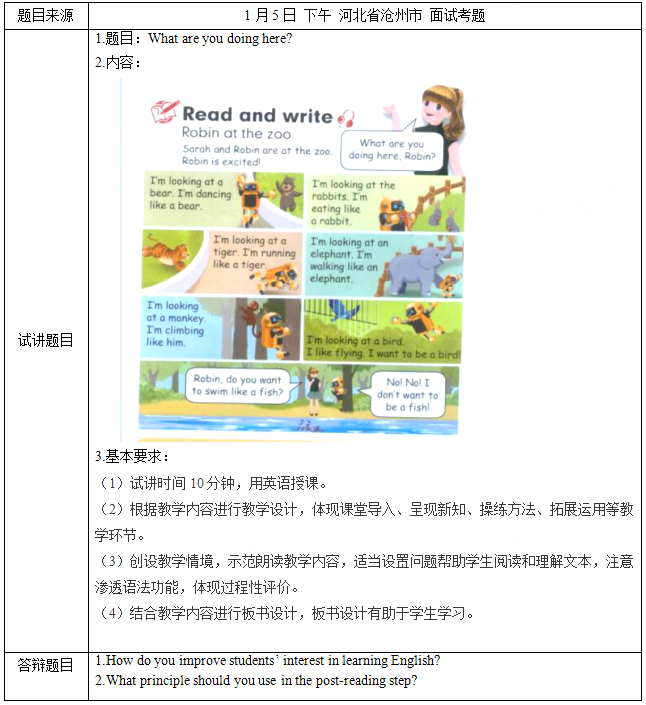
二、考题解析
【教学设计】
Teaching aims:
Knowledge aim:
Students will master the meaning and usage of the structure “be doing” through reading the passage.
Ability aim:
Students will apply the “be doing” to communicate with each other in real situation.
Emotional aim:
Students will be more interest in learning English.
Key and difficult point:
Key Point: Students will master how to improve reading abilities through finding main idea and details.
Difficult Point: Students will apply the “be doing” to communicate with each other in real situation.
Teaching procedure:
Step 1: Warming-up
1. Greetings.
2. Play a riddle and students guess the animals, such as “long nose, big ears and strong body——elephant”, then lead to the topic of “let’s go to the zoo to see what animals are doing”.
Step 2: Pre-reading
1. According to the title, students have a prediction about what kinds of animals are mentioned in the passage.
Step 3: While-reading
1. Fast reading: students read the passage fast and figure out what kinds of animals are mentioned in the passage then make a list.
2. Careful reading: students read the passage carefully and answer the question: what are the animals doing? Then fill in the blanks.
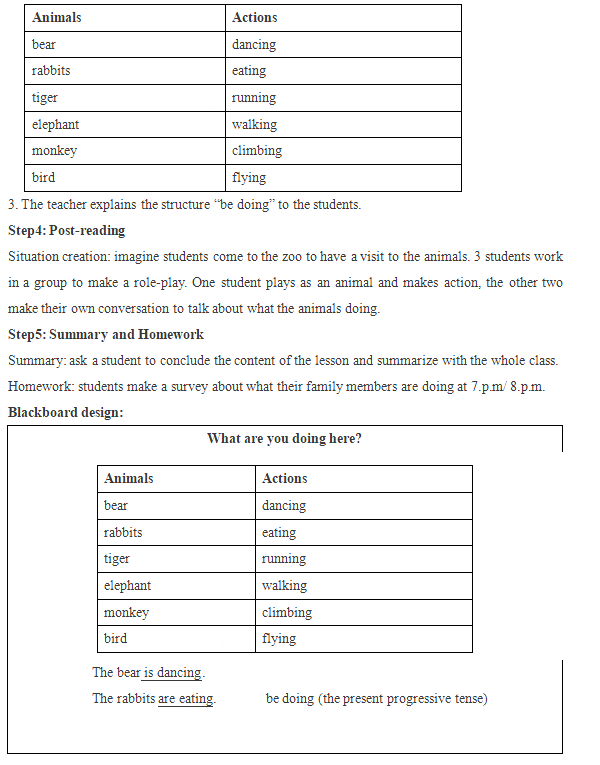
1. How do you improve students’ interest in learning English?
2. What principle should you use in the post-reading step?答案:解析:1.
In the process of English teaching, teachers should enrich the teaching approaches, not only teach students through "listening, speaking, reading", but also integrate situational teaching, so that students can feel the diversity of teaching and learning.
Besides, teachers can make use of the form of cooperative study and organize various practice activities in the classroom to create an atmosphere of mutual assistance and cooperation, so that students have positive sense of learning.
2.
First, we should persist in the communicative principle. In the production step of reading
class, students should be organized in groups to cultivate their speaking ability and communicative ability. In this way, we can reach the New Curriculum Standard.
Then, we should insist on the truth principle. That means we should provide more real materials that are closet to students’ real life, such as situation creation like what I did in this class. In this way, students’ interest can be aroused and they can apply what they’ve learned in real communication. -
第18题:
The division of English into Old English, Middle English, and Modern English is nonconventional and not arbitrary.
正确答案:错误 -
第19题:
单选题Every Englishman knows _____.Amore or less about Shakespeare
BShakespeare, but only slightly
Call Shakespeare’s works
Donly the name of the greatest English writer
正确答案: B解析:
细节题。由“Every Englishman has some knowledge, however slight, of the works of our greatest writer.”可知,每个英国人都对莎士比亚有所了解。 -
第20题:
单选题According to the passage, which of the following statements is NOT true? _____AAs there exist weak parts in different departments of a firm, the training of its staff is highly necessary.
BA training specification is based on the information collected from a job description and a job specification.
CTraining in using skills and learning about skills usually do not happen at the same place
DIt is easier to evaluate management training than to evaluate the training of workers and technicians.
正确答案: B解析:
从第四段“The evaluation of management training is much more complex than that.”可知,评价经理培训要比评价员工及技工培训复杂得多。 -
第21题:
单选题English teachers often ask students to_____ a passage to get the gist of it.Askim
Bscan
Cpredict
Dinfer
正确答案: A解析: -
第22题:
单选题The passage mainly examines the factors related to _____.Athe rising status of English in Europe
BEnglish learning in non-English-speaking E.U. nations
Cthe preference for English by European businessmen
Dthe switch from French to English in the European Commission
正确答案: D解析:
主旨大意题。文中从第二段起就开始依次分析了英语在欧洲兴起的经济、语言、社会等各方面的因素,所以A项正确。 -
第23题:
单选题A cynic,in the passage, is a person______.Awhose behavior usually leads to serious health problems
Bwho is always ready to fight
Cwho usually has doubts about the people around him
Dwhose behavior usually seems strange to the people he knows
正确答案: C解析: -
第24题:
单选题Many words in English have _____ new senses with the passage of time and social development.Aembarked on
Bconcentrated on
Ctaken on
Dturned on
正确答案: D解析:
句意:随着时间的流逝和社会的发展,许多英语单词呈现出新的意思。embark on开始从事,着手。concentrate on集中于。take on雇用;呈现出;具有。