
A JavaBeans component has the following field: 11. private boolean enabled; Which two pairs of method declarations follow the JavaBeans standard for accessing this field?()A、 public void setEnabled( boolean enabled) public boolean getEnabled()B、 public
题目
A JavaBeans component has the following field: 11. private boolean enabled; Which two pairs of method declarations follow the JavaBeans standard for accessing this field?()
- A、 public void setEnabled( boolean enabled) public boolean getEnabled()
- B、 public void setEnabled( boolean enabled) public void isEnabled()
- C、 public void setEnabled( boolean enabled) public boolean isEnabled()
- D、 public boolean setEnabled( boolean enabled) public boolean getEnabled()
相似考题
更多“A JavaBeans component has the following field: 11. private boolean enabled; Which two pairs of method declarations follow the JavaBeans standard for accessing this field?()A、 public void setEnabled( boolean enabled) public boolean getEnabled()B、 public ”相关问题
-
第1题:
阅读下列说明和Java代码,将应填入 (n) 处的字句写在答题纸的对应栏内。
【说明】
现欲构造一文件/目录树,采用组合(Composite)设计模式来设计,得到的类图如6—8所示:
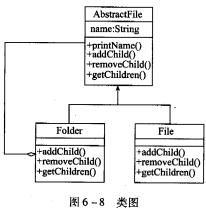
【Java代码】
import JavA.util.ArrayList;
import JavA.util.List;(1)class AbstractFile{
protected String name;
public void printName(){System.out.println(name);}
public abstract boolean addChild(AbstractFile file);
public abstract boolean removeChild(AbstractFile file);
public abstract ListgetChildren {};
}
class File extends AbstractFile{
public File(String name)(this.name=name;}
public boolean addChild(AbstractFile file){return false;}
public boolean removeChild(AbstractFile file){return false;}
public ListgetChildren(){return (2) ;)
}
clasS Folder extends AbstractFile{
private ListchildList;
public Folder(String name){
thiS.name=name;
this.childList=new ArrayList{};
}
public boolean addChild(AbstractFile file){return childList.add(file);}
public boolean removeChild(AbstractFile file){return childList.remove(file);
public (3)getChildren(){return (4) ;)
}
public class Client{
public static void main(String[]args){
//构造一个树形的文件/目录结构
AbstractFile rootFolder=new Folder(“C:\”’);
AbstractFile compositeFolder=new Folder(”composite”);
AbstractFile windowsFolder=new Folder(”windows”);
AbstractFile file=new File(”TestComposite.java”);
rootFOlder.addChild (compositeFolder);
rootFolder.addChiid(windowsFolder);
compositeFolder.addChild(file);
//打印目录文件树
printTree(rootFolder);
}
private static void printTree(AbstractFile ifile){
ifile.PrIntName();
Listchildren:ifile.getChildren ();
if(chiidren==null)return;
for(AbstractFile file:children){(5) ;
}
}
}
该程序运行后输出结果为:
C:\
composite
TestComposite.java
Windows
正确答案:(1)Abstract(2)null(3)List(4)childList(5)printTree(file)
(1)Abstract(2)null(3)List(4)childList(5)printTree(file) 解析:Composite模式定义:将对象以树型结构组织起来,以达成“部分-整体”的层次结构,使得客户端对单个对象和组合对象的使用具有一致性。Composite比较容易理解,想到Composite就应该想到树型结构图。组合体内这些对象都有共同接口,当组合体一个对象的方法被调用执行时,Composite将遍历(Iterator)整个树形结构,寻找同样包含这个方法的对象并实现调用执行。AbstractFile为一个抽象文件类,其作用主要是实现对文件或者文件夹的抽象。文件类File继承自AbstractFile。File(stringname)为File类的一个属性,用于获取文件名称。Add-child方法用来给一个目录增加子目录或文件。Removechild方法用于删除一个目录的子目录或文件。Getchildren方法用于获取一个目录或文件,所以返回值类型应该是一个列表形式的AbstractFile,但文件本身不包括子目录,故返回NUIJIJ。Fold类表示一个文件夹,属性Folder用于获取文件夹名称,Getchildren方法返回值应为List型的AbstractFile对象指针。 -
第2题:
下列哪个成员方法声明是正确的? ( )
A.public abstract final int f(){...}
B.public static boolean f(){...}
C.static protected void g(a,{...}
D.protected private number;
正确答案:B
解析:本题考查对成员方法声明的掌握程度。选项A错误,成员变量不能同时声明成abstract和final;选项B正确,声明了一个公有静态返回值类型是布尔类型的方法f();选项C错误,protected应在static之前;选项D错误,既不是方法声明,也不是正确的成员变量声明。 -
第3题:
以下哪个是Java应用程序main方法的有效定义?A. public static void main();
B. public static void main( String args );
C. public static void main( String args[] );
D. public static void main( Graphics g );
E. public static boolean main( String a[] );
正确答案:C
-
第4题:
Which lines of code are valid declarations of a native method when occurring within the declaration of the following class?() public class Qf575 { // insert declaration of a native method here }
- A、native public void setTemperature(int kelvin);
- B、private native void setTemperature(int kelvin);
- C、protected int native getTemperature();
- D、public abstract native void setTemperature(int kelvin);
- E、native int setTemperature(int kelvin) {}
正确答案:A,B -
第5题:
11. public void testIfA() { 12. if(testIfB(”True”)) { 13. System.out.println(”True”); 14. } else { 15. System.out.println(”Not true”); 16. } 17. } 18. public Boolean testIfB(String str) { 19. return Boolean.valueOf(str); 20. } What is the result when method testIfA is invoked?()
- A、 True
- B、 Not true
- C、 An exception is thrown at runtime.
- D、 Compilation fails because of an error at line 12.
- E、 Compilation fails because of an error at line 19.
正确答案:A -
第6题:
Which the two demonstrate an “is a” relationship?()
- A、 public interface Person {} Public class Employee extends Person {}
- B、 public interface Shape {} public interface Rectangle extends Shape {}
- C、 public interface Color {} public class Shape { private Color color; }
- D、 public class Species {} public class Animal { private Species species; }
- E、 interface Component {} Class Container implements Component {private Component [] children;
正确答案:B,E -
第7题:
public class test ( private static int j = 0; private static boolean methodB(int k) ( j += k; return true; ) public static void methodA(int i)( boolean b: b = i < 10 | methodB (4); b = i < 10 || methodB (8); ) public static void main (String args[])( methodA (0); system.out.printIn(j); ) ) What is the result?()
- A、 The program prints “0”
- B、 The program prints “4”
- C、 The program prints “8”
- D、 The program prints “12”
- E、 The code does not complete.
正确答案:B -
第8题:
public class Key { private long id1; private long 1d2; // class Key methods } A programmer is developing a class Key, that will be used as a key in a standard java.util.HashMap. Which two methods should be overridden to assure that Key works correctly as a key?()
- A、 public int hashCode()
- B、 public boolean equals(Key k)
- C、 public int compareTo(Object o)
- D、 public boolean equals(Object o)
- E、 public boolean compareTo(Key k)
正确答案:A,D -
第9题:
多选题A JavaBeans component has the following field: 11. private boolean enabled; Which two pairs of method declarations follow the JavaBeans standard for accessing this field?()Apublic void setEnabled( boolean enabled) public boolean getEnabled()
Bpublic void setEnabled( boolean enabled) public void isEnabled()
Cpublic void setEnabled( boolean enabled) public boolean isEnabled()
Dpublic boolean setEnabled( boolean enabled) public boolean getEnabled()
正确答案: C,D解析: 暂无解析 -
第10题:
单选题Which is a method of the MouseMotionListener interface?()APublic void mouseMoved(MouseEvent)
BPublic boolean mouseMoved(MouseEvent)
CPublic void mouseMoved(MouseMotionEvent)
DPublic boolean MouseMoved(MouseMotionEvent)
EPublic boolean mouseMoved(MouseMotionEvent)
正确答案: B解析: 暂无解析 -
第11题:
多选题A JavaBeans component has the following field: 11. private boolean enabled; Which two pairs of method declarations follow the JavaBeans standard for accessing this field?()AA
BB
CC
DD
正确答案: C,D解析: 暂无解析 -
第12题:
单选题public class test ( private static int j = 0; private static boolean methodB(int k) ( j += k; return true; ) public static void methodA(int i)( boolean b: b = i < 10 | methodB (4); b = i < 10 || methodB (8); ) public static void main (String args[])( methodA (0); system.out.printIn(j); ) ) What is the result?()AThe program prints “0”
BThe program prints “4”
CThe program prints “8”
DThe program prints “12”
EThe code does not complete.
正确答案: B解析: 暂无解析 -
第13题:
下列代码的编译或执行结果是( )。 public class Myval{ public static void main(string args[]){ MyVal m=new MyVal; aMethod; } public void aMethod{ boolean b[]=new Boolean[5]; System.OUt.println(b[0]); } }
A.1
B.null
C.0
D.编译错误
正确答案:A
A。【解析】boolean类型的变量值只有ture或false,b[0]的默认初始值为false。 -
第14题:
下列哪个成员方法声明是正确的? ( )
A.public abstract final int f(){…}
B.public static boolean f(){…}
C.static protected void g(a,b){…}
D.protected private number;
正确答案:B
解析:本题考查对成员方法声明的掌握程度。选项A错误,成员变量不能同时声明成abstract 和 final;选项B正确,声明了一个公有静态返回值类型是布尔类型的方法 f();选项C错误,protected应在static之前;选项D错误,既不是方法声明,也不是正确的成员变量声明。 -
第15题:
以下哪个方法可以用来获得进度条的当前进度值?()
- A、public synchronized int getProgress()
- B、public synchronized void setIndeterminate (boolean indeterminate)
- C、public synchronized void setProgress(int progress)
- D、Public final synchronized void incrementProgressBy(int diff)
正确答案:A -
第16题:
Which statements concerning the following code are true?() class a { public a() {} public a(int i) { this(); } } class b extends a { public boolean b(String msg) { return false; } } class c extends b { private c() { super(); } public c(String msg) { this(); } public c(int i) {} }
- A、The code will fail to compile.
- B、The constructor in a that takes an int as an argument will never be called as a result of constructing an object of class b or c.
- C、Class c has three constructors.
- D、Objects of class b cannot be constructed.
- E、At most one of the constructors of each class is called as a result of constructing an object of class c.
正确答案:B,C -
第17题:
Which is a method of the MouseMotionListener interface?()
- A、 Public void mouseMoved(MouseEvent)
- B、 Public boolean mouseMoved(MouseEvent)
- C、 Public void mouseMoved(MouseMotionEvent)
- D、 Public boolean MouseMoved(MouseMotionEvent)
- E、 Public boolean mouseMoved(MouseMotionEvent)
正确答案:A -
第18题:
Which two demonstrate an “is a” relationship?()
- A、 public interface Person { } public class Employee extends Person { }
- B、 public interface Shape { } public class Employee extends Shape { }
- C、 public interface Color { } public class Employee extends Color { }
- D、 public class Species { } public class Animal (private Species species;)
- E、 interface Component { } Class Container implements Component ( Private Component[ ] children; )
正确答案:D,E -
第19题:
public void testIfA(){ if(testIfB("True")){ System.out.println("True"); }else{ System.out.println("Nottrue"); } } public Boolean testIfB(Stringstr){ return Boolean.valueOf(str); } What is the result when method testIfA is invoked?()
- A、True
- B、Nottrue
- C、Anexceptionisthrownatruntime.
- D、Compilationfailsbecauseofanerroratline12.
- E、Compilationfailsbecauseofanerroratline19.
正确答案:A -
第20题:
多选题Which statements concerning the following code are true?() class a { public a() {} public a(int i) { this(); } } class b extends a { public boolean b(String msg) { return false; } } class c extends b { private c() { super(); } public c(String msg) { this(); } public c(int i) {} }AThe code will fail to compile.
BThe constructor in a that takes an int as an argument will never be called as a result of constructing an object of class b or c.
CClass c has three constructors.
DObjects of class b cannot be constructed.
EAt most one of the constructors of each class is called as a result of constructing an object of class c.
正确答案: E,D解析: 暂无解析 -
第21题:
单选题下列代码的编译或执行结果是( )。 public class MyVal{ public static void main(String args[]){ MyVal m = new MyVal(); m.aMethod(); } public void aMethod(){ boolean b[] = new Boolean[5]; System.out.println(b[0]); } }A1
Bnull
C0
D编译错误
正确答案: D解析:
boolean b[]=new Boolean[5];等号左右布尔类型大小写要一致,故会出现编译错误,选项D正确。 -
第22题:
单选题11. public void testIfA() { 12. if(testIfB(”True”)) { 13. System.out.println(”True”); 14. } else { 15. System.out.println(”Not true”); 16. } 17. } 18. public Boolean testIfB(String str) { 19. return Boolean.valueOf(str); 20. } What is the result when method testIfA is invoked?()ATrue
BNot true
CAn exception is thrown at runtime.
DCompilation fails because of an error at line 12.
ECompilation fails because of an error at line 19.
正确答案: D解析: 暂无解析 -
第23题:
多选题public class Key { private long id1; private long 1d2; // class Key methods } A programmer is developing a class Key, that will be used as a key in a standard java.util.HashMap. Which two methods should be overridden to assure that Key works correctly as a key?()Apublic int hashCode()
Bpublic boolean equals(Key k)
Cpublic int compareTo(Object o)
Dpublic boolean equals(Object o)
Epublic boolean compareTo(Key k)
正确答案: C,E解析: 暂无解析