
1 Rowlands & Medeleev (R&M), a major listed European civil engineering company, was successful in its bid to becomeprincipal (lead) contractor to build the Giant Dam Project in an East Asian country. The board of R&M prided itself inobserving the highest
题目
1 Rowlands & Medeleev (R&M), a major listed European civil engineering company, was successful in its bid to become
principal (lead) contractor to build the Giant Dam Project in an East Asian country. The board of R&M prided itself in
observing the highest standards of corporate governance. R&M’s client, the government of the East Asian country, had
taken into account several factors in appointing the principal contractor including each bidder’s track record in large
civil engineering projects, the value of the bid and a statement, required from each bidder, on how it would deal with
the ‘sensitive issues’ and publicity that might arise as a result of the project.
The Giant Dam Project was seen as vital to the East Asian country’s economic development as it would provide a
large amount of hydroelectric power. This was seen as a ‘clean energy’ driver of future economic growth. The
government was keen to point out that because hydroelectric power did not involve the burning of fossil fuels, the
power would be environmentally clean and would contribute to the East Asian country’s ability to meet its
internationally agreed carbon emission targets. This, in turn, would contribute to the reduction of greenhouse gases
in the environment. Critics, such as the environmental pressure group ‘Stop-the-dam’, however, argued that the
project was far too large and the cost to the local environment would be unacceptable. Stop-the-dam was highly
organised and, according to press reports in Europe, was capable of disrupting progress on the dam by measures such
as creating ‘human barriers’ to the site and hiding people in tunnels who would have to be physically removed before
proceeding. A spokesman for Stop-the-dam said it would definitely be attempting to resist the Giant Dam Project when
construction started.
The project was intended to dam one of the region’s largest rivers, thus creating a massive lake behind it. The lake
would, the critics claimed, not only displace an estimated 100,000 people from their homes, but would also flood
productive farmland and destroy several rare plant and animal habitats. A number of important archaeological sites
would also be lost. The largest community to be relocated was the indigenous First Nation people who had lived on
and farmed the land for an estimated thousand years. A spokesman for the First Nation community said that the ‘true
price’ of hydroelectric power was ‘misery and cruelty’. A press report said that whilst the First Nation would be unlikely
to disrupt the building of the dam, it was highly likely that they would protest and also attempt to mobilise opinion in
other parts of the world against the Giant Dam Project.
The board of R&M was fully aware of the controversy when it submitted its tender to build the dam. The finance
director, Sally Grignard, had insisted on putting an amount into the tender for the management of ‘local risks’. Sally
was also responsible for the financing of the project for R&M. Although the client was expected to release money in
several ‘interim payments’ as the various parts of the project were completed to strict time deadlines, she anticipated
a number of working capital challenges for R&M, especially near the beginning where a number of early stage costs
would need to be incurred. There would, she explained, also be financing issues in managing the cash flows to R&M’s
many subcontractors. Although the major banks financed the client through a lending syndicate, R&M’s usual bank
said it was wary of lending directly to R&M for the Giant Dam Project because of the potential negative publicity that
might result. Another bank said it would provide R&M with its early stage working capital needs on the understanding
that its involvement in financing R&M to undertake the Giant Dam Project was not disclosed. A press statement from
Stop-the-dam said that it would do all it could to discover R&M’s financial lenders and publicly expose them. Sally
told the R&M board that some debt financing would be essential until the first interim payments from the client
became available.
When it was announced that R&M had won the contract to build the Giant Dam Project, some of its institutional
shareholders contacted Richard Markovnikoff, the chairman. They wanted reassurance that the company had fully
taken the environmental issues and other risks into account. One fund manager asked if Mr Markovnikoff could
explain the sustainability implications of the project to assess whether R&M shares were still suitable for his
environmentally sensitive clients. Mr Markovnikoff said, through the company’s investor relations department, that he
intended to give a statement at the next annual general meeting (AGM) that he hoped would address these
environmental concerns. He would also, he said, make a statement on the importance of confidentiality in the
financing of the early stage working capital needs.
(a) Any large project such as the Giant Dam Project has a number of stakeholders.
Required:
(i) Define the terms ‘stakeholder’ and ‘stakeholder claim’, and identify from the case FOUR of R&M’s
external stakeholders as it carries out the Giant Dam Project; (6 marks)
相似考题
更多“1 Rowlands Medeleev (RM), a major listed European civil engineering company, was successful in its bid to becomeprincipal (lead) contractor to build the Giant Dam Project in an East Asian country. The board of RM prided itself inobserving the highest sta”相关问题
-
第1题:
(b) Describe a framework to assess the risks to the progress of the Giant Dam Project. Your answer should
include a diagram to represent the framework. (6 marks)
正确答案:(b) Framework for assessing risk
Risk is assessed by considering each identified risk in terms of two variables:
– its hazard (or consequences or impact) and,
– its probability of happening (or being realised or ‘crystallising’).
The most material risks are those identified as having high impact/hazard and the highest probability of happening. Risks
with low hazard and low probability will have low priority whilst between these two extremes are situations where judgement
is required on how to manage the risk.
In practice, it is difficult to measure both variables with any degree of certainty and so if is often sufficient to consider each
in terms of relative crude metrics such as ‘high/medium/low’ or even ‘high/low’. The framework can be represented as a ‘map’
of two intersecting continuums with each variable being plotted along a continuum.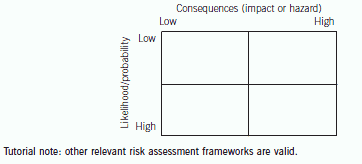
-
第2题:
(ii) An evaluation of the environmental and sustainability implications of the Giant Dam Project; (8 marks)
正确答案:
(ii) Environmental and sustainability implications of the Giant Dam Project
In our preparation for the bid to act as principal contractor for the Giant Dam Project, we established that there were
two prominent negative implications of the project but these are, in our view, more than offset by two major
environmental positives.
The environmental arguments against the Giant Dam Project both concern the flooding of the valley behind the dam.
Regrettably, it seems that there will be some loss of important habitats. This, in turn, may mean the removal of balanced
environmental conditions for certain animal and plant species. In addition, the flooding of the valley will result in the
loss of productive farmland. This will mean reduced capacity for the host country to grow food and thus support citizens
such as the members of First Nation. From our point of view, as the board of R&M, however, we would remind
shareholders and other observers that the decisions involving the size and positioning of the Giant Dam were taken by
the client, the government. It is R&M’s job, having won the contract as principal contractor, to now carry out the plans,
regardless of our own views.
Happily, however, there are two very powerful environmental arguments in favour of the Giant Dam Project. It will create
a large source of clean energy for economic development that will be sustainable, as it will create no carbon emissions
nor will it consume any non-renewable resources as it does so (compared to, for example, fossil fuels).
At a time when people are becoming very concerned about greenhouse gases produced from conventional power
generation, the Giant Dam Project will contribute to the East Asian country’s internationally agreed carbon reduction
targets. This, in turn, will contribute to the reduction of greenhouse gases in the environment.
It is clear that the construction of the Giant Dam Project is an environmental conundrum with strong arguments on both
sides. The deciding factor may be the opinion that we each have of the desirability of economic growth in the East Asian
country (which the energy from the dam is intended to support). It seems that Stop-the-dam values the preservation of
the original environment more than the economic growth that the energy from the dam would support. The client does
not agree with this assessment and we are happy to be involved with a project that will create such a useful source of
renewable and non-polluting energy. -
第3题:
渐退抗阻训练第3组的重量为
A、30%的10RM重量
B、40%的10RM重量
C、50%的10RM重量
D、60%的10RM重量
E、70%的10RM重量
参考答案:C
-
第4题:
As Huawei's highest decision-making body, the Representatives' Commission makes decisions on major company matters.()此题为判断题(对,错)。
参考答案:对
-
第5题:
Software quality assurance is now an (1) sub-discipline of software engineering. As Buckly and Oston point out, (2) software quality assurance is likely to lead to an ultimate (3) of software costs. However, the major hurdle in the path of software management in this area is the lack of (4) software standards. The development of accepted and generally applicable standards should be one of the principal goals of (5) in software engineering.
A.emerging
B.emergent
C.engaging
D.evolve
正确答案:A
-
第6题:
1RM
正确答案: 指受试者仅能完成一次全关节范围的最大抗阻力重量。 -
第7题:
适合长跑运动员力量训练的最佳负荷是()。
- A、30RM负荷
- B、10-15RM负荷
- C、6-10RM负荷
- D、5RM负荷
正确答案:A -
第8题:
进行1RM测试容易导致损伤,因此大学生需要经过()周训练后,方能参加1RM测试。
正确答案:1-2 -
第9题:
()系列均为快速熔断电。
- A、RM和RS
- B、RL1和RLS
- C、RS和RLS
- D、RM和RLS
正确答案:C -
第10题:
单选题磁路中磁势Fm、磁通φ及磁阻Rm三者之间的关系可用磁路的“欧姆定律”来表示,它们的关系为()AFm=φ/Rm
Bφ=Fm/Rm
Cφ=Rm/Fm
DFm=1/(Rm·φ)
正确答案: C解析: 暂无解析 -
第11题:
单选题按复合投资收益率法计算资本化率的公式是( )。AR=M·RM+(1-M)RE
BR=M·RE+(1-M)RM
CR=M·RM+M·RE
DR=(1-M)RM+(1-M)RE
正确答案: B解析: 复合投资收益率法是指将购买建筑物的抵押贷款收益率与自有资本收益率的加权平均数作为资本化率,按下式计算R=M·RM+(1-M)RE。式中:R——资本化率(%);M——贷款价值比率(%),抵押贷款额占房地产价值的比率;RM——抵押贷款资本化率(%),第一年还本息额与抵押贷款额的比率;RE——自有资本要求的正常收益率(%)。 -
第12题:
单选题To ensure the safe operation of each ship and to provide a link between the Company and those on board, every Company, as appropriate, should designate a person or persons ashore having direct () to the highest level of management.Aspace
Bdistance
Cvisibility
Daccess
正确答案: A解析: 暂无解析 -
第13题:
(c) Using information from the case, assess THREE risks to the Giant Dam Project. (9 marks)
正确答案:
(c) Assessment of three risks
Disruption and resistance by Stop-the-dam. Stop-the-dam seems very determined to delay and disrupt progress as much as
possible. The impact of its activity can be seen on two levels. It is likely that the tunnelling and other ‘human’ disruption will
cause a short-term delay but the more significant impact is that of exposing the lenders. In terms of probability, the case says
that it ‘would definitely be attempting to resist the Giant Dam Project when it started’ but the probability of exposing the
lenders is a much lower probability event if the syndicate membership is not disclosed.
Impact/hazard: low
Probability/likelihood: high
The risk to progress offered by First Nation can probably be considered to be low impact/hazard but high probability. The case
says that it ‘would be unlikely to disrupt the building of the dam’, meaning low impact/hazard, but that ‘it was highly likely
that they would protest’, meaning a high level of probability that the risk event would occur.
Impact: low
Probability: high
There are financing risks as banks seems to be hesitant when it comes to lending to R&M for the project. Such a risk event,
if realised, would have a high potential for disruption to progress as it may leave R&M with working capital financing
difficulties. The impact would be high because the bank may refuse to grant or extend loans if exposed (subject to existing
contractual terms). It is difficult to estimate the probability. Perhaps there will be a range of attitudes by the lending banks
with some more reticent than others (perhaps making it a ‘medium’ probability event).
Impact: medium to high (depending on the reaction of the bank)
Probability: low to medium (depending on how easy it would be to discover the lender) -
第14题:
(e) Internal controls are very important in a complex civil engineering project such as the Giant Dam Project.
Required:
Describe the difficulties of maintaining sound internal controls in the Giant Dam Project created by working
through sub-contractors. (4 marks)
正确答案:
(e) Control and sub-contractors
Specifically in regard to the maintenance of internal controls when working with sub-contractors, the prominent difficulties
are likely to be in the following areas:
Configuring and co-ordinating the many activities of sub-contractors so as to keep progress on track. This may involve taking
the different cultures of sub-contractor organisations into account.
Loss of direct control over activities as tasks are performed by people outside R&M’s direct employment and hence its
management structure.
Monitoring the quality of work produced by the sub-contractors. Monitoring costs will be incurred and any quality problems
will be potentially costly.
Budget ‘creep’ and cost control. Keeping control of budgets can be a problem in any large civil engineering project (such the
construction of the new Wembley Stadium in the UK) and problems are likely to be made worse when the principal contractor
does not have direct control over all activities.
Time limit over-runs. Many projects (again, such as the new Wembley Stadium, but others also) over-run significantly on time.
Tutorial note: only four difficulties need to be described. -
第15题:
In some countries of Asia or the Middle East, like Iran, students take an exit exam in their last year of high school. The people with the highest scores attend the best universities in the country.()
参考答案:正确
-
第16题:
选择电源线时,应使电源线的阻值RL、电源电阻Rm和电源变压器内阻应满足以下关系A、RL=Rm+R0
B、RL=Rm-R0
C、RL≤Rm+R0
D、RL≤Rm-R0
E、RL>Rm+R0
参考答案:D
-
第17题:
A project manager is called to an informal meeting with the customer and a problem is raised. This problem has major implications for the project manager’s company, but the customer wants to pursue a solution at the meeting, The project manager should()A.Tell the customer that he will not address any problems
B.Tell the customer that the problem is not sufficiently defined to company to a solution
C.Collect as much information on the problem without committing his company to a solution
D.Give the customer a range of solutions that might be acceptable to his company答案:C解析:经理与客户的非正式会议上提出一个问题对于项目有重大影响,客户希望开一个专题会议,项目经理应该(72)。A.告诉客户他不会提出任何问题B.告诉客户这个问题是没有充分定义C.收集更多的问题信息决定是否召开专题会议D.给客户几个可能被接受的解决方案 -
第18题:
地铁列车的运行模式由高到低是()。
- A、SM.AM.RM.AN
- B、AM.RM.SM
- C、RM.AM.SM
- D、AM.SM.RM.RS
正确答案:D -
第19题:
在肌肉力量评定中,正确的计算公式为()
- A、肌肉力量分数=[1RM重量(kg)×体重(kg)]×100
- B、肌肉力量分数=[1RM重量(kg)/体重(kg)]×100/2
- C、肌肉力量分数=[1RM重量(kg)/体重(kg)]×100
正确答案:C -
第20题:
下列何者组合最为适当()
- A、肌力70~80%1RM、15Reps休息:60秒
- B、肌力85~90%1RM、12Reps休息:30秒
- C、肌持久力60~70%1RM、6Reps休息:60秒
- D、肌持久力40~60%1RM、20Reps休息:30秒
正确答案:D -
第21题:
问答题Practice 4 Few creations of big technology capture the imagination like giant dams. Perhaps it is humankind’s long suffering at the mercy of flood and drought that makes the ideal of forcing the waters to do our bidding so fascinating. But to be fascinated is also, sometimes, to be blind. Several giant dam projects threaten to do more harm than good. The lesson from dams is that big is not always beautiful. It doesn’t help that building a big, powerful dam has become a symbol of achievement for nations and people striving to assert themselves. Egypt’s leadership in the Arab world was cemented by the Aswan High Dam. Turkey’s bid for First World status includes the giant Ataturk Dam.正确答案:
【参考译文】
重大技术的创造中,几乎没有哪个比巨型大坝更令人心驰神往。也许正是由于人类长期遭受旱涝之灾才使得让洪水听从人的调遣这种理想如此令人痴迷。但使人痴迷有时也就使人盲目。有几个巨型大坝项目可能弊大于利。
从堤坝中获得的教训是,大的并不总是美的。对于那些在努力显示自身力量的国家和人民,建一个功能强大的大水坝标志着他们取得了成就,然而修建大坝并没有什么实际作用。埃及的阿拉伯世界的领导地位因阿斯旺大坝得以巩固和加强,土耳其在其争取跻身于第一世界的努力中也包括建造阿搭特克大坝。解析: 暂无解析 -
第22题:
问答题The high performance innovators depended on different models and approaches to outperform their competitors. In many cases, the company’s success is attributed to a distinctive skill. Google, for example, is known for generating new ideas with blistering speed. Toyota excels at developing its products and processes far more efficiency and effectively than most other companies. And Apple is noted for its well-honed capabilities in project selection and customer understanding. The most successful companies exhibited strong capabilities across four key areas: ideation, project selection, product development, and commercialization.正确答案:
创新回报高的公司比对手做得好,靠的是不同的模式和方法。在很多情况下,公司的成功归功于一项独门绝技。以谷歌公司为例:它是以极快的速度产生新的创意而闻名。丰田在开发其产品和生产过程方面的效率和效果远高于其他大多数的公司:苹果公司则以炉火纯青的选择项目和了解客户的能力为人称道。最成功的公司在四个关键领域展示出非凡本领,即构思能力、项目选择、产品开发和商品化。解析: 暂无解析 -
第23题:
填空题进行1RM测试容易导致损伤,因此大学生需要经过()周训练后,方能参加1RM测试。正确答案: 1-2解析: 暂无解析