
(iii) the warranty provision. (3 marks)
题目
(iii) the warranty provision. (3 marks)
相似考题
更多“(iii) the warranty provision. (3 marks)”相关问题
-
第1题:
(b) Coaching. (3 marks)
正确答案:
(b) Coaching involves the trainee being assisted by another, experienced employee. It is a specialised, systematic learning programme based on communication, defined targets and continuous learning. It encourages constructive feedback between the trainee and trainer.
-
第2题:
(iii) job enrichment. (5 marks)
正确答案:
(iii) Job enrichment, which is often referred to as ‘vertical job enlargement’, is a planned, deliberate action to build greater responsibility, breadth and challenge into the work of the individual. The emphasis is on the individual rather than the organisation, team or group. This may be a way forward for some of Bailey’s employees since it provides the individual employee with the responsibility for decision making of a higher order, provides greater freedom to decide how the job or task should be undertaken, improves understanding of the entire process, encourages participation in the planning and production procedures and provides regular feedback to management – urgently needed at Bailey’s.
-
第3题:
(iii) How items not dealt with by an IFRS for SMEs should be treated. (5 marks)
正确答案:
(iii) The treatment of items not dealt with by an IFRS for SMEs
IFRSs for SMEs would not necessarily deal with all the recognition and measurement issues facing an entity but the key
issues should revolve around the nature of the recognition, measurement and disclosure of the transactions of SMEs. In
the case where the item is not dealt with by the standards there are three alternatives:
(a) the entity can look to the full IFRS to resolve the issue
(b) management’s judgement can be used with reference to the Framework and consistency with other IFRSs for SMEs
(c) existing practice could be used.
The first approach is more likely to result in greater consistency and comparability. However, this approach may also
increase the burden on SMEs as it can be argued that they are subject to two sets of standards.
An SME may wish to make a disclosure required by a full IFRS which is not required by the SME standard, or a
measurement principle is simplified or exempted in the SME standard, or the IFRS may give a choice between two
measurement options and the SME standard does not allow choice. Thus the issue arises as to whether SMEs should
be able to choose to comply with a full IFRS for some items and SME standards for other items, allowing an SME to
revert to IFRS on a principle by principle basis. The problem which will arise will be a lack of consistency and
comparability of SME financial statements.
-
第4题:
5 The directors of Quapaw, a limited liability company, are reviewing the company’s draft financial statements for the
year ended 31 December 2004.
The following material matters are under discussion:
(a) During the year the company has begun selling a product with a one-year warranty under which manufacturing
defects are remedied without charge. Some claims have already arisen under the warranty. (2 marks)
Required:
Advise the directors on the correct treatment of these matters, stating the relevant accounting standard which
justifies your answer in each case.
NOTE: The mark allocation is shown against each of the three matters
正确答案:
(a) The correct treatment is to provide for the best estimate of the costs likely to be incurred under the warranty, as required by
IAS37 Provisions, contingent liabilities and contingent assets. -
第5题:
(b) Discuss ways in which the traditional budgeting process may be seen as a barrier to the achievement of the
aims of EACH of the following models for the implementation of strategic change:
(i) benchmarking;
(ii) balanced scorecard; and
(iii) activity-based models. (12 marks)
正确答案:
(b) Benchmarking
Benchmarks enable goals to be set that may be based on either external measures of ‘best practice’ organisations or internal
cross-functional comparisons which exhibit ‘best practice’. A primary aim of the traditional budgeting process is the setting of
realistic targets that can be achieved within the budget period. The setting of realistic targets means that the extent of
underperformance against ‘best practice’ standards loses visibility, and thus short-term financial targets remain the
predominant focus of the traditional budgeting process. It is arguable that because the budgetary reporting system purports
to give managers ‘control’, there is very little real incentive to seek out benchmarks which may be used to raise budgeted
performance targets. Much depends upon the prevailing organisational culture since benchmarking may be viewed as an
attempt by top management to impose impossible targets upon operational managers. The situation is further exacerbated
where organisations do not measure their success relative to their competition.
Balanced scorecard
The Balanced scorecard is often misunderstood as a consequence of the failure by top management to ensure that it is
implemented effectively within the organisation. Thus it may be viewed as the addition of a few non-financial measures to
the conventional budget. In an attempt to overcome this misperception many management teams now establish a
performance-rewards linkage based upon the achievement of Scorecard targets for the forthcoming budget period.
Unfortunately this can precipitate dysfunctional behaviour at every level within the organisation.
Even in situations where the Scorecard has been well-designed and well-implemented it is difficult for it to gain widespread
acceptance. This is because all too often there exists a culture which places a very high value upon the achievement of the
fixed annual targets in order to avoid the loss of status, recognition and rewards.
A well-constructed Scorecard contains a mix of long-term and short-term measures and therefore drives the company in the
direction of medium-term strategic goals which are supported by cross-functional initiatives. On the other hand, the budgeting
process focuses the organisation on the achievement of short-term financial goals supported by the initiatives of individual
departments. Budgets can also act as an impediment to the acceptance of responsibility by local managers for the
achievement of the Scorecard targets. This is often the case in situations where a continued emphasis exists on meeting shortterm
e.g. quarterly targets.
Activity-based models
Traditional budgets show the costs of functions and departments (e.g. staff costs and establishment costs) instead of the costs
of those activities that are performed by people (e.g. receipt of goods inwards, processing and dispatch of orders etc). Thus
managers have no visibility of the real ‘cost drivers’ of their business. In addition, it is probable that a traditional budget
contains a significant amount of non-value-added costs that are not visible to the managers. The annual budget also tends
to fix capacity for the forthcoming budget period thereby undermining the potential of Activity-based management (ABM)
analysis to determine required capacity from a customer demand perspective. Those experienced in the use of ABM
techniques are used to dealing with such problems, however their tasks would be much easier to perform. and their results
made more reliable if these problems were removed. -
第6题:
(b) Identify and discuss the appropriateness of the cost drivers of any TWO expense values in EACH of levels (i)
to (iii) above and ONE value that relates to level (iv).
In addition, suggest a likely cause of the cost driver for any ONE value in EACH of levels (i) to (iii), and
comment on possible benefits from the identification of the cause of each cost driver. (10 marks)
正确答案:
(b) A cost driver is the factor that determines the level of resource required for an activity. This may be illustrated by considering
costs for each of the four levels in Order Number 377.
Unit based costs:
Direct material costs are driven by the quantity, range, quality and price of materials required per product unit according to
the specification for the order.
Direct labour costs are driven by the number of hours required per product unit and the rate per hour that has been agreed
for each labour grade.
Batch related costs:
The number of machine set-ups per batch is the cost driver for machines used.
The number of design hours per batch is the cost driver for design work.
Product sustaining costs:
The number of marketing visits to a client per order is the cost driver for marketing cost chargeable to the order.
The number of hours of production line maintenance per order is the cost driver for production line cost.
Business sustaining costs:
These costs are absorbed at a rate of 30% of total cost excluding business sustaining costs. This is an arbitrary rate which
indicates the difficulty in identifying a suitable cost driver/drivers for the range of residual costs in this category. Wherever
possible efforts should be made to identify aspects of this residual cost that can be added to the unit, batch or product related
analysis.
The cost drivers are useful in that they provide a basis for an accurate allocation of the cost of resources consumed by an
order. In addition, investigation of the cause(s) of a cost driver occurring at its present level allows action to be considered
that will lead to a reduction in the cost per unit of cost driver.
Examples of causes that might be identified are:
Material price may be higher than necessary due to inefficient sourcing of materials. This may be overcome through efforts
to review sourcing policy and possibly provide additional training to staff responsible for the sourcing of materials.
The number of machine set-ups per batch may be due to lack of planning of batch sizes. It may be possible for batch sizes
in this order to be increased to 1,250 units which would reduce the number of batches required to fulfil the order from five
to four. This should reduce overall costs.
The amount of production line maintenance (and hence cost) required per order may be reduced by examining causes such
as level of skill of maintenance carried out – by GMB’s own staff or out-sourced provision. Action would involve re-training of
own staff or recruitment of new staff or changing of out-source providers.
(alternative relevant examples and discussion would be acceptable for all aspects of part (b)) -
第7题:
(iii) Whether or not you agree with the statement of the marketing director in note (9) above. (5 marks)
Professional marks for appropriateness of format, style. and structure of the report. (4 marks)
正确答案:(iii) The marketing director is certainly correct in recognising that success is dependent on levels of service quality provided
by HFG to its clients. However, whilst the number of complaints is an important performance measure, it needs to be
used with caution. The nature of a complaint is, very often, far more indicative of the absence, or a lack, of service
quality. For example, the fact that 50 clients complained about having to wait for a longer time than they expected to
access gymnasium equipment is insignificant when compared to an accident arising from failure to maintain properly a
piece of gymnasium equipment. Moreover, the marketing director ought to be aware that the absolute number of
complaints may be misleading as much depends on the number of clients serviced during any given period. Thus, in
comparing the number of complaints received by the three centres then a relative measure of complaints received per
1,000 client days would be far more useful than the absolute number of complaints received.
The marketing director should also be advised that the number of complaints can give a misleading picture of the quality
of service provision since individuals have different levels of willingness to complain in similar situations.
The marketing director seems to accept the current level of complaints but is unwilling to accept any increase above this
level. This is not indicative of a quality-oriented organisation which would seek to reduce the number of complaints over
time via a programme of ‘continuous improvement’.
From the foregoing comments one can conclude that it would be myopic to focus on the number of client complaints
as being the only performance measure necessary to measure the quality of service provision. Other performance
measures which may indicate the level of service quality provided to clients by HFG are as follows:
– Staff responsiveness assumes critical significance in service industries. Hence the time taken to resolve client
queries by health centre staff is an important indicator of the level of service quality provided to clients.
– Staff appearance may be viewed as reflecting the image of the centres.
– The comfort of bedrooms and public rooms including facilities such as air-conditioning, tea/coffee-making and cold
drinks facilities, and office facilities such as e-mail, facsimile and photocopying.
– The availability of services such as the time taken to gain an appointment with a dietician or fitness consultant.
– The cleanliness of all areas within the centres will enhance the reputation of HFG. Conversely, unclean areas will
potentially deter clients from making repeat visits and/or recommendations to friends, colleagues etc.
– The presence of safety measures and the frequency of inspections made regarding gymnasium equipment within
the centres and compliance with legislation are of paramount importance in businesses like that of HFG.
– The achievement of target reductions in weight that have been agreed between centre consultants and clients.
(Other relevant measures would be acceptable.)
-
第8题:
(iii) State any disadvantages to the relief in (i) that Sharon should be aware of, and identify and describe
another relief that she might use. (4 marks)
正确答案:
(iii) There are several disadvantages to incorporation relief as follows:
1. The requirement to transfer all business assets to the company means that it will not be possible to leave behind
certain assets, such as the property. This might lead to a double tax charge (sale of the property, then extraction
of sale proceeds) at a future date.
2. Taper relief is lost on the transfer of the business. This means that any disposal of chargeable business assets (the
shares) within two years of the incorporation will lead to a higher chargeable gain, as the full rate of business asset
taper relief will not be available.
3. The relief does not eliminate the tax charge, it merely defers the payment of tax until some future event. The
deferred gain will become taxable when Sharon sells her shares in the company.
Gift relief could be used instead of incorporation relief. The assets would be gifted to the company for no consideration,
with the base cost of the assets to the company being reduced by the deferred gain arising. Unlike incorporation relief,
gift relief applies to individual assets used in a trade and not to an entire business. This is particularly useful if the
transferor wishes to retain some assets, such as property outside the company, as not all assets have to be transferred.
Note: If the business was non-trading, incorporation relief would still be available, but gift relief would not. However,
this restriction should not apply to Sharon and gift relief remains an option in this case. -
第9题:
(iii) Explain the potential corporation tax (CT) implications of Tay Limited transferring work to Trent Limited,
and suggest how these can be minimised or eliminated. (3 marks)
正确答案:
(iii) Trading losses may not be carried forward where, within a period of three years there is both a change in the ownership
of a company and a major change in the nature or conduct of its trade. The transfer of work from Tay Limited to Trent
Limited is likely to constitute a major change in the nature or conduct of the latter’s trade. As a consequence, any tax
losses at the date of acquisition will be forfeited. Assuming losses were incurred uniformly in 2005, the tax losses at the
date of acquisition were £380,000 (300,000 + 2/3 x 120,000)). This is worth £114,000 assuming a corporation tax
rate of 30%.
Thus, Tay Limited should not consider transferring any trade to Trent Limited until after the third anniversary of the date
of the change of ownership i.e. not before 1 September 2008. As the trades are similar, there should be little problem
in transferring work from that date onwards. -
第10题:
(iii) Advice in connection with the sale of the manufacturing premises by Tethys Ltd; (7 marks)
正确答案:
(iii) Tethys Ltd – Sale of the manufacturing premises
Value added tax (VAT)
– The building is not a new building (i.e. it is more than three years old). Accordingly, the sale of the building is an
exempt supply and VAT should not be charged unless Tethys Ltd has opted to tax the building in the past.
Taxable profits on sale
– There will be no balancing adjustment in respect of industrial building allowances as the building is to be sold on
or after 21 March 2007.
– The capital gain arising on the sale of the building will be £97,760 (£240,000 – (£112,000 x 1·27)).
Rollover relief
– Tethys Ltd is not in a capital gains group with Saturn Ltd. Accordingly, rollover relief will only be available if Tethys
Ltd, rather than any of the other Saturn Ltd group companies, acquires sufficient qualifying business assets.
– The amount of sales proceeds not spent in the qualifying period is chargeable, i.e. £40,000 (£240,000 –
£200,000). The balance of the gain, £57,760 (£97,760 – £40,000), can be rolled over.
– Qualifying business assets include land and buildings and fixed plant and machinery. The assets must be brought
into immediate use in the company’s trade.
– The assets must be acquired in the four-year period beginning one year prior to the sale of the manufacturing
premises.
Further information required:
– Whether or not Tethys Ltd has opted to tax the building in the past for the purposes of VAT. -
第11题:
2 (a) Define the following terms:
(i) Forensic Accounting;
(ii) Forensic Investigation;
(iii) Forensic Auditing. (6 marks)
正确答案:
2 Crocus Co
(a) (i) Forensic accounting utilises accounting, auditing, and investigative skills to conduct an examination into a company’s
financial statements. The aim of forensic accounting is to provide an accounting analysis that is potentially suitable for
use in court. Forensic accounting is an umbrella term encompassing both forensic investigations and forensic audits. It
includes the audit of financial information to prove or disprove a fraud, the interview process used during an
investigation, and the act of serving as an expert witness.
Tutorial note: Forensic accounting can be used in a very wide range of situations, e.g. settling monetary disputes in
relation to a business closure, marriage break up, insurance claim, etc. Credit will be awarded for any reasonable
examples provided.
(ii) A forensic investigation is a process whereby a forensic accountant carries out procedures to gather evidence, which
could ultimately be used in legal proceedings or to settle disputes. This could include, for example, an investigation into
money laundering. A forensic investigation involves many stages (similar to an audit), including planning, evidence
gathering, quality control reviews, and finally results in the production of a report.
(iii) Forensic auditing is the specific use of audit procedures within a forensic investigation to find facts and gather evidence,
usually focused on the quantification of a financial loss. This could include, for example, the use of analytical
procedures, and substantive procedures to determine the amount of an insurance claim. -
第12题:
Examine the description of the MARKS table: STD_ID NUMBER(4) STUDENT_NAME VARCHAR2(30) SUBJ1 NUMBER(3) SUBJ2 NUMBER(3) SUBJ3 NUMBER(3) SUBJ1, SUBJ2, and SUBJ3 indicate the marks (grades) obtained by a student in the three subjects. Which two statements are valid? ()
- A、SELECT SUM(subj1, subj2, subj3) FROM marks;
- B、SELECT SUM(subj1 + subj2 + subj3) FROM marks;
- C、SELECT SUM(subj1), SUM(subj2), SUM(subj3) FROM marks;
- D、SELECT MAX(subj1, subj2, subj3) FROM marks;
- E、SELECT MINIMUM(subj1) FROM marks;
- F、SELECT COUNT(std_id) FROM marks WHERE subj1 >= AVG(subj1);
正确答案:B,C -
第13题:
(d) Job rotation. (3 marks)
正确答案:
(d) Job rotation is an important training method and is often also seen as a means of motivation. It involves moving the trainee from one job to another and is therefore more suitable for lower level employees. The trainee is required to do different jobs in logical succession, thus broadening experience and gaining a picture of the organisation’s wider activities.
-
第14题:
(iii) Lateral or horizontal. (3 marks)
正确答案:
(iii) Lateral or horizontal. Traditional communication assumes a hierarchical structure with only vertical communication,however horizontal communication has become important and necessary in less formal organisations. It takes the form. of coordination with departmental managers or supervisors meeting regularly, problem solving with department members meeting to resolve an issue or information sharing and it also describes interdepartmental sharing of ideas or conflict resolution where there is a need to resolve interdepartmental friction.
-
第15题:
(b) (i) Discusses the principles involved in accounting for claims made under the above warranty provision.
(6 marks)
(ii) Shows the accounting treatment for the above warranty provision under IAS37 ‘Provisions, Contingent
Liabilities and Contingent Assets’ for the year ended 31 October 2007. (3 marks)
Appropriateness of the format and presentation of the report and communication of advice. (2 marks)
正确答案:(b) Provisions – IAS37
An entity must recognise a provision under IAS37 if, and only if:
(a) a present obligation (legal or constructive) has arisen as a result of a past event (the obligating event)
(b) it is probable (‘more likely than not’), that an outflow of resources embodying economic benefits will be required to settle
the obligation
(c) the amount can be estimated reliably
An obligating event is an event that creates a legal or constructive obligation and, therefore, results in an enterprise having
no realistic alternative but to settle the obligation. A constructive obligation arises if past practice creates a valid expectation
on the part of a third party. If it is more likely than not that no present obligation exists, the enterprise should disclose a
contingent liability, unless the possibility of an outflow of resources is remote.
The amount recognised as a provision should be the best estimate of the expenditure required to settle the present obligation
at the balance sheet date, that is, the amount that an enterprise would rationally pay to settle the obligation at the balance
sheet date or to transfer it to a third party. This means provisions for large populations of events such as warranties, are
measured at a probability weighted expected value. In reaching its best estimate, the entity should take into account the risks
and uncertainties that surround the underlying events.
Expected cash outflows should be discounted to their present values, where the effect of the time value of money is material
using a risk adjusted rate (it should not reflect risks for which future cash flows have been adjusted). If some or all of the
expenditure required to settle a provision is expected to be reimbursed by another party, the reimbursement should be
recognised as a separate asset when, and only when, it is virtually certain that reimbursement will be received if the entity
settles the obligation. The amount recognised should not exceed the amount of the provision. In measuring a provision future
events should be considered. The provision for the warranty claim will be determined by using the expected value method.
The past event which causes the obligation is the initial sale of the product with the warranty given at that time. It would be
appropriate for the company to make a provision for the Year 1 warranty of $280,000 and Year 2 warranty of $350,000,
which represents the best estimate of the obligation (see Appendix 2). Only if the insurance company have validated the
counter claim will Macaljoy be able to recognise the asset and income. Recovery has to be virtually certain. If it is virtually
certain, then Macaljoy may be able to recognise the asset. Generally contingent assets are never recognised, but disclosed
where an inflow of economic benefits is probable.
The company could discount the provision if it was considered that the time value of money was material. The majority of
provisions will reverse in the short term (within two years) and, therefore, the effects of discounting are likely to be immaterial.
In this case, using the risk adjusted rate (IAS37), the provision would be reduced to $269,000 in Year 1 and $323,000 in
Year 2. The company will have to determine whether this is material.
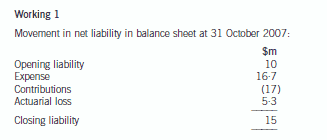
Appendix 1
The accounting for the defined benefit plan is as follows:

-
第16题:
(iii) A statement on the importance of confidentiality in the financing of the early stage working capital needs
and an explanation of how this conflicts with the duty of transparency in matters of corporate
governance. (6 marks)
Professional marks for layout, logical flow and persuasiveness of the statement. (4 marks)
正确答案:
(iii) Importance of confidentiality in the financing of the project and the normal duty of transparency.
I have been asked to include a statement in my remarks on the balance between our duty to be transparent whenever
possible and the need for discretion and confidentiality in some situations. In the case of our initial working capital needs
for the Giant Dam Project, the importance of confidentiality in financing is due to the potential for adverse publicity that
may arise for the lender. It is important that R&M have the project adequately financed, especially in the early stages
before the interim payments from the client become fully effective.
In general, of course, we at R&M attempt to observe the highest standards of corporate governance and this involves
adopting a default position of transparency rather than concealment wherever possible. We recognise that transparency
is important to underpin investor confidence and to provide investors with the information they need to make fund
allocation decisions.
Whilst it is normal to disclose the amount of debt we carry at any given point (on the balance sheet), it is rarely normal
practice to disclose the exact sources of those loans. In the case of the financing of initial working capital for the Giant
Dam Project, I’m sure you will realise that in this unique situation, disclosure of the lender’s identity could threaten the
progress of the project. For this reason we must resist any attempts to release this into the public domain. We are aware
of one pressure group that is actively seeking to discover this information in order to disrupt the project’s progress and
we shall be taking all internal measures necessary to ensure they do not obtain the information.
Thank you for listening. -
第17题:
(iii) whether you agree or not with the statement of the production director. (3 marks)
正确答案:
(iii) ‘If we implement a reward scheme then it is bound to be beneficial for BGL’.
The statement of the manufacturing director is not necessarily correct. Indeed there is much evidence to support the
proposition that the existence of performance-related reward schemes can encourage dysfunctional behaviour. This often
manifests itself in the form. of ‘budgetary slack’ which is incorporated into budgets in anticipation of subsequent cuts by
higher levels of management or to make subsequent performance look better. -
第18题:
(iii) assesses TSC in terms of financial performance, competitiveness, service quality, resource utilisation,
flexibility and innovation and discusses the interrelationships between these terms, incorporating
examples from within TSC; and (10 marks)
正确答案:
(iii) The terms listed may be seen as representative of the dimensions of performance. The dimensions may be analysed into
results and determinants.
The results may be measured by focusing on financial performance and competitiveness. Financial performance may
be measured in terms of revenue and profit as shown in the data in the appendix of the question in respect of TSC. The
points system in part (a) of the answer shows which depots have achieved or exceeded the target set. In addition,
liquidity is another aspect of the measurement of financial performance. The points total in part (a) showed that
Leonardotown and Michaelangelotown depots appear to have the best current record in aspects of credit control.
15
Competitiveness may be measured in terms of sales growth but also in terms of market share, number of new
customers, etc. In the TSC statistics available in (a) we only have data for the current quarter. This shows that three of
the four depots listed have achieved increased revenue compared to target.
The determinants are the factors which may be seen to contribute to the achievement of the results. Quality, resource
utilisation, flexibility and innovation are cited by Fitzgerald and Moon as examples of factors that should contribute to
the achievement of the results in terms of financial performance and competitiveness. In TSC a main quality issue
appears to be customer care and service delivery. The statistics in the points table in part (a) of the answer show that
the Raphaeltown depot appears to have a major problem in this area. It has only achieved one point out of the six
available in this particular segment of the statistics.
Resource utilisation for TSC may be measured by the level of effective use of drivers and vehicles. To some extent, this
is highlighted by the statistics relating to customer care and service delivery. For example, late collection of consignments
from customers may be caused by a shortage of vehicles and/or drivers. Such shortages could be due to staff turnover,
sickness, etc or problems with vehicle maintenance.
Flexibility may be an issue. There may, for example, be a problem with vehicle availability. Possibly an increased focus
on sources for short-term sub-contracting of vehicles/collections/deliveries might help overcome delay problems.
The ‘target v actual points system’ may be seen as an example of innovation by the company. This gives a detailed set
of measures that should provide an incentive for improvement at all depots. The points system may illustrate the extent
of achievement/non-achievement of company strategies for success. For example TSC may have a customer care
commitment policy which identifies factors that should be achieved on a continuing basis. For example, timely collection
of consignments, misdirected consignments re-delivered at no extra charge, prompt responses to customer claims and
compensation for customers. -
第19题:
(iii) Identify and discuss an alternative strategy that may assist in improving the performance of CTC with
effect from 1 May 2009 (where only the products in (a) and (b) above are available for manufacture).
(4 marks)
正确答案:
(iii) If no new products are available then CTC must look to boost revenues obtained from its existing product portolio whilst
seeking to reduce product specific fixed overheads and the company’s other fixed overheads. In order to do this attention
should be focused on the marketing activities currently undertaken.
CTC should consider selling all of its products in ‘multi product’ packages as it might well be the case that the increased
contribution achieved from increased sales volumes would outweigh the diminution in contribution arising from
reductions in the selling price per unit of each product.
CTC could also apply target costing principles in order to reduce costs and thereby increase the margins on each of its
products. Value analysis should be undertaken in order to evaluate the value-added features of each product. For
example, the use of non-combustible materials in manufacture would be a valued added feature of such products
whereas the use of pins and metal fastenings which are potentially harmful to children would obviously not comprise
value added features. CTC should focus on delivering ‘value’ to the customer and in attempting to do so should seek to
identify all non-value activities in order that they may be eliminated and hence margins improved. -
第20题:
(iii) State how your answer in (ii) would differ if the sale were to be delayed until August 2006. (3 marks)
正确答案:
-
第21题:
(iii) The extent to which Amy will be subject to income tax in the UK on her earnings in respect of duties
performed for Cutlass Inc and the travel costs paid for by that company. (5 marks)
Appropriateness of format and presentation of the report and the effectiveness with which its advice is
communicated. (2 marks)
Note:
You should assume that the income tax rates and allowances for the tax year 2006/07 and the corporation tax
rates and allowances for the financial year 2006 apply throughout this questio
正确答案:
(iii) Amy’s UK income tax position
Amy will remain UK resident and ordinarily resident as she is not leaving the UK permanently or for a complete tax year
under a full time contract of employment. Accordingly, she will continue to be subject to UK tax on her worldwide income
including her earnings in respect of the duties she performs for Cutlass Inc. The earnings from these duties will also be
taxable in Sharpenia as the income arises in that country.
The double tax treaty between the UK and Sharpenia will either exempt the employment income in one of the two
countries or give double tax relief for the tax paid in Sharpenia. The double tax relief will be the lower of the UK tax and
the Sharpenian tax on the income from Cutlass Inc.
Amy will not be subject to UK income tax on the expenses borne by Cutlass Inc in respect of her flights to and from
Sharpenia provided her journeys are wholly and exclusively for the purposes of performing her duties in Sharpenia.
The amounts paid by Cutlass Inc in respect of Amy’s family travelling to Sharpenia will be subject to UK income tax as
Amy will not be absent from the UK for a continuous period of at least 60 days. -
第22题:
(iii) Can audit teams cross sell services to their clients? (4 marks)
Required:
For EACH of the three FAQs, explain the threats to objectivity that may arise and the safeguards that should
be available to manage them to an acceptable level.
NOTE: The mark allocation is shown against each of the three questions.
正确答案:
(iii) Cross selling services
The practice of cross selling is intended to give incentives to members of audit teams to concentrate their efforts on the
selling of non-audit services to audit clients.
It is not inappropriate for an audit firm to cross sell or for members of the audit team to recognise on an ongoing basis
the need of a client to have non audit services. However it should not be an aim of the audit team member to seek out
such opportunities.
Boleyn should have policies and procedures to ensure that, in relation to each audit client:
■ the objectives of the members of the audit team do not include selling of non-audit services to the audit client;
■ the criteria for evaluating the performance of members of the audit team do not include success in selling nonaudit
services to the audit client;
■ no specific element of remuneration of a member of the audit team and no decision concerning promotion within
the audit firm is based on his or her success in selling non-audit services to the audit client; and
■ the ethics partner being available for consultation when needed.
Therefore objectives such as the following are inappropriate:
■ to meet a quota of opportunities;
■ to specifically make time to discuss with clients which non-audit services they should consider;
■ to develop identified selling opportunities.
An audit engagement partner’s performance should be judged on the quality and integrity of the audit only. There are
no restrictions on normal partnership profit-sharing arrangements.
-
第23题:
保证(Warranty)
正确答案: 是指双方在海上保险合同中约定的或法律上默示的被保险人对其某一事项的作为或不作为,或担保某一事项的真实性