
(ii) Assuming the new structure is implemented with effect from 1 August 2006, calculate the level ofmanagement charge that should be made by Bold plc to Linden Limited for the year ended 31 July2007, so as to minimise the group’s overall corporation tax
题目
(ii) Assuming the new structure is implemented with effect from 1 August 2006, calculate the level of
management charge that should be made by Bold plc to Linden Limited for the year ended 31 July
2007, so as to minimise the group’s overall corporation tax (CT) liability for that year. (2 marks)
相似考题
更多“(ii) Assuming the new structure is implemented with effect from 1 August 2006, calculate the level ofmanagement charge that should be made by Bold plc to Linden Limited for the year ended 31 July2007, so as to minimise the group’s overall corporation tax ”相关问题
-
第1题:
(c) Assuming that Joanne registers for value added tax (VAT) with effect from 1 April 2006:
(i) Calculate her income tax (IT) and capital gains tax (CGT) payable for the year of assessment 2005/06.
You are not required to calculate any national insurance liabilities in this sub-part. (6 marks)
正确答案:
-
第2题:
For this part, assume today’s date is 15 August 2005.
5 (a) Donald is aged 22, single, and about to finish his university education. He has plans to start up a business selling
computer games, and intends to start trading on 1 April 2006, making up accounts to 31 March annually.
He believes that his business will generate cash (equal to taxable profits) of £47,500 in the first year. He
originally intended to operate as a sole trader, but he has recently discovered that as an alternative, he could
operate through a company. He has been advised that if this is the case, he can take a maximum gross salary
of £42,648 out of the company.
Required:
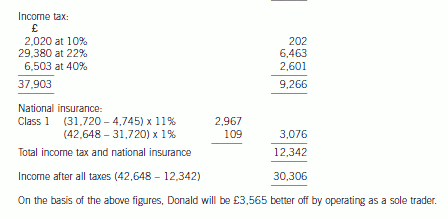
(i) Advise Donald on the income tax (IT), national insurance (NIC) and corporation tax (CT) liabilities he
will incur for the year ended 31 March 2007 trading under each of the two alternative business
structures (sole trade/company). Your advice should be supported by calculations of disposable income
for both alternatives assuming that in the company case, he draws the maximum salary stated.
(7 marks)
正确答案: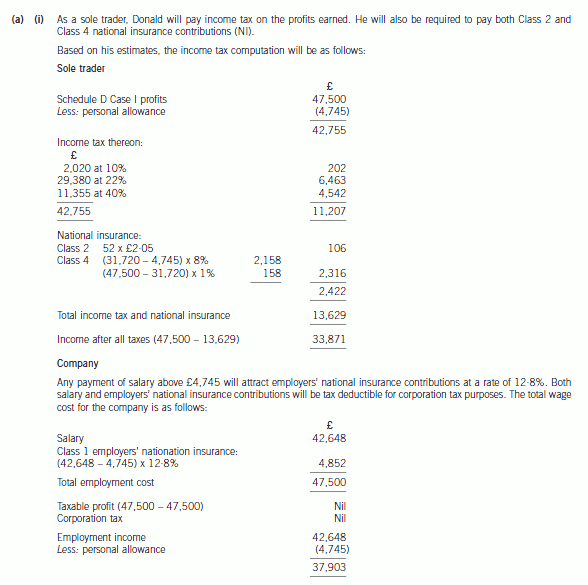
-
第3题:
6 Alasdair, aged 42, is single. He is considering investing in property, as he has heard that this represents a good
investment. In order to raise the funds to buy the property, he wants to extract cash from his personal company, Beezer
Limited, whose year end is 31 December.
Beezer Limited was formed on 1 May 1998 with £1,000 of capital issued as 1,000 £1 ordinary shares, and traded
until 1 January 2005 when Alasdair sold the trade and related assets. The company’s only asset is cash of
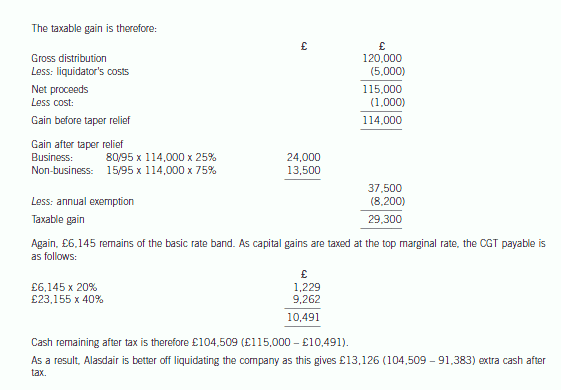
£120,000. Alasdair wants to extract this cash from the company with the minimum amount of tax payable. He is
considering either, paying himself a dividend of £120,000, on 31 March 2006, after which the company would have
no assets and be wound up or, leaving the cash in the company and then liquidating the company. Costs of liquidation
of £5,000 would then be incurred.
Since Beezer Limited ceased trading, Alasdair has been taken on as a partner at a marketing firm, Gallus & Co. He
estimates his profit share for the year of assessment 2005/06 will be £30,000. He has not made any capital disposals
in the current tax year.
Alasdair wishes to reinvest the cash extracted from Beezer Limited in property but is not sure whether he should invest
directly in residential or commercial property, or do so via some form. of collective investment. He is aware that Gallus
& Co are looking to rent a new warehouse which could be bought for £200,000. Alasdair thinks that he may be able
to buy the warehouse himself and lease it to his firm, but only if he can borrow the additional money to buy the
property.
Alasdair has a 25% shareholding in another company, Glaikit Limited, whose year end is 31 March. The remaining
shares in this company are held by his friend, Gill. Alasdair is considering borrowing £15,000 from Glaikit Limited
on 1 January 2006. He does not intend to pay any interest on the loan, which is likely to be written off some time
in 2007. Alasdair does not have any connection with Glaikit Limited other than his shareholding.
Required:
(a) Advise Alasdair whether or not a dividend payment will result in a higher after-tax cash sum than the
liquidation of Beezer Limited. Assume that either the dividend would be paid on 31 March 2006 or the
liquidation would take place on 31 March 2006. (9 marks)
Assume that Beezer Limited has always paid corporation tax at or above the small companies rate of 19%
and that the tax rates and allowances for 2004/05 apply throughout this part.
正确答案: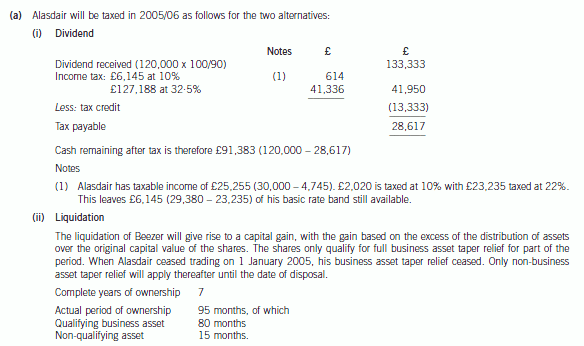
-
第4题:
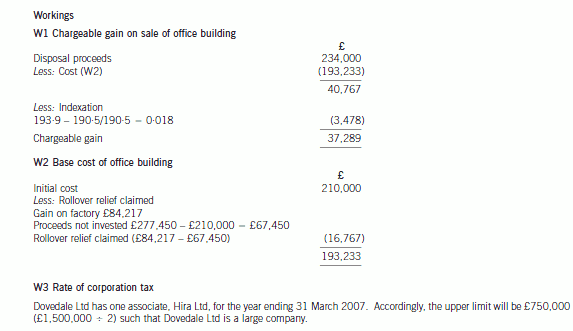
(c) Calculate the expected corporation tax liability of Dovedale Ltd for the year ending 31 March 2007 on the
assumption that all available reliefs are claimed by Dovedale Ltd but that Hira Ltd will not claim any capital
allowances in that year. (4 marks)
正确答案:
-
第5题:
(b) Peter, one of Linden Limited’s non-executive directors, having lived and worked in the UK for most of his adult
life, sold his home near London on 22 March 2006 and, together with his wife (a French citizen), moved to live
in a villa which she owns in the south of France. Peter is now demanding that the tax deducted from his director’s
fees, for the board meetings held on 18 April and 16 May 2006, be refunded, on the grounds that, as he is no
longer resident in the UK, he is no longer liable to UK income tax. All of the company’s board meetings are held
at its offices in Cambridge.
Despite Peter’s assurance that none of the other companies of which he is a director has disputed his change of
tax status, Damian is uncertain whether he should make the refunds requested. However, as Peter is a friend of
the company’s founder, Linden Limited’s managing director is urging him to do so, stating that if the tax does
have to be paid, then Linden Limited could always bear the cost.
Required:
Advise Damian whether Peter is correct in his assertion regarding his tax position and in the case that there
is a UK tax liability the implications of the managing director’s suggestion. You are not required to consider
national insurance (NIC) issues. (4 marks)
正确答案:
(b) Peter will have been resident and ordinarily resident in the UK. When such individuals leave the UK for a purpose other than
to take up full time employment abroad, they normally continue to still be so regarded unless their absence spans a complete
tax year. But, where someone intends to live permanently abroad or to do so for a period of at least three tax years, they may
be treated as non-resident and non-ordinarily resident from the day after the date of their departure, if they can provide
evidence to HMRC of that intention. Selling a residence in the UK and setting up home abroad will normally constitute such
evidence. However to retain non-resident status the intention must actually be fulfilled, and visits to the UK must not exceed
182 days in any tax year or average more than 90 days per year over a period of four tax years. Given that Peter would appear
to have several company directorships in the UK, it is possible that he might fail to satisfy the 90 day average ‘substantial
visits’ rule.
Even if Peter is classed as non-resident, any remuneration earned in the UK will still be liable to UK income tax, and subject
to PAYE, unless it is for duties incidental to an overseas employment, which is unlikely to be the case for fees paid to a nonexecutive
director for attending board meetings. Thus, income tax should still be deducted from the fees under PAYE. Where
PAYE should have been deducted from a director’s emoluments and it has not been, but the tax is nevertheless accounted
for by the company to HMRC, then to the extent that the tax is not reimbursed by the director, he will be treated as receiving
a benefit equivalent to the amount of tax. -
第6题:
(iii) State the value added tax (VAT) and stamp duty (SD) issues arising as a result of inserting Bold plc as
a holding company and identify any planning actions that can be taken to defer or minimise these tax
costs. (4 marks)
You should assume that the corporation tax rates for the financial year 2005 and the income tax rates
and allowances for the tax year 2005/06 apply throughout this question.
正确答案:
(iii) Bold plc will be making a taxable supply of services, likely to exceed the VAT threshold. It should therefore consider
registering for VAT – either immediately on a voluntary basis, or when its cumulative taxable supplies in the previous
twelve months exceed £60,000.
As an alternative, the new group can apply for a group VAT registration. This will simplify its VAT administration as intragroup
transactions are broadly disregarded for VAT purposes, and only one VAT return is required for the group as a
whole.
Stamp duty normally applies at 0·5% on the consideration payable in respect of transactions in shares. However, an
exemption is available in the case of a takeover, reconstruction or amalgamation where there is no real change in
ownership, i.e. the new shareholdings mirror the old shareholdings, and the transaction is for commercial purposes. The
insertion of a new holding company over an existing company, as proposed here, would qualify for this exemption.
There is no VAT on transactions in shares. -
第7题:
(ii) Calculate the corporation tax (CT) payable by Tay Limited for the year ended 31 March 2006, taking
advantage of all available reliefs. (3 marks)
正确答案:
-
第8题:
(b) (i) Calculate Amanda’s income tax payable for the tax year 2006/07; (11 marks)
正确答案:

-
第9题:
(iii) The effect of the restructuring on the group’s ability to recover directly and non-directly attributable input
tax. (6 marks)
You are required to prepare calculations in respect of part (ii) only of this part of this question.
Note: – You should assume that the corporation tax rates and allowances for the financial year 2006 apply
throughout this question.
正确答案:(iii) The effect of the restructuring on the group’s ability to recover its input tax
Prior to the restructuring
Rapier Ltd and Switch Ltd make wholly standard rated supplies and are in a position to recover all of their input tax
other than that which is specifically blocked. Dirk Ltd and Flick Ltd are unable to register for VAT as they do not make
taxable supplies. Accordingly, they cannot recover any of their input tax.
Following the restructuring
Rapier Ltd will be carrying on four separate trades, two of which involve the making of exempt supplies such that it will
be a partially exempt trader. Its recoverable input tax will be calculated as follows.
– Input tax in respect of inputs wholly attributable to taxable supplies is recoverable.
– Input tax in respect of inputs wholly attributable to exempt supplies cannot be recovered (subject to the de minimis
limits below).
– A proportion of the company’s residual input tax, i.e. input tax in respect of inputs which cannot be directly
attributed to particular supplies, is recoverable. The proportion is taxable supplies (VAT exclusive) divided by total
supplies (VAT exclusive). This proportion is rounded up to the nearest whole percentage where total residual input
tax is no more than £400,000 per quarter.
The balance of the residual input tax cannot be recovered (subject to the de minimis limits below).
– If the de minimis limits are satisfied, Rapier Ltd will be able to recover all of its input tax (other than that which is
specifically blocked) including that which relates to exempt supplies. The de minimis limits are satisfied where the
irrecoverable input tax:
– is less than or equal to £625 per month on average; and
– is less than or equal to 50% of total input tax.
The impact of the restructuring on the group’s ability to recover its input tax will depend on the level of supplies made
by the different businesses and the amounts of input tax involved. The restructuring could result in the group being able
to recover all of its input tax (if the de minimis limits are satisfied). Alternatively the amount of irrecoverable input tax
may be more or less than the amounts which cannot be recovered by Dirk Ltd and Flick Ltd under the existing group
structure.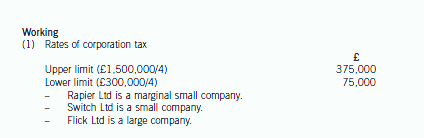
-
第10题:
(b) Explain why making sales of Sabals in North America will have no effect on Nikau Ltd’s ability to recover its
input tax. (3 marks)
Notes: – you should assume that the corporation tax rates and allowances for the financial year to 31 March 2007
will continue to apply for the foreseeable future.
– you should ignore indexation allowance.
正确答案:
(b) Recoverability of input tax
Sales by Nikau Ltd of its existing products are subject to UK VAT at 17·5% because it is selling to domestic customers who
will not be registered for VAT. Accordingly, at present, Nikau Ltd can recover all of its input tax.
Sales to customers in North America will be zero rated because the goods are being exported from the EU. Zero rated supplies
are classified as taxable for the purposes of VAT and therefore Nikau Ltd will continue to be able to recover all of its input tax. -
第11题:
(b) You are the audit manager of Johnston Co, a private company. The draft consolidated financial statements for
the year ended 31 March 2006 show profit before taxation of $10·5 million (2005 – $9·4 million) and total
assets of $55·2 million (2005 – $50·7 million).
Your firm was appointed auditor of Tiltman Co when Johnston Co acquired all the shares of Tiltman Co in March
2006. Tiltman’s draft financial statements for the year ended 31 March 2006 show profit before taxation of
$0·7 million (2005 – $1·7 million) and total assets of $16·1 million (2005 – $16·6 million). The auditor’s
report on the financial statements for the year ended 31 March 2005 was unmodified.
You are currently reviewing two matters that have been left for your attention on the audit working paper files for
the year ended 31 March 2006:
(i) In December 2004 Tiltman installed a new computer system that properly quantified an overvaluation of
inventory amounting to $2·7 million. This is being written off over three years.
(ii) In May 2006, Tiltman’s head office was relocated to Johnston’s premises as part of a restructuring.
Provisions for the resulting redundancies and non-cancellable lease payments amounting to $2·3 million
have been made in the financial statements of Tiltman for the year ended 31 March 2006.
Required:
Identify and comment on the implications of these two matters for your auditor’s reports on the financial
statements of Johnston Co and Tiltman Co for the year ended 31 March 2006. (10 marks)
正确答案:
(b) Tiltman Co
Tiltman’s total assets at 31 March 2006 represent 29% (16·1/55·2 × 100) of Johnston’s total assets. The subsidiary is
therefore material to Johnston’s consolidated financial statements.
Tutorial note: Tiltman’s profit for the year is not relevant as the acquisition took place just before the year end and will
therefore have no impact on the consolidated income statement. Calculations of the effect on consolidated profit before
taxation are therefore inappropriate and will not be awarded marks.
(i) Inventory overvaluation
This should have been written off to the income statement in the year to 31 March 2005 and not spread over three
years (contrary to IAS 2 ‘Inventories’).
At 31 March 2006 inventory is overvalued by $0·9m. This represents all Tiltmans’s profit for the year and 5·6% of
total assets and is material. At 31 March 2005 inventory was materially overvalued by $1·8m ($1·7m reported profit
should have been a $0·1m loss).
Tutorial note: 1/3 of the overvaluation was written off in the prior period (i.e. year to 31 March 2005) instead of $2·7m.
That the prior period’s auditor’s report was unmodified means that the previous auditor concurred with an incorrect
accounting treatment (or otherwise gave an inappropriate audit opinion).
As the matter is material a prior period adjustment is required (IAS 8 ‘Accounting Policies, Changes in Accounting
Estimates and Errors’). $1·8m should be written off against opening reserves (i.e. restated as at 1 April 2005).
(ii) Restructuring provision
$2·3m expense has been charged to Tiltman’s profit and loss in arriving at a draft profit of $0·7m. This is very material.
(The provision represents 14·3% of Tiltman’s total assets and is material to the balance sheet date also.)
The provision for redundancies and onerous contracts should not have been made for the year ended 31 March 2006
unless there was a constructive obligation at the balance sheet date (IAS 37 ‘Provisions, Contingent Liabilities and
Contingent Assets’). So, unless the main features of the restructuring plan had been announced to those affected (i.e.
redundancy notifications issued to employees), the provision should be reversed. However, it should then be disclosed
as a non-adjusting post balance sheet event (IAS 10 ‘Events After the Balance Sheet Date’).
Given the short time (less than one month) between acquisition and the balance sheet it is very possible that a
constructive obligation does not arise at the balance sheet date. The relocation in May was only part of a restructuring
(and could be the first evidence that Johnston’s management has started to implement a restructuring plan).
There is a risk that goodwill on consolidation of Tiltman may be overstated in Johnston’s consolidated financial
statements. To avoid the $2·3 expense having a significant effect on post-acquisition profit (which may be negligible
due to the short time between acquisition and year end), Johnston may have recognised it as a liability in the
determination of goodwill on acquisition.
However, the execution of Tiltman’s restructuring plan, though made for the year ended 31 March 2006, was conditional
upon its acquisition by Johnston. It does not therefore represent, immediately before the business combination, a
present obligation of Johnston. Nor is it a contingent liability of Johnston immediately before the combination. Therefore
Johnston cannot recognise a liability for Tiltman’s restructuring plans as part of allocating the cost of the combination
(IFRS 3 ‘Business Combinations’).
Tiltman’s auditor’s report
The following adjustments are required to the financial statements:
■ restructuring provision, $2·3m, eliminated;
■ adequate disclosure of relocation as a non-adjusting post balance sheet event;
■ current period inventory written down by $0·9m;
■ prior period inventory (and reserves) written down by $1·8m.
Profit for the year to 31 March 2006 should be $3·9m ($0·7 + $0·9 + $2·3).
If all these adjustments are made the auditor’s report should be unmodified. Otherwise, the auditor’s report should be
qualified ‘except for’ on grounds of disagreement. If none of the adjustments are made, the qualification should still be
‘except for’ as the matters are not pervasive.
Johnston’s auditor’s report
If Tiltman’s auditor’s report is unmodified (because the required adjustments are made) the auditor’s report of Johnston
should be similarly unmodified. As Tiltman is wholly-owned by Johnston there should be no problem getting the
adjustments made.
If no adjustments were made in Tiltman’s financial statements, adjustments could be made on consolidation, if
necessary, to avoid modification of the auditor’s report on Johnston’s financial statements.
The effect of these adjustments on Tiltman’s net assets is an increase of $1·4m. Goodwill arising on consolidation (if
any) would be reduced by $1·4m. The reduction in consolidated total assets required ($0·9m + $1·4m) is therefore
the same as the reduction in consolidated total liabilities (i.e. $2·3m). $2·3m is material (4·2% consolidated total
assets). If Tiltman’s financial statements are not adjusted and no adjustments are made on consolidation, the
consolidated financial position (balance sheet) should be qualified ‘except for’. The results of operations (i.e. profit for
the period) should be unqualified (if permitted in the jurisdiction in which Johnston reports).
Adjustment in respect of the inventory valuation may not be required as Johnston should have consolidated inventory
at fair value on acquisition. In this case, consolidated total liabilities should be reduced by $2·3m and goodwill arising
on consolidation (if any) reduced by $2·3m.
Tutorial note: The effect of any possible goodwill impairment has been ignored as the subsidiary has only just been
acquired and the balance sheet date is very close to the date of acquisition. -
第12题:
You are the Exchange administrator for the Xxx Corporation’s Exchange 2010 organization.People from outside your organization make inquiries to the Xxx’s Tax department.You create a Tax distribution group that contains all members of the Tax department so people can send questions to the members of the department.You have a number of additional requirements: (1)Only authorized questions should be sent to the Tax department.You must determine what an authorized question is. (2)All users in the Tax department, except the department supervisor named George, must receive authorized questions. (3)George must be able to send feedback to the Tax department. What should you do?()
- A、Check Messages sent to this group have to be approved by a moderator on the properties page of the Tax distribution group
- B、Add George’s account as group moderator of the Tax distribution group Leading the way in IT testing and certification tools,
- C、Remove George’s account from the Tax distribution group, add him to another distribution group, and add that group as a member of the Tax distribution group
- D、Add George’s account as a sender that does not require message approval
- E、Check Notify senders in your organization only when their messages aren’t approved
正确答案:A,D -
第13题:
(ii) Calculate her income tax (IT) and national insurance (NIC) payable for the year of assessment 2006/07.
(4 marks)
正确答案:
-
第14题:
(ii) Assuming that Donald operates through a company, advise Donald on the corporation tax (CT) that
would be payable for the year ended 31 March 2007 if he pays himself a gross salary of £31,000, plus
a net dividend of £10,000, instead of a gross salary of £42,648. (4 marks)
正确答案: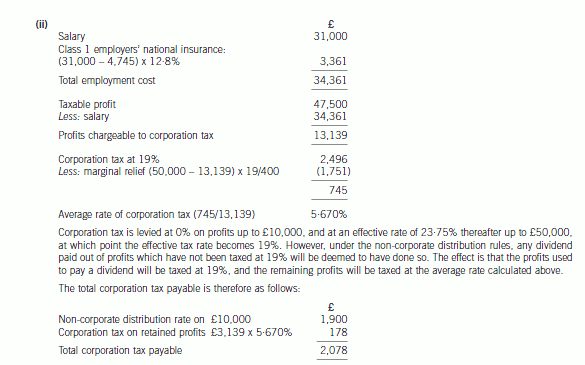
-
第15题:
3 Assume that today’s date is 10 May 2005.
You have recently been approached by Fred Flop. Fred is the managing director and 100% shareholder of Flop
Limited, a UK trading company with one wholly owned subsidiary. Both companies have a 31 March year-end.
Fred informs you that he is experiencing problems in dealing with aspects of his company tax returns. The company
accountant has been unable to keep up to date with matters, and Fred also believes that mistakes have been made
in the past. Fred needs assistance and tells you the following:
Year ended 31 March 2003
The corporation tax return for this period was not submitted until 2 November 2004, and corporation tax of £123,500
was paid at the same time. Profits chargeable to corporation tax were stated as £704,300.
A formal notice (CT203) requiring the company to file a self-assessment corporation tax return (dated 1 February
2004) had been received by the company on 4 February 2004.
A detailed examination of the accounts and tax computation has revealed the following.
– Computer equipment totalling £50,000 had been expensed in the accounts. No adjustment has been made in
the tax computation.
– A provision of £10,000 was made for repairs, but there is no evidence of supporting information.
– Legal and professional fees totalling £46,500 were allowed in full without any explanation. Fred has
subsequently produced the following analysis:
Analysis of legal & professional fees
£
Legal fees on a failed attempt to secure a trading loan 15,000
Debt collection agency fees 12,800
Obtaining planning consent for building extension 15,700
Accountant’s fees for preparing accounts 14,000
Legal fees relating to a trade dispute 19,000
– No enquiry has yet been raised by the Inland Revenue.
– Flop Ltd was a large company in terms of the Companies Act definition for the year in question.
– Flop Ltd had taxable profits of £595,000 in the previous year.
Year ended 31 March 2004
The corporation tax return has not yet been submitted for this year. The accounts are late and nearing completion,
with only one change still to be made. A notice requiring the company to file a self-assessment corporation tax return
(CT203) dated 27 July 2004 was received on 1 August 2004. No corporation tax has yet been paid.
1 – The computation currently shows profits chargeable to corporation tax of £815,000 before accounting
adjustments, and any adjustments for prior years.
– A company owing Flop Ltd £50,000 (excluding VAT) has gone into liquidation, and it is unlikely that any of this
money will be paid. The money has been outstanding since 3 September 2003, and the bad debt will need to
be included in the accounts.
1 Fred also believes there are problems in relation to the company’s VAT administration. The VAT return for the quarter
ended 31 March 2005 was submitted on 5 May 2005, and VAT of £24,000 was paid at the same time. The previous
return to 31 December 2004 was also submitted late. In addition, no account has been made for the VAT on the bad
debt. The VAT return for 30 June 2005 may also be late. Fred estimates the VAT liability for that quarter to be £8,250.
Required:
(a) (i) Calculate the revised corporation tax (CT) payable for the accounting periods ending 31 March 2003
and 2004 respectively. Your answer should include an explanation of the adjustments made as a result
of the information which has now come to light. (7 marks)
(ii) State, giving reasons, the due payment date of the corporation tax (CT) and the filing date of the
corporation tax return for each period, and identify any interest and penalties which may have arisen to
date. (8 marks)
正确答案:(a) Calculation of corporation tax
Year ended 31 March 2003
Corporation tax payable
There are three adjusting items:.
(i) The computers are capital items, as they have an enduring benefit. These need to be added back in the Schedule D
Case I calculation, and capital allowances claimed instead. The company is not small or medium by Companies Act
definitions and therefore no first year allowances are available. Allowances of £12,500 (50,000 x 25%) can be claimed,
leaving a TWDV of £37,500.
(ii) The provision appears to be general in nature. In addition there is insufficient information to justify the provision and it
should be disallowed until such times as it is released or utilised.
(iii) Costs relating to trading loan relationships are allowable, as are costs relating to the trade (debt collection, trade disputes
and accounting work). Costs relating to capital items (£5,700) are not allowable so will have to be added back.
Total profit chargeable to corporation tax is therefore £704,300 + 50,000 – 12,500 + 10,000 + 5,700 = 757,500. There are two associates, and therefore the 30% tax rate starts at £1,500,000/2 = £750,000. Corporation tax payable is 30% x£757,500 = £227,250.
Payment date
Although the rate of tax is 30% and the company ‘large’, quarterly payments will not apply, as the company was not large in the previous year. The due date for payment of tax is therefore nine months and one day after the end of the tax accounting period (31 March 2003) i.e. 1 January 2004.
Filing date
This is the later of:
– 12 months after the end of the period of account: 31 March 2004
– 3 months after the date of the notice requiring the return 1 May 2004
i.e. 1 May 2004.
-
第16题:
3 Damian is the finance director of Linden Limited, a medium sized, unquoted, UK trading company, with a 31 July
year end. Damian personally owns 10% of the ordinary issued share capital of Linden Limited, for which he paid
£10,000 in June 1998. He estimates that the current market value of Linden Limited is £9 million and that the
company will make taxable profits of £1·4 million in the forthcoming year to 31 July 2007.
(a) Damian believes that Linden Limited should conduct its activities in a socially responsible manner and to this
end has proposed that in future all cars purchased by the company should be low emission vehicles. The sales
director has stated that several of his staff, who are the main recipients of company cars, other than the directors,
are extremely unhappy with this proposal, perceiving it as downgrading their value and status.
The cars currently provided to the sales staff have a list price of £19,600, on which Linden Limited receives a
bulk purchase discount of 6% from the dealer, and a CO2 emission rate of 168 grams/kilometre. The company
pays for up to £400 of accessories, of the salesmen’s own choice to be fitted to the cars and all of the running
costs, including private petrol. The cars are replaced every three years and the ‘old’ cars are sold at auction,
because they are high mileage vehicles.
The low emission cars it is proposed to purchase will have the same list price as the current cars, but the dealer
is only prepared to offer a bulk discount of 5% on these vehicles. Damian does not propose to make any other
changes to Linden Limited’s company car policy or practice.
Required:
(i) Explain the tax consequences of the proposed move to low emission vehicles for both the individual
salesmen and Linden Limited, illustrating your answer by means of relevant calculations of the tax and
national insurance (NIC) savings arising. (9 marks)
正确答案:
(a) (i) Individual salesmen
The taxable benefit is determined by the list price of the vehicle plus the cost of the accessories (£20,000) and the CO2
emission rate. The current vehicles have a CO2 emission rate of 168 grams/kilometre, so the benefit will be calculated
at the rate of 20% ((168 – 140)/5 + 15), resulting in a total annual car and car fuel benefit charge of £6,880 (20,000
x 20% + 14,400 x 20%). The low emission vehicles will be chargeable at the basic percentage rate of 15% resulting
in a total annual car and fuel benefit charge of £5,160 (20,000 x 15% + 14,400 x 15%). The salesmen will thus
make an annual income tax saving at their marginal rate of tax, i.e. £378 (1,720 x 22%) if they are basic rate taxpayers
and £688 (1,720 x 40%) if they are higher rate taxpayers.
Linden Limited
The current vehicles will be classed as ‘expensive’ cars based on the discounted list price plus the cost of the accessories
of £18,824 (19,600 x 94% + 400). The annual writing down allowances will thus be restricted to £3,000 throughout
the period of ownership, but there will be no restriction of the balancing allowance available on disposal. The low
emission vehicles will be eligible for a 100% first year allowance of £19,020 (19,600 x 95% + 400), but there will
also be a balancing charge on disposal equivalent to the sales proceeds. Therefore, the total of the allowances available
over the life of the cars will be effectively the same in both cases. As a single company with taxable profits of
£1·4 million, Linden Limited will pay corporation tax at the small companies marginal rate of 32·75% in the year to
31 July 2007, giving a tax benefit in that year of £5,247 for each low emission car purchased ((19,020 – 3,000) x
32·75%).
The company will also make an annual saving in terms of the Class 1A national insurance contributions payable on the
salesmen’s benefits of £220 ((6,880 – 5,160) x 12·8%). But, as these Class 1A contributions are deductible for
corporation tax, the net saving will only be £205 (220 x (100 – 32·75)%).
As the VAT liability payable on the provision of private fuel is based on engine capacity (not the CO2 emission rate) this
will not necessarily be affected. -
第17题:
(c) For commercial reasons, Damian believes that it would be sensible to place a new holding company, Bold plc,
over the existing company, Linden Limited. Bold plc would also be unquoted and would acquire the existing
Linden Limited shares in exchange for the issue of its own shares.
If the new structure is implemented, Bold plc will provide management services to Linden Limited, but the
amount that will be charged for these services is yet to be determined.
Required:
(i) State the capital gains tax (CGT) issues that Damian should be aware of before disposing of his shares
in Linden Limited to Bold plc. Your answer should include details of any conditions that will need to be
satisfied if an immediate charge to tax is to be avoided. (4 marks)
正确答案:
(c) (i) The proposed transaction broadly falls under the ‘paper for paper’ rules. Where this is the case, chargeable gains do not
arise. Instead, the new holding stands in the shoes (and inherits the base cost) of the original holding.
The company issuing the new shares must:
(i) end up with more than 25% of the ordinary share capital or a majority of the voting power of the old company,
OR
(ii) make a general offer to shareholders in the old company with a condition which would give the acquiring company
control of the company if accepted.
The exchange must be for bona fide commercial reasons and not have as its main purpose (or one of its main purposes)
the avoidance of capital gains tax or corporation tax.
The issue of shares by Bold plc satisfies these conditions, thus Damian, as a shareholder of Linden Limited, will not be
taxed on the exchange of shares. -
第18题:
4 (a) For this part, assume today’s date is 1 March 2006.
Bill and Ben each own 50% of the ordinary share capital in Flower Limited, an unquoted UK trading company
that makes electronic toys. Flower Limited was incorporated on 1 August 2005 with 1,000 £1 ordinary shares,
and commenced trading on the same day. The business has been successful, and the company has accumulated
a large cash balance of £180,000, which is to be used to purchase a new factory. However, Bill and Ben have
received an offer from a rival company, which they are considering. The offer provides Bill and Ben with two
alternative methods of payment for the purchase of their shares:
(i) £480,000 for the company, inclusive of the £180,000 cash balance.
(ii) £300,000 for the company assuming the cash available for the factory purchase is extracted prior to sale.
Bill and Ben each currently receive a gross salary of £3,750 per month from Flower Limited. Part of the offer
terms is that Bill and Ben would be retained as employees of the company on the same salary.
Neither Bill nor Ben has used any of their capital gains tax annual exemption for the tax year 2005/06.
Required:
(i) Calculate which of the following means of extracting the £180,000 from Flower Limited on 31 March
2006 will result in the highest after tax cash amount for Bill and Ben:
(1) payment of a dividend, or
(2) payment of a salary bonus.
You are not required to consider the corporation tax (CT) implications for Flower Limited in your
answer. (5 marks)
正确答案: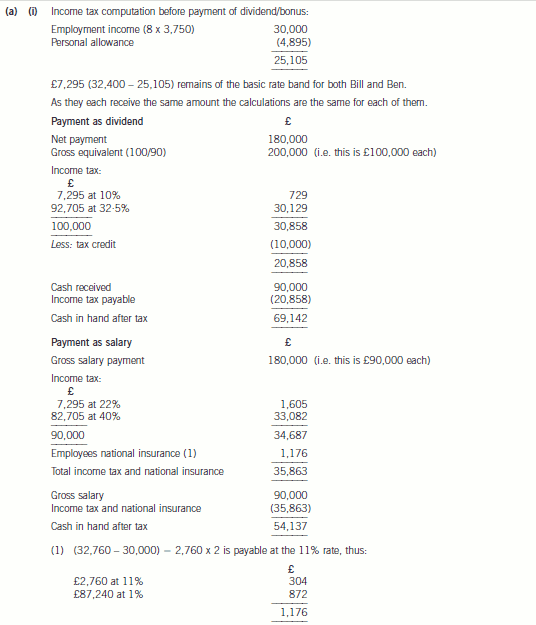
As a result, Bill and Ben would each be better off by £15,005 (69,142 – 54,137). If the cash were extracted by way
of dividend.
Tutorial note: In this answer the employers’ national insurance liability on the salary has been ignored. Credit would be
given to a candidate who recognised this issue. -
第19题:
(b) Calculate Alvaro Pelorus’s capital gains tax liability for the tax year 2006/07 on the assumption that all
available reliefs are claimed. (8 marks)
正确答案: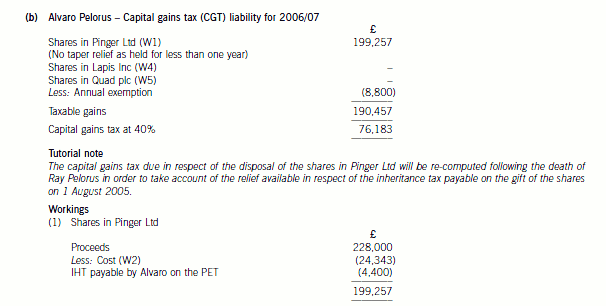

-
第20题:
(ii) Any increase or decrease in the group’s budgeted corporation tax liability for the year ending 30 June
2008 due to the restructuring on the assumption that trading losses will be used as efficiently as
possible. (8 marks)
正确答案:(ii) The budgeted corporation tax liability for the year ending 30 June 2008
Following the proposed restructuring, Rapier Ltd will be carrying on four separate trades. The current year loss arising
in the Dirk trade can be offset against its total profits. Its three subsidiaries will be dormant and will not be associates
for the purpose of determining the rate of corporation tax.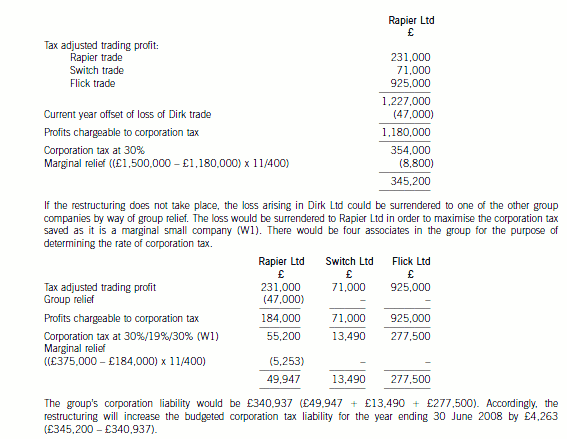
-
第21题:
(d) Evaluate the effect on Gerard of the changes to be made by Fizz plc to its performance related bonus scheme.
You should ignore the effect of any pension contributions to be made by Gerard in the future, consider both
the value and timing of amounts received by Gerard and include relevant supporting calculations.
(5 marks)
Note: – You should assume that the income tax rates and allowances for the tax year 2006/07 apply throughout
this question.
正确答案:
(d) Implications for Gerard of the changes to Fizz plc’s bonus scheme
Value received
Under the existing scheme Gerard receives approximately £4,500 each year. This is subject to income tax at 40% and
national insurance contributions at 1% such that Gerard receives £2,655 (£4,500 x 59%) after all taxes.
Under the proposed share incentive plan (SIP), Gerard expects to receive free shares worth £3,500 (£2,100 + £1,400).
Provided the shares remain in the plan for at least five years there will be no income tax or national insurance contributions
in respect of the value received. Gerard’s base cost in the shares for the purposes of capital gains tax will be their value at
the time they are withdrawn from the scheme.
In addition, the amount he spends on partnership shares will be allowable for both income tax and national insurance such
that he will obtain shares with a value of £700 for a cost of only £413 (£700 x 59%).
Accordingly, Gerard will receive greater value under the SIP than he does under the existing bonus scheme. However, as noted
below, he will not be able to sell the free or matching shares until they have been in the scheme for at least three years by
which time they may have fallen in value.
Timing of receipt of benefit
Under the existing scheme Gerard receives a cash bonus each year.
The value of free and matching shares awarded under a SIP cannot be realised until the shares are withdrawn from the
scheme and sold. This withdrawal cannot take place until at least three years after the shares are awarded to Gerard.
Accordingly, Gerard will not have access to the value of the bonuses he receives under the SIP until the scheme has been in
operation for at least three years. In addition, if the shares are withdrawn within five years of being awarded, income tax and
national insurance contributions will become payable on the lower of their value at the time of the award and their value at
the time of withdrawal thus reducing the value of Gerard’s bonus. -
第22题:
(ii) Explain how the inclusion of rental income in Coral’s UK income tax computation could affect the
income tax due on her dividend income. (2 marks)
You are not required to prepare calculations for part (b) of this question.
Note: you should assume that the tax rates and allowances for the tax year 2006/07 and for the financial year to
31 March 2007 will continue to apply for the foreseeable future.
正确答案:
(ii) The effect of taxable rental income on the tax due on Coral’s dividend income
Remitting rental income to the UK may cause some of Coral’s dividend income currently falling within the basic rate
band to fall within the higher rate band. The effect of this would be to increase the tax on the gross dividend income
from 0% (10% less the 10% tax credit) to 221/2% (321/2% less 10%).
Tutorial note
It would be equally acceptable to state that the effective rate of tax on the dividend income would increase from 0%
to 25%. -
第23题:
(ii) On 1 July 2006 Petrie introduced a 10-year warranty on all sales of its entire range of stainless steel
cookware. Sales of stainless steel cookware for the year ended 31 March 2007 totalled $18·2 million. The
notes to the financial statements disclose the following:
‘Since 1 July 2006, the company’s stainless steel cookware is guaranteed to be free from defects in
materials and workmanship under normal household use within a 10-year guarantee period. No provision
has been recognised as the amount of the obligation cannot be measured with sufficient reliability.’
(4 marks)
Your auditor’s report on the financial statements for the year ended 31 March 2006 was unmodified.
Required:
Identify and comment on the implications of these two matters for your auditor’s report on the financial
statements of Petrie Co for the year ended 31 March 2007.
NOTE: The mark allocation is shown against each of the matters above.
正确答案:
(ii) 10-year guarantee
$18·2 million stainless steel cookware sales amount to 43·1% of revenue and are therefore material. However, the
guarantee was only introduced three months into the year, say in respect of $13·6 million (3/4 × 18·2 million) i.e.
approximately 32% of revenue.
The draft note disclosure could indicate that Petrie’s management believes that Petrie has a legal obligation in respect
of the guarantee, that is not remote and likely to be material (otherwise no disclosure would have been required).
A best estimate of the obligation amounting to 5% profit before tax (or more) is likely to be considered material, i.e.
$90,000 (or more). Therefore, if it is probable that 0·66% of sales made under guarantee will be returned for refund,
this would require a warranty provision that would be material.
Tutorial note: The return of 2/3% of sales over a 10-year period may well be probable.
Clearly there is a present obligation as a result of a past obligating event for sales made during the nine months to
31 March 2007. Although the likelihood of outflow under the guarantee is likely to be insignificant (even remote) it is
probable that some outflow will be needed to settle the class of such obligations.
The note in the financial statements is disclosing this matter as a contingent liability. This term encompasses liabilities
that do not meet the recognition criteria (e.g. of reliable measurement in accordance with IAS 37 Provisions, Contingent
Liabilities and Contingent Assets).
However, it is extremely rare that no reliable estimate can be made (IAS 37) – the use of estimates being essential to
the preparation of financial statements. Petrie’s management must make a best estimate of the cost of refunds/repairs
under guarantee taking into account, for example:
■ the proportion of sales during the nine months to 31 March 2007 that have been returned under guarantee at the
balance sheet date (and in the post balance sheet event period);
■ the average age of cookware showing a defect;
■ the expected cost of a replacement item (as a refund of replacement is more likely than a repair, say).
If management do not make a provision for the best estimate of the obligation the audit opinion should be qualified
‘except for’ non-compliance with IAS 37 (no provision made). The disclosure made in the note to the financial
statements, however detailed, is not a substitute for making the provision.
Tutorial note: No marks will be awarded for suggesting that an emphasis of matter of paragraph would be appropriate
(drawing attention to the matter more fully explained in the note).
Management’s claim that the obligation cannot be measured with sufficient reliability does not give rise to a limitation
on scope on the audit. The auditor has sufficient evidence of the non-compliance with IAS 37 and disagrees with it.