
(b) Illustrate EACH of the six problems chosen in (a) using the data from the Bettamould division/TRG scenario;and (6 marks)
题目
(b) Illustrate EACH of the six problems chosen in (a) using the data from the Bettamould division/TRG scenario;
and (6 marks)
相似考题
更多“(b) Illustrate EACH of the six problems chosen in (a) using the data from the Bettamould division/TRG scenario;and (6 marks)”相关问题
-
第1题:
(b) Using the information provided in the case scenario, strategically evaluate the performance of the company
up to 2004, indicating any areas of particular concern. (20 marks)
正确答案:
(b) Essentially, Universal is a one product or service company selling its services into two main customer segments in the housing
market. From the performance information provided in Table 1, the company has achieved impressive rates of growth over
the 2001–4 period and this growth has come almost exclusively from private house owners. Universal is in the replacement
market. Its customers are looking to replace existing roofing systems with low maintenance/high attractiveness Universal
systems. To date growth has been exclusively within one region and been achieved by growing the area served through
investment in showrooms and depots.
Universal has chosen to grow its business through a differentiation focus strategy. It has identified a niche not served by the
major PVC doors and windows installers and poorly served by small independent installers. The value chain analysis
discussed above has shown the ways in which Universal has successfully distinguished itself from its competitors. Growth
has been through increasing its market penetration of one particular region. Such is the size of the private house owner market
and the lack of effective competition that the company has achieved a significant share of the market in its particular region.
However, in national terms, with 1% of the available market, Universal is a small operator. What is clear from the sales figures
is that as the firm grows bigger the relative rate of growth inevitably slows down, so that by 2004 it has an annual growth of
27% – still impressive by most companies standards. The move into supplying the commercial housing market has been
successful, but the share of total sales seems to have stabilised at around 5%. Universal clearly is finding it difficult to commit
sufficient new resources to this sector while coping with the growth from the domestic housing sector. Direct labour and other
direct costs seem to be a reasonable proportion of sales and predictably grow with the number of installation teams. Overall,
the gross margin, which sustains sales, marketing and overhead expenses, is moving in the right direction with a gross margin
of 52·6% achieved in 2004.
Labour, not surprisingly in a service business, consumes a considerable amount of costs. If one combines the direct labour
with the commission costs of sales canvassers and representatives together with salaries to staff in head office, one is in a
business where well over 50% of costs are attributable to people. Equally important is the fact that over 80% of the staff
employed by Universal is paid by results. This has significant consequences for the structure of reward systems and the
training and development of staff looking to maximise their incomes through either their individual or team performance.
Clearly, Universal sees no incompatibility between a reward system dominated by payments by results and the delivery of a
quality service differentiating it from its competitors.
Marketing has grown considerably over the period and reflects the recruitment of Mick Hendry as Sales and Marketing Director
in 2002. The marketing and sales model is very much one influenced by the one used by large PVC installers of doors and
windows. Here there is a heavy emphasis on direct selling techniques supported by increasing levels of advertising. Universal
sells to its customers directly and therefore avoids the costs and channel complications of using third parties to provide its
services. In many ways the direct selling techniques used are a very well established way of reaching the customer. Elements
of the marketing mix may be influenced by changes in communication technology, but the nature of the service requires
effective face-to-face contact with the customer. Sales to private house owners using credit generates significant finance
commission and is an important source of extra margin to Universal. Often in businesses depending on significant amounts
of credit sales the sales representative receives significant reward for selling a finance arrangement to the customer.
In terms of net profit achieved, 2001 and 2002 represents a significant change and, as argued in the scenario, this reflects
the recruitment of the Sales and Marketing Director. The achievement of this ‘step change’ in sales required commensurate
increases in most costs, but it is the significant increase in sales costs that explains the losses experienced in 2002. Sales
costs as a proportion of total sales rose from 14% in 2001 to almost 34% in 2002.
Particularly significant is the increase in sales commissions paid. The detailed changes in the way commission is paid is not
given in the case scenario, but it seems likely to reflect the previous experience of the Sales and Marketing Director in a closely
related industry. Similar levels of sales costs are incurred in 2003 and 2004 but the increase in sales, improvement in gross
margin and slower rate of growth in commissions paid explain the improved return on sales from –6·7% in 2002 to 4·2%
in 2003 and 5·8% in 2004.
Equally significant is the growth in showrooms and depots to support the growth in sales. Each additional facility costs in the
order of £30K with significant additions to costs in terms of staff and stock. Overall the performance of Universal over the
2001–2004 period is of a company achieving high rates of growth, incurring significant costs in so doing and moving into
modest levels of profit over the period. Its cost structure reflects the service it provides and the staff and reward systemsenabling the service to be provided. -
第2题:
(c) Using information from the case, assess THREE risks to the Giant Dam Project. (9 marks)
正确答案:
(c) Assessment of three risks
Disruption and resistance by Stop-the-dam. Stop-the-dam seems very determined to delay and disrupt progress as much as
possible. The impact of its activity can be seen on two levels. It is likely that the tunnelling and other ‘human’ disruption will
cause a short-term delay but the more significant impact is that of exposing the lenders. In terms of probability, the case says
that it ‘would definitely be attempting to resist the Giant Dam Project when it started’ but the probability of exposing the
lenders is a much lower probability event if the syndicate membership is not disclosed.
Impact/hazard: low
Probability/likelihood: high
The risk to progress offered by First Nation can probably be considered to be low impact/hazard but high probability. The case
says that it ‘would be unlikely to disrupt the building of the dam’, meaning low impact/hazard, but that ‘it was highly likely
that they would protest’, meaning a high level of probability that the risk event would occur.
Impact: low
Probability: high
There are financing risks as banks seems to be hesitant when it comes to lending to R&M for the project. Such a risk event,
if realised, would have a high potential for disruption to progress as it may leave R&M with working capital financing
difficulties. The impact would be high because the bank may refuse to grant or extend loans if exposed (subject to existing
contractual terms). It is difficult to estimate the probability. Perhaps there will be a range of attitudes by the lending banks
with some more reticent than others (perhaps making it a ‘medium’ probability event).
Impact: medium to high (depending on the reaction of the bank)
Probability: low to medium (depending on how easy it would be to discover the lender) -
第3题:
(b) Using the unit cost information available and your calculations in (a), prepare a financial analysis of the
decision strategy which TOC may implement with regard to the manufacture of each product. (6 marks)
正确答案: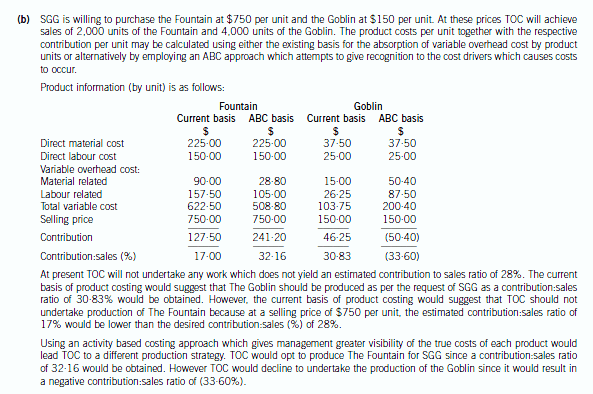
-
第4题:
(c) Suggest ways in which each of the six problems chosen in (a) above may be overcome. (6 marks)
正确答案:
(c) Ways in which each of the problems might be overcome are as follows:
Meeting only the lowest targets
– To overcome the problem there must be some additional incentive. This could be through a change in the basis of bonus
payment which currently only provides an incentive to achieve the 100,000 tonnes of output.
Using more resources than necessary
– Overcoming the problem may require a change in the bonus system which currently does not provide benefit from any
output in excess of 100,000 tonnes. This may not be perceived as sufficiently focused in order to achieve action. It may
be that engendering a culture of continuous improvement would help ensure that employees actively sought ways of
reducing idle time levels.
Making the bonus – whatever it takes
– It is likely that efforts to change the ‘work ethos’ at all levels is required, while not necessarily removing the concept of
a bonus payable to all employees for achievement of targets. This may require the fostering of a culture for success within
the company. Dissemination of information to all staff relating to trends in performance, meeting targets, etc may help
to improve focus on continuous improvement.
Competing against other divisions, business units and departments
– The problem may need some input from the directors of TRG. For example, could a ‘dual-cost’ transfer pricing system
be explained to management at both the Bettamould division and also the Division with spare capacity in order to
overcome resistance to problems on transfer pricing and its impact on divisional budgets and reported results? In this
way it may be possible for the Bettamould division to source some of its input materials at a lower cost (particularly from
TRG’s viewpoint) and yet be acceptable to the management at the supplying division.
Ensuring that what is in the budget is spent
– In order to overcome the problem it may be necessary to educate management into acceptance of aspects of budgeting
such as the need to consider the committed, engineered and discretionary aspects of costs. For example, it may be
possible to reduce the number of salaried staff involved in the current quality checking of 25% of throughput on a daily
basis.
Providing inaccurate forecasts
– In order to overcome this problem there must be an integrated approach to the budget setting process. This may be
achieved to some extent through all aspects of the budget having to be agreed by all functions involved. For example,
engineers as well as production line management in reaching the agreed link between percentage process losses and
the falling efficiency of machinery due to age. In addition, TRC may insist an independent audit of aspects of budget
revisions by group staff.
Meeting the target but not beating it
– To overcome the problem may require that the bonus system should be altered to reflect any failure to control costs per
tonne at the budget level.
Avoiding risks
– In order to overcome such problems, TRC would have to provide some guarantees to Bettamould management that the
supply would be available during the budget period at the initially agreed price and that the quality would be maintained
at the required level. This would remove the risk element that the management of the Bettamould division may consider
currently exists. -
第5题:
Examine the following scenario:The target database instance is running. The most recent backup available for the target database was taken two days ago. Log files switches have occurred in last two days. The target database is duplicated on the same host, using the Recovery Manager (RMAN) duplicate command as follows:Which statement is true about the duplicate database in this scenario?()

A. It contains data till the last backup
B. It contains all data from target database until the current time
C. It contains all data from only the committed transactions in the target database
D. It contains all data except that which is used by the transactions in the current online redo file of target database
参考答案:D
-
第6题:
Which of the following is TRUE about the ping -f command?()
- A、 It is useful for diagnosing data dependent problems by filling the packet with the byte pattern following the "f" in the command line.
- B、 It is useful for flooding from slow character based terminals since it only displays a dot "." for each packet sent in fast mode.
- C、 It is useful for flooding from slow character based terminals since it only displays a dot "." for each packet sent and a backspace on returned in fast mode.
- D、 The command can only be run by root.
正确答案:D -
第7题:
Your company uses a SQL Server 2005 database. This database contains a trigger named trg_InsertOrders, which fires when order data is inserted into the Orders table. The trigger is responsible for ensuring that a customer exists in the Customers table before data is inserted into the Orders table. You need to configure the trigger to prevent it from firing during the data import process. You must accomplish this goal while using the least amount of administrative effort. Which two Transact-SQL statements can you use to achieve this goal?()
- A、 ALTER TABLE OrdersDISABLE TRIGGER trg_InsertOrders
- B、 DROP TRIGGER trg_InsertOrders
- C、 DISABLE TRIGGER trg_InsertOrders ON Orders
- D、 ALTER TRIGGER trg_InsertOrders ON Orders NOT FOR REPLICATION
- E、 sp_settriggerorder@triggername= 'trg_InsertOrders', @order='None'
正确答案:A,C -
第8题:
Examine the following scenario: The target database instance is running. The most recent backup available for the target database was taken two days ago. Log files switches have occurred in last two days. The target database is duplicated on the same host, using the Recovery Manager (RMAN) duplicate command as follows: RMAN> RUN { ALLOCATE AUXILIARY CHANNEL aux 1 DEVICE TYPE DISK; DUPLICATE TARGET DATABASE TO auxdb; } Which statement is true about the duplicate database in this scenario?()
- A、 It contains data till the last backup
- B、 It contains all data from target database until the current time
- C、 It contains all data from only the committed transactions in the target database
- D、 It contains all data except that which is used by the transactions in the current online redo file of target database
正确答案:D -
第9题:
How can you configure High Availability for interacting with a non-Oracle database using WebLogic?()
- A、Configure multiple physical data sources and reuse the same JNDI name for each.
- B、Use the "compatibility" option of Active GridLink to enable compatibility with non-Oracle databases.
- C、Configure a single physical data source for each node in a database cluster and wrap it using Multi Data Source.
- D、Configure a Data Source Group that contains a physical connection pool to each node in the database cluster.
正确答案:C -
第10题:
单选题On the development database rac0, there are six raw devices: /dev/raw/raw1 through /dev/raw/raw6. /dev/raw/raw1 and /dev/raw/raw2 are 8GB each, and the rest are 6GB each. An existing disk group +DATA1, of NORMAL REDUNDANCY, uses /dev/raw/raw1 and /dev/raw/raw2. Which series of the following commands will drop one of the failure groups for +DATA1, create a new disk group +DATA2 using two of the remaining four raw devices, and then cancel the drop operation from +DATA1? ()AA
BB
CC
DD
正确答案: B解析: 暂无解析 -
第11题:
单选题How can you configure High Availability for interacting with a non-Oracle database using WebLogic?()AConfigure multiple physical data sources and reuse the same JNDI name for each.
BUse the compatibility option of Active GridLink to enable compatibility with non-Oracle databases.
CConfigure a single physical data source for each node in a database cluster and wrap it using Multi Data Source.
DConfigure a Data Source Group that contains a physical connection pool to each node in the database cluster.
正确答案: D解析: 暂无解析 -
第12题:
多选题SQ L*Loader is a utility that can perform which two tasks?()ALoad data from a disk, tape, or named pipes.
BLoad data into an Oracle database using DML statements.
CExtract, reorganize, and insert data within an Oracle database.
DLoad data from external files into tables in an Oracle database.
ELoad data into an Oracle database using operating system commands.
FLoad data directly from a non-Oracle database to an Oracle database.
正确答案: A,E解析: 暂无解析 -
第13题:
(b) Using the TARA framework, construct four possible strategies for managing the risk presented by Product 2.
Your answer should describe each strategy and explain how each might be applied in the case.
(10 marks)
正确答案:
(b) Risk management strategies and Chen Products
Risk transference strategy
This would involve the company accepting a portion of the risk and seeking to transfer a part to a third party. Although an
unlikely possibility given the state of existing claims, insurance against future claims would serve to limit Chen’s potential
losses and place a limit on its losses. Outsourcing manufacture may be a way of transferring risk if the ourtsourcee can be
persuaded to accept some of the product liability.
Risk avoidance strategy
An avoidance strategy involves discontinuing the activity that is exposing the company to risk. In the case of Chen this would
involve ceasing production of Product 2. This would be pursued if the impact (hazard) and probability of incurring an
acceptable level of liability were both considered to be unacceptably high and there were no options for transference or
reduction.
Risk reduction strategy
A risk reduction strategy involves seeking to retain a component of the risk (in order to enjoy the return assumed to be
associated with that risk) but to reduce it and thereby limit its ability to create liability. Chen produces four products and it
could reconfigure its production capacity to produce proportionately more of Products 1, 3 and 4 and proportionately less of
Product 2. This would reduce Product 2 in the overall portfolio and therefore Chen’s exposure to its risks. This would need
to be associated with instructions to other departments (e.g. sales and marketing) to similarly reconfigure activities to sell
more of the other products and less of Product 2.
Risk acceptance strategy
A risk acceptance strategy involves taking limited or no action to reduce the exposure to risk and would be taken if the returns
expected from bearing the risk were expected to be greater than the potential liabilities. The case mentions that Product 2 is
highly profitable and it may be that the returns attainable by maintaining and even increasing Product 2’s sales are worth the
liabilities incurred by compensation claims. This is a risk acceptance strategy. -
第14题:
2 The Information Technology division (IT) of the RJ Business Consulting Group provides consulting services to its
clients as well as to other divisions within the group. Consultants always work in teams of two on every consulting
day. Each consulting day is charged to external clients at £750 which represents cost plus 150% profit mark up. The
total cost per consulting day has been estimated as being 80% variable and 20% fixed.
The director of the Human Resources (HR) division of RJ Business Consulting Group has requested the services of
two teams of consultants from the IT division on five days per week for a period of 48 weeks, and has suggested that
she meets with the director of the IT division in order to negotiate a transfer price. The director of the IT division has
responded by stating that he is aware of the limitations of using negotiated transfer prices and intends to charge the
HR division £750 per consulting day.
The IT division always uses ‘state of the art’ video-conferencing equipment on all internal consultations which would
reduce the variable costs by £50 per consulting day. Note: this equipment can only be used when providing internal
consultations.
Required:
(a) Calculate and discuss the transfer prices per consulting day at which the IT division should provide
consulting services to the HR division in order to ensure that the profit of the RJ Business Consulting Group
is maximised in each of the following situations:
(i) Every pair of consultants in the IT division is 100% utilised during the required 48-week period in
providing consulting services to external clients, i.e. there is no spare capacity.
(ii) There is one team of consultants who, being free from other commitments, would be available to
undertake the provision of services to the HR division during the required 48-week period. All other
teams of consultants would be 100% utilised in providing consulting services to external clients.
(iii) A major client has offered to pay the IT division £264,000 for the services of two teams of consultants
during the required 48-week period.
(12 marks)
正确答案:
(a) (i) The transfer price of £750 proposed by the IT division is based on cost plus 150% from which it can be deduced that
the total cost of a consulting day is (100/250) x £750 = £300. This comprises £240 (80%) variable cost and £60
(20%) fixed cost. In this instance the transfer price should be set at marginal costs plus opportunity cost. It is assumed
in this situation that transferring internally would result in the IT division having a lost contribution of £750 – £240 =
£510 per consulting day. The marginal cost of the transfer of services to the HR division is £190 (£240 external variable
costs less £50 saving due to use of internal video-conferencing equipment). Adding the opportunity cost of £510 gives
a transfer price of £700 per consulting day. This is equivalent to using market price as a basis for transfer pricing where
the transfer price is set at the external market price (£750) less any costs avoided (£50) by transferring internally.
(ii) There is in effect no external market available for one of the required pairs of consultants within the IT division and
therefore opportunity cost will not apply and transfers should be made at the variable cost per consulting day of £190.
The other pair of consultants, who would otherwise be 100% utilised in providing consulting services to external clients,
should be charged at a rate of £700 per day which represents marginal cost plus opportunity cost.
(iii) The lost contribution from the major client amounts to £264,000/(2 x 240) = £550 less variable costs of £240 =
£310 per consulting day. Thus, in this instance the transfer price should be the contribution foregone of £310 plus
internal variable costs of £190 making a total of £500 per consulting day.
-
第15题:
2 The Rubber Group (TRG) manufactures and sells a number of rubber-based products. Its strategic focus is channelled
through profit centres which sell products transferred from production divisions that are operated as cost centres. The
profit centres are the primary value-adding part of the business, where commercial profit centre managers are
responsible for the generation of a contribution margin sufficient to earn the target return of TRG. The target return is
calculated after allowing for the sum of the agreed budgeted cost of production at production divisions, plus the cost
of marketing, selling and distribution costs and central services costs.
The Bettamould Division is part of TRG and manufactures moulded products that it transfers to profit centres at an
agreed cost per tonne. The agreed cost per tonne is set following discussion between management of the Bettamould
Division and senior management of TRG.
The following information relates to the agreed budget for the Bettamould Division for the year ending 30 June 2009:
(1) The budgeted output of moulded products to be transferred to profit centres is 100,000 tonnes. The budgeted
transfer cost has been agreed on a two-part basis as follows:
(i) A standard variable cost of $200 per tonne of moulded products;
(ii) A lump sum annual charge of $50,000,000 in respect of fixed costs, which is charged to profit centres, at
$500 per tonne of moulded products.
(2) Budgeted standard variable costs (as quoted in 1 above) have been set after incorporating each of the following:
(i) A provision in respect of processing losses amounting to 15% of material inputs. Materials are sourced on
a JIT basis from chosen suppliers who have been used for some years. It is felt that the 15% level of losses
is necessary because the ageing of the machinery will lead to a reduction in the efficiency of output levels.
(ii) A provision in respect of machine idle time amounting to 5%. This is incorporated into variable machine
costs. The idle time allowance is held at the 5% level partly through elements of ‘real-time’ maintenance
undertaken by the machine operating teams as part of their job specification.
(3) Quality checks are carried out on a daily basis on 25% of throughput tonnes of moulded products.
(4) All employees and management have contracts based on fixed annual salary agreements. In addition, a bonus
of 5% of salary is payable as long as the budgeted output of 100,000 tonnes has been achieved;
(5) Additional information relating to the points in (2) above (but NOT included in the budget for the year ending
30 June 2009) is as follows:
(i) There is evidence that materials of an equivalent specification could be sourced for 40% of the annual
requirement at the Bettamould Division, from another division within TRG which has spare capacity.
(ii) There is evidence that a move to machine maintenance being outsourced from a specialist company could
help reduce machine idle time and hence allow the possibility of annual output in excess of 100,000 tonnes
of moulded products.
(iii) It is thought that the current level of quality checks (25% of throughput on a daily basis) is vital, although
current evidence shows that some competitor companies are able to achieve consistent acceptable quality
with a quality check level of only 10% of throughput on a daily basis.
The directors of TRG have decided to investigate claims relating to the use of budgeting within organisations which
have featured in recent literature. A summary of relevant points from the literature is contained in the following
statement:
‘The use of budgets as part of a ‘performance contract’ between an organisation and its managers may be seen as a
practice that causes management action which might lead to the following problems:
(a) Meeting only the lowest targets
(b) Using more resources than necessary
(c) Making the bonus – whatever it takes
(d) Competing against other divisions, business units and departments
(e) Ensuring that what is in the budget is spent
(f) Providing inaccurate forecasts
(g) Meeting the target, but not beating it
(h) Avoiding risks.’
Required:
(a) Explain the nature of any SIX of the eight problems listed above relating to the use of budgeting;
(12 marks)
正确答案:
2 Suggested answer content for each of the eight problems contained within the scenario is as follows:
(a) The nature of each of the problems relating to the use of budgeting is as follows:
Meeting only the lowest targets
– infers that once a budget has been negotiated, the budget holder will be satisfied with this level of performance unless
there is good reason to achieve a higher standard.
Using more resources than necessary
– Once the budget has been agreed the focus will be to ensure that the budgeted utilisation of resources has been adhered
to. Indeed the current system does not provide a specific incentive not to exceed the budget level. It may be, however,
that failure to achieve budget targets would reflect badly on factors such as future promotion prospects or job security.
Making the bonus – whatever it takes
– A bonus system is linked to the budget setting and achievement process might lead to actions by employees and
management which they regard as ‘fair game’. This is because they view the maximisation of bonuses as the main
priority in any aspect of budget setting or work output.
Competing against other divisions, business units and departments
– Competition may manifest itself through the attitudes adopted in relation to transfer pricing of goods/services between
divisions, lack of willingness to co-operate on sharing information relating to methods, sources of supply, expertise, etc.
Ensuring that what is in the budget is spent
– Management may see the budget setting process as a competition for resources. Irrespective of the budgeting method
used, there will be a tendency to feel that unless the budget allowance for one year is spent, there will be imposed
reductions in the following year. This will be particularly relevant in the case of fixed cost areas where expenditure is
viewed as discretionary to some extent.
Providing inaccurate forecasts
– This infers that some aspects of budgeting problems such as ‘Gaming’ and ‘misrepresentation’ may be employed by the
budget holder in order to gain some advantage. Gaming may be seen as a deliberate distortion of the measure in order
to secure some strategic advantage. Misrepresentation refers to creative planning in order to suggest that the measure
is acceptable.
Meeting the target but not beating it
– There may be a view held by those involved in the achievement of the budget target that there is no incentive for them
to exceed that level of effectiveness.
Avoiding risks
– There may be a prevailing view by those involved in the achievement of the budget target that wherever possible
strategies incorporated into the achievement of the budget objective should be left unchanged if they have been shown
to be acceptable in the past. Change may be viewed as increasing the level of uncertainty that the proposed budget
target will be achievable. -
第16题:
(c) Illustrate how:
(i) inquiry; and (4 marks)
正确答案:
(c) Due diligence review
(i) Inquiries
Tutorial note: These should be focussed on uncovering facts that may not be revealed by the audited financial
statements (e.g. off balance sheet finance, contingencies, commitments and contracts) especially where knowledge
may be confined to management.
■ Do any members of MCM’s senior/executive management have contractual terms that will result in significant
payouts to them (e.g. on change of ownership of the company or their being made redundant)?
■ What contracts with clients, if any, will lapse or be made void in the event that MCM is purchased from Frontiers?
■ What synergy or inter-company trading, if any, currently exists between MCM and Frontiers? For example, Frontiers
may publish MCM’s training materials.
■ Are there any major clients who are likely to be lost if MCM is purchased by Plaza (e.g. any competitor food
retailers)?
■ What are the principal terms of the operating leases relating to the International business’s premises?
■ What penalties should be expected to be incurred if operating leases and/or contracts with training consultants are
terminated?
■ Has MCM entered into any purchase commitments since 31 December 2004 (e.g. to buy or lease further
premises)?
■ Who are the best trainers that Plaza should seek to retain after the purchase of MCM?
■ What events since the audited financial statements to 31 December 2004 were published have made a significant
impact on MCM’s assets, liabilities, operating capability and/or cash flows? (For example, storm damage to
premises, major clients defaulting on payments, significant interest/foreign-exchange rate fluctuations, etc.)
■ Are there any unresolved tax issues which have not been provided for in full?
■ What effect will the purchase have on loan covenants? For example, term loans may be rendered repayable on a
change of ownership. -
第17题:
A manufacturing company, Man Co, has two divisions: Division L and Division M. Both divisions make a single standardised product. Division L makes component L, which is supplied to both Division M and external customers.
Division M makes product M using one unit of component L and other materials. It then sells the completed
product M to external customers. To date, Division M has always bought component L from Division L.
The following information is available:

Division L charges the same price for component L to both Division M and external customers. However, it does not incur the selling and distribution costs when transferring internally.
Division M has just been approached by a new supplier who has offered to supply it with component L for $37 per unit. Prior to this offer, the cheapest price which Division M could have bought component L for from outside the group was $42 per unit.
It is head office policy to let the divisions operate autonomously without interference at all.
Required:
(a) Calculate the incremental profit/(loss) per component for the group if Division M accepts the new supplier’s
offer and recommend how many components Division L should sell to Division M if group profits are to be
maximised. (3 marks)
(b) Using the quantities calculated in (a) and the current transfer price, calculate the total annual profits of each division and the group as a whole. (6 marks)
(c) Discuss the problems which will arise if the transfer price remains unchanged and advise the divisions on a suitable alternative transfer price for component L. (6 marks)
正确答案:
(a)MaximisinggroupprofitDivisionLhasenoughcapacitytosupplybothDivisionManditsexternalcustomerswithcomponentL.Therefore,incrementalcostofDivisionMbuyingexternallyisasfollows:CostperunitofcomponentLwhenboughtfromexternalsupplier:$37CostperunitforDivisionLofmakingcomponentL:$20.ThereforeincrementalcosttogroupofeachunitofcomponentLbeingboughtinbyDivisionMratherthantransferredinternally:$17($37–20).Fromthegroup’spointofview,themostprofitablecourseofactionisthereforethatall120,000unitsofcomponentLshouldbetransferredinternally.(b)CalculatingtotalgroupprofitTotalgroupprofitswillbeasfollows:DivisionL:Contributionearnedpertransferredcomponent=$40–$20=$20Profitearnedpercomponentsoldexternally=$40–$24=$16(c)ProblemswithcurrenttransferpriceandsuggestedalternativeTheproblemisthatthecurrenttransferpriceof$40perunitisnowtoohigh.Whilstthishasnotbeenaproblembeforesinceexternalsupplierswerecharging$42perunit,itisaproblemnowthatDivisionMhasbeenofferedcomponentLfor$37perunit.IfDivisionMnowactsinitsowninterestsratherthantheinterestsofthegroupasawhole,itwillbuycomponentLfromtheexternalsupplierratherthanfromDivisionL.ThiswillmeanthattheprofitsofthegroupwillfallsubstantiallyandDivisionLwillhavesignificantunusedcapacity.Consequently,DivisionLneedstoreduceitsprice.Thecurrentpricedoesnotreflectthefactthattherearenosellinganddistributioncostsassociatedwithtransferringinternally,i.e.thecostofsellinginternallyis$4lessforDivisionLthansellingexternally.So,itcouldreducethepriceto$36andstillmakethesameprofitonthesesalesasonitsexternalsales.ThiswouldthereforebethesuggestedtransferpricesothatDivisionMisstillsaving$1perunitcomparedtotheexternalprice.Atransferpriceof$37wouldalsopresumablybeacceptabletoDivisionMsincethisisthesameastheexternalsupplierisoffering. -
第18题:
SQ L*Loader is a utility that can perform which two tasks?()
- A、Load data from a disk, tape, or named pipes.
- B、Load data into an Oracle database using DML statements.
- C、Extract, reorganize, and insert data within an Oracle database.
- D、Load data from external files into tables in an Oracle database.
- E、Load data into an Oracle database using operating system commands.
- F、Load data directly from a non-Oracle database to an Oracle database.
正确答案:A,D -
第19题:
For which two tasks would it be best NOT to use the utility SQL*Loader?()
- A、When loading selected rows into each table.
- B、When loading data from an export dump file.
- C、When loading data from disk, tape, or named pipes.
- D、When your data is NOT being inserted from a flat file.
- E、When using a record management system to access data files.
正确答案:B,D -
第20题:
You issue the following statement: SQL> SELECT FIRSTNAME, LASTNAME FROM HR.EMPLOYEE; You receive the following error: 01578: ORACLE data block corrupted (file# 6, block # 54) ORA-01110 : data file 6: ’u01/oracle/oradata/data1.dbf’ How will you resolve this problem of data block corruption by reducing the mean time to recover (MTTR)?()
- A、 by using the DBMS_REPAIR package
- B、 by using the DBVERIFY utility
- C、 by using Block Media Recovery
- D、 by issuing the ANALYZE TABLE HR.EMPLOYEES VALIDATE STRUCTURE command
正确答案:C -
第21题:
TestKing.com uses a SQL Server 2005 database. This database contains a trigger named trg InsertOrders, which fires when order data is inserted into the Orders table. The trigger is responsible for ensuring that a customer exists in the Customers table before data is inserted into the Orders table. You need to configure the trigger to prevent it from firing during the data import process. You must accomplish this goal while using the least amount of administrative effort. Which two Transact-SQL statements can you use to achieve this goal?()
- A、ALTER TABLE OrdersDISABLE TRIGGER trg InsertOrders
- B、DROP TRIGGER trg InsertOrders
- C、DISABLE TRIGGER trg InsertOrders ON Orders
- D、ALTER TRIGGER trg InsertOrders ON Orders NOT FOR REPLICATION
正确答案:A,C -
第22题:
多选题For which two tasks would it be best NOT to use the utility SQL*Loader?()AWhen loading selected rows into each table.
BWhen loading data from an export dump file.
CWhen loading data from disk, tape, or named pipes.
DWhen your data is NOT being inserted from a flat file.
EWhen using a record management system to access data files.
正确答案: C,D解析: 暂无解析 -
第23题:
多选题Your company uses a SQL Server 2005 database. This database contains a trigger named trg_InsertOrders, which fires when order data is inserted into the Orders table. The trigger is responsible for ensuring that a customer exists in the Customers table before data is inserted into the Orders table. You need to configure the trigger to prevent it from firing during the data import process. You must accomplish this goal while using the least amount of administrative effort. Which two Transact-SQL statements can you use to achieve this goal?()AALTER TABLE OrdersDISABLE TRIGGER trg_InsertOrders
BDROP TRIGGER trg_InsertOrders
CDISABLE TRIGGER trg_InsertOrders ON Orders
DALTER TRIGGER trg_InsertOrders ON Orders NOT FOR REPLICATION
Esp_settriggerorder@triggername= 'trg_InsertOrders', @order='None'
正确答案: E,B解析: 暂无解析